
 РУССКИЙ
 11:39 16.02.2026 •
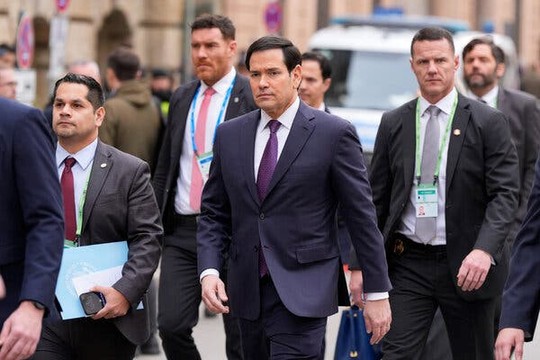
Secretary of State Marco Rubio in Munich
Photo: NYT
In Munich, European leaders were talking about “de-risking” from the United States, citing President Trump’s unpredictability, ‘The New York Times’notes.
The disputes this past year between Washington and Europe — over tariffs, Greenland, free speech for right-wing political parties and the Trump administration’s declaration that Europe is headed to “civilizational erasure” unless it controls its borders — have obscured a more fundamental shift. Leaders of several European nations said that after that series of shocks they are talking about “de-risking” from the United States.
It is a term previously reserved for describing a strategy of avoiding over-dependence on China, or fragile supply chains for Russian oil or critical minerals. It is now applied to the United States. The Europeans now warn of threats that the Americans, in their speeches to the conference, never acknowledged. And among them is Mr. Trump’s unpredictability.
In his speech on Saturday, Mr. Rubio tried easing some of Europe’s fears, sounding a far more diplomatic tone than Vice President JD Vance did a year ago from the same stage. “We will always be a child of Europe,’’ he said, focusing on the depth and history of Europe’s settlement of North America rather than lecturing about the repression of far-right groups. While some of Mr. Vance’s themes were sounded, the softer delivery made it a lot easier for the heavily European audience to swallow.
But Mr. Rubio scarcely mentioned Russia, the source of the Europeans’ greatest security concerns, and offered no warnings to Mr. Putin.
At the same time, evidence of the damage done over the past year was everywhere. The Danes, still stunned by how quickly the prospect of military conflict with the United States flared in December and January, are publicly negotiating with Washington. But here in Munich, they kept asking the Americans whether they think Mr. Trump could suddenly revive his demand that the United States must own, not lease, the 836,000 ice-encased square miles of Greenland. (Very likely, the Danish prime minister, Mette Fredericksen, was told by several Americans.)
Merz’s nuclear initiative
Chancellor Friedrich Merz of Germany chastised his fellow Europeans in a speech on Friday for their over-dependence on the United States for far too long — echoing Washington’s longtime complaint about Europe.
The purest crystallization of Mr. Merz’s concern underlies his yearlong conversation with President Emmanuel Macron of France about whether Germany should be covered under the French nuclear umbrella. Mr. Merz has repeatedly said that any arrangement for France to offer the ultimate protection to Germany would be coordinated with NATO and the United States.
But at the root of Mr. Merz’s nuclear initiative lies an obvious nervousness that Washington can no longer be trusted to risk New York while protecting Berlin. He clearly sees the need for a nuclear Plan B. That may take a while: It is far from certain that France’s small, independent nuclear deterrent is big enough to shield Germany, and perhaps Poland as well, or that the French would be willing to risk Paris to save Berlin.
The kind of backroom negotiation Mr. Merz is conducting never came up during the Cold War or the era that followed, nuclear experts say. But the slow separation from Washington is most evident in how the Europeans talk about the Russian threat, four years after the war with Ukraine began.
But there is little question that the Americans and the Europeans regard the current threat very differently. “In London and other capitals, the Europeans keep talking like this is 1939,” as the continent veered toward war, said Richard Fontaine, the chief executive of the Center for a New American Security and a former aide to Senator John McCain. “Nobody in the U.S. is thinking this is 1939.”
The biggest concern
Perhaps the biggest concern voiced by European officials now is that Mr. Trump will agree to almost any kind of deal on Ukraine, to claim a victory even if it sets Mr. Putin up for future attacks. Petr Pavel, the Czech president, said, “A very quick peace will not result in a Nobel Prize for peace,” but in “another aggression.”
Ms. Frederiksen, the Danish prime minister, sounded a similar theme. “A bad peace deal in Ukraine will open the door for more attacks from Russia, in Ukraine again or in another European country,” she said on Saturday.
Other European officials noted that the Trump administration is already discussing potential business deals with Moscow — especially in the energy sector, presumably after a peace deal is negotiated. The Europeans, in contrast, are preparing for another year or two of war.
One continuing subject of conversation at Munich is the makeup of a European and American “security guarantee” for Ukraine, should a deal be reached. Some of the outlines of the force are becoming clear: It would consist of about two brigades, or about 7,000 to 10,000 troops.
Still unclear, however, is where it would be located: Inside Ukraine or outside. Moscow has stoutly insisted it would not accept any deal calling for European troops inside Ukraine.
Rubio skips Ukraine meeting with European leaders in Munich
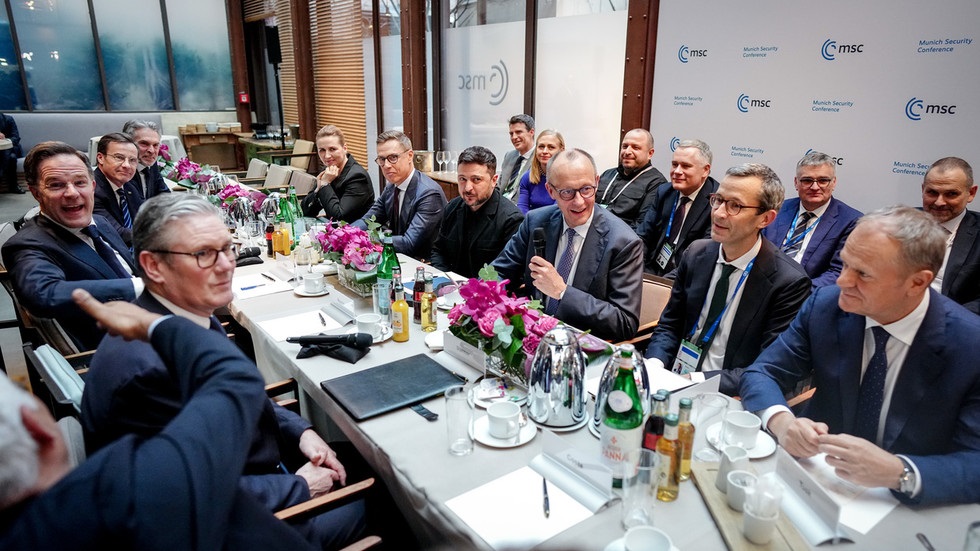 Rubio refused to visit the European chicken coop
Photo: MSM
US secretary of state cancels attendance at last minute in move that EU official calls ‘insane’, ‘Financial Times’ stresses.
US secretary of state Marco Rubio has skipped a meeting with European leaders on the war in Ukraine, in a move seen by European capitals as signalling Washington’s waning interest in involving them in its efforts to solve the conflict.
Rubio was set to attend the meeting with leaders from countries including Germany, Poland, Finland and the European Commission in Munich, but cancelled at the last minute because of scheduling conflicts.
“The secretary won’t be attending the Berlin Format meeting on Ukraine given the number of meetings he has happening at the same time,” a US official said. “He’s engaging on Russia-Ukraine in many of his meetings here in Munich.”
One European official said the cancellation was “insane”. It came as the Trump administration increasingly distances itself from its European allies and is seeking to push Ukraine towards a settlement with Russia to end the almost four-year-long war.
The meeting lacked substance without US participation, a second European official told the FT.
“It’s confirming our allies’ worst fears. They’re on their own . . . they’re reluctantly coming to accept that when Trump says Europe is on its own, he means it,” US Democratic senator Peter Welch told the FT.
“People have such a hard time here believing that the country that played this role in liberating Europe and built the Marshall Plan and alliances is turning its back. And doing it by accommodating Russia.”
read more in our Telegram-channel https://t.me/The_International_Affairs

















