
 РУССКИЙ
 10:34 14.02.2026 •
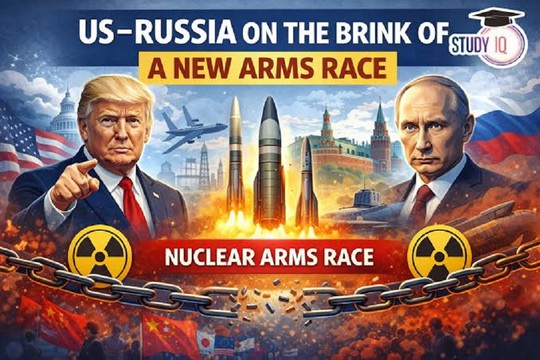
Already, there are signs that the Trump administration is planning to break out of the numeric limits of New START in ways that could set off a new arms race, ‘The New York Times’ stresses.
Last week, the United States and Russia allowed their last nuclear arms control treaty, known as New START, to expire. For the first time since 1972, the superpowers have no limits on the size or structure of their arsenals.
President Trump has said he wants to negotiate a new agreement — “a new, improved, and modernized treaty,” as he described it on social media recently. But he said nothing about freezing American and Russian arsenals at current levels, leaving open the possibility of a renewed arms race.
In fact, the U.S., Russia and China have been preparing for that possibility. And some U.S. allies, uneasy about whether they can count on the U.S. “nuclear umbrella,” have begun talking about establishing their own nuclear forces.
As Vipin Narang and Pranay Vaddi, two of America’s leading nuclear strategists, wrote recently, “Nuclear weapons are back with a vengeance.”
‘No one wants to discuss Swedish nuclear weapons’
It’s “miraculous” that the world has as few nuclear weapon states as it currently does, said Graham Allison, a Harvard political scientist.
“They’re not too hard to make,” J. Robert Oppenheimer said of atomic bombs in 1945. “They’ll be universal if people wish to make them universal.” In 1963, President John F. Kennedy predicted that by 1975 there could be up to 20 nuclear-armed states.
In fact, there are currently just nine: Britain, China, France, India, Israel, North Korea, Pakistan, Russia and the U.S.
A central factor behind this restricted outcome has been the U.S. “nuclear umbrella” — the promise that Washington would come to the defense of allies if they ever came under nuclear attack. This strategy has kept most American allies from building their own nuclear weapons.
But the U.S. strategy is under fire.
Trump often portrays allies as freeloaders, and has cast doubt on whether he would use nuclear weapons to protect them.
The allies have gotten the message. Last year, President Emmanuel Macron of France warned that Europe needed to prepare for America’s retreat. He said he was willing to discuss extending the protection of France’s nuclear arsenal to its European allies.
Poland’s prime minister said his nation had to “reach for opportunities related to nuclear weapons.” And early last month, as Trump’s threats to take over Greenland grew louder, Stockholm’s leading newspaper called for a joint Nordic nuclear arsenal.
“No one wants to discuss Swedish nuclear weapons,” it declared, “but we must.”
Already, there are signs that the Trump administration is planning to break out of the numeric limits of New START in ways that could set off a new arms race. For instance, the U.S. is planning to increase the number of warheads that can be carried by its nuclear-armed submarines.
To Trump administration officials, this planned increase puts foes on notice: If they attempt a nuclear strike, the retaliation could be larger than at any time in years. But there’s a counterargument. America’s deployment of new weapons could fuel an arms race. And U.S. rivals are already making their own moves, including some that would make it impossible for Trump’s “Golden Dome” project to intercept enemy missiles.
To put China on the table
Every effort by the Trump administration to engage China in some kind of discussion of its nuclear capabilities has been shut down by Beijing.
Many among arms control experts agree with elements of Trump’s argument that New START aged poorly. A new, better treaty would cover both new technologies and additional countries — starting with China.
Trump wrote last week he wants to begin such negotiations, but he offered no specifics. The Chinese have little interest in arms control, it seems, until their arsenal is roughly the size of Washington’s and Moscow’s. And so strategists instead see a looming surge in moves and countermoves around the globe that could, eventually, lead to a crisis.
“We’re seeing the end to an era of arms control,” said Erin D. Dumbacher, a senior security fellow at the Council on Foreign Relations.
…Any Western commentator must put a question: “Why does the US insist on China's participation in nuclear arms negotiations, but ignore the fact that France and Britain are also countries with atomic bombs and should also be at the negotiating table? Does the nuclear control system not apply to London and Paris? For what reason?”
However, the entire “free press” in the West refuses to discuss this crucial issue. This means that negotiations between Russia and the US alone will be incomplete, and the world will move closer to nuclear Armageddon.
Well, that's what the Westerners wanted. So, they'll get what they deserve.
read more in our Telegram-channel https://t.me/The_International_Affairs

















