
 РУССКИЙ
 10:18 11.01.2026 •

The message came screaming through the skies at 8,000 miles per hour.
Early Friday morning, for just the second time since its all-out invasion of Ukraine, Russia fired a nuclear-capable Oreshnik missile — a hypersonic intermediate-range ballistic weapon that until recently was banned under international treaty, ‘The New York Times’ writes.
The missile landed on a military site in western Ukraine but its true target was farther afield, analysts and political officials said: Ukraine’s allies in Europe.
The site that was struck is about 40 miles from the border with Poland, a NATO country. Britain and France, fellow members of the alliance, said this week that they were prepared to deploy troops to Ukraine to guarantee postwar peace. If they were to follow through, their forces most likely would be stationed in the area that Russia hit on Friday.
Moscow has said repeatedly, including in remarks by the Foreign Ministry spokeswoman on Thursday, that any NATO forces on Ukrainian soil would be a legitimate military target for Russia. By firing the Oreshnik, which has a range covering almost all of Europe, Moscow showed how it could carry out its threat both inside Ukraine and well beyond.
That the missile is capable of carrying nuclear warheads only added to the menace, as strong European support of Ukraine has led President Vladimir V. Putin to declare that Europe has all but declared war against Russia.
The Russian Defense Ministry said the strike was a response to an attempted attack on one of Mr. Putin’s residences last month.
Cheering the missile strike, Dmitri Medvedev, a former president, said it should bring Russia’s adversaries to their senses, likening it to an injection of an antipsychotic medication.
Some Russian analysts said that in firing the Oreshnik, the Kremlin was also sending a message to the Trump administration.
Mr. Putin has argued that Russia is winning the war and has said that his military is prepared to fight until it has achieved all of its objectives. The Kremlin, these analysts said, wants the Trump administration to know that the war will end only if the United States and Ukraine’s European allies push Kyiv to concede.
Mr. Putin has hailed the Oreshnik as a symbol of Russian military might and technological innovation. He has called the missile, which slammed into Ukraine at speeds exceeding Mach 10, an unstoppable tool in Moscow’s arsenal. Ukraine has no air defenses that can bring it down.
The Oreshnik can carry conventional or dummy warheads in addition to nuclear ones. A Ukrainian assessment that the warheads in the missile fired on Friday held no explosives was one sign that it had been launched largely to send a message.
Traveling at supersonic speed, the metal still carried enough energy to smash through buildings, vehicles or people.
The first time Moscow launched an Oreshnik into Ukraine, in November 2024, it was in response to Ukraine’s firing of longer-range missiles provided by the United States and Britain at military targets inside Russia.
Russia just put Mach 10 missiles on Europe’s border
The Oreshnik missile supposedly travels at Mach 10, making it all but impossible to intercept with existing air defenses. Deploying these systems to Belarus not only further threatens Ukraine, but it also increases Russia’s threat to European NATO members such as Poland, Lithuania, and Latvia — all of which are near to Belarus’ borders, ‘The National Interest’ writes.
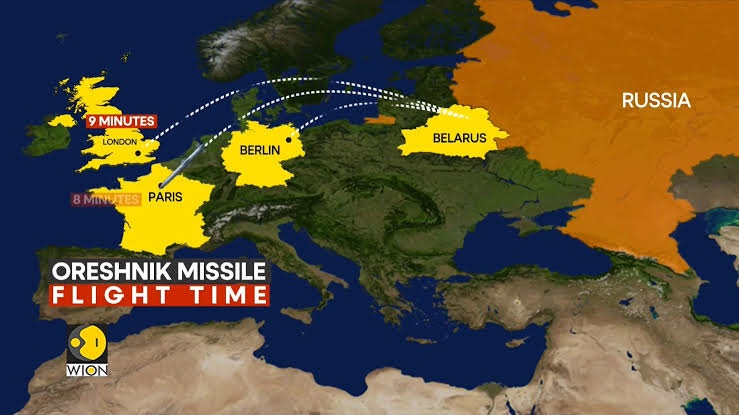
Russia’s deployment comes both at a time in which the Kremlin wants to button up the Ukraine War and at the moment in which the European NATO members are all clamoring for war with Russia. By placing a handful of these weapons so near to NATO’s borders — weapons that can easily outfly any NATO defense — Moscow is attempting to send a strong signal of renewed deterrence to the Europeans.
Oreshniks have an estimated range of up to 3,400 miles, or 5,500 kilometers, meaning that nowhere in Europe is safe from these weapons. This is on top of Moscow’s conventional nuclear weapons capability.
While Western news outlets have breathlessly reported the movement of these lethal weapons as being an outgrowth of Putin’s mania. In fact, the movement of these systems nearer to Ukraine and the rest of NATO Europe is a response to more provocative actions taken by NATO. As 2025 closed out, the United States Army announced they would be stationing their own intermediate-range hypersonic weapons system, known as Dark Eagle.
Of course, it should be noted that unlike the Oreshnik, the Army’s Dark Eagle platform is largely untested and is still very much an experimental system. The Russians, on the other han, have had access to the Oreshnik for years and they have perfected this system.
Nevertheless, Moscow is committed to restoring deterrence. If the Americans are planning to place the Dark Eagle system in Germany, nearer to Russian borders, at some point this year, Moscow was going to preempt that move by placing their more advanced — and numerous — Oreshniks in Belarus.
We have fully reached the tit-for-tat stage of geopolitics that once defined Europe during the dark days of the Cold War.
The end of new START changes everything
There’s another interesting development behind the Russian decision to deploy the Oreshnik in Belarus.
The 2010 New START Treaty, negotiated by Putin and former US President Barack Obama, expires this year. Once that treaty is gone, there will be no further strategic arms limitation agreement existing between the world’s two largest nuclear powers.
So, the deployment of the Oreshnik gives the Kremlin added leverage as the Americans make moves to expand their own capabilities. This is not the work of madmen. It’s the product of careful strategy.
read more in our Telegram-channel https://t.me/The_International_Affairs

















