РУССКИЙ
 13:51 01.01.2026 •
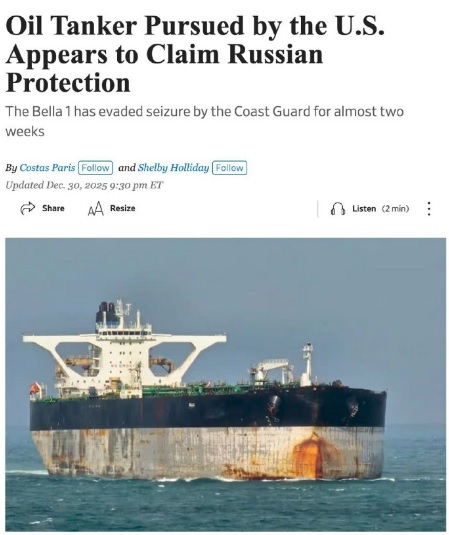
The U.S. military tried to intercept the Bella 1 last week in the Caribbean Sea as it headed to Venezuela to pick up oil. But the crew of an oil tanker fleeing U.S. forces in the Atlantic Ocean recently painted a Russian flag on the side of the vessel, in an apparent attempt to claim Russian protection, ‘The New York Times’ reports.
It’s the latest twist in a bizarre odyssey that began on Dec. 21 when the U.S. Coast Guard tried to intercept the ship, Bella 1, in the Caribbean Sea as it sailed toward Venezuela to pick up oil, putting it in the cross hairs of President Trump’s quasi-blockade of the Venezuelan government’s economic lifeline.
The Bella 1’s crew members have since painted a Russian flag on the tanker during the escape and are now claiming Russian status, according to the U.S. officials, who were briefed on the matter and spoke on condition of anonymity to discuss a sensitive operation.
The tanker has been under U.S. sanctions since last year for transporting Iranian oil, which federal authorities have said is sold to finance terrorism.
The ship also appears to have recently changed its course northwest, away from the Mediterranean Sea, possibly heading toward Greenland or Iceland, the officials said. It is not believed to be carrying cargo. The Bella 1’s location transponder has not been on since Dec. 17, meaning The New York Times has not been able to track the vessel as it flees from U.S. forces.
The White House declined to comment on the record. The Pentagon and the Homeland Security Department declined to comment. And the Russian Embassy in Washington did not respond to requests for comment.
U.S. officials said the Coast Guard tried to intercept Bella 1 in the Caribbean after determining that it was not flying a valid national flag, making it subject to boarding under international law. But the ship did not comply and continued sailing. It has been pursued by U.S. forces ever since.
American officials have not publicly explained why the Coast Guard is waiting to board the tanker, which is not capable of outrunning U.S. vessels.
But boarding the fleeing Bella 1 would require a specialized boarding team capable of securing a moving vessel with a potentially hostile crew. It is unusual for civilian tankers to flee from such operations. The crews of two other tankers intercepted by U.S. forces near Venezuela this month both agreed to be boarded.
The officials said they had obtained a seizure warrant based on the vessel’s previous involvement in the Iranian oil trade. The Bella 1 is part of a so-called ghost fleet of tankers that move oil from Russia, Iran and Venezuela in violation of sanctions imposed by the United States and other countries. Most of the Bella 1’s crew are from Russia, India and Ukraine, according to one of the officials.
The Coast Guard successfully boarded another tanker in the Caribbean earlier in the month, and the United States took possession of a third tanker on Dec. 10. It is now at a port in Texas. Federal officials say they are planning to seize more tankers involved in Venezuela’s oil trade, which provides the country with badly needed revenue.
One potential challenge for the U.S. administration is the cost of keeping the massive military presence in the Caribbean, ‘The New York Times’ stresses. The aircraft carrier Gerald R. Ford was redirected to the Caribbean in October, and if the Pentagon extends its deployment it would delay crucial maintenance for the Ford and strain the crew’s morale. The crew is entering its seventh month at sea, and peacetime deployments typically do not go beyond six months.
Keeping not only the Ford strike group near Venezuela, but also an expeditionary strike group in the same region built around the amphibious assault ship Iwo Jima, is an extraordinary amount of conventional naval firepower for what began as an unconventional counternarcotics mission.
read more in our Telegram-channel https://t.me/The_International_Affairs