
 РУССКИЙ
 13:03 12.02.2026 •
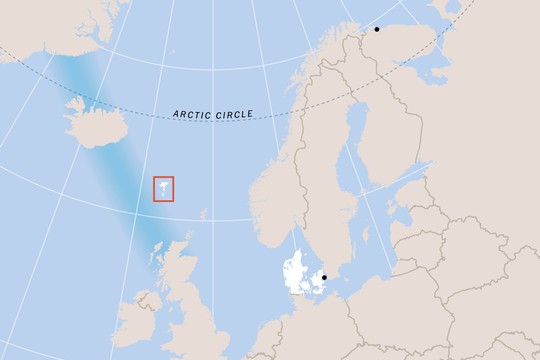
With Mr. Trump’s threats about Greenland, some might think this is a great time for the Faroese to extract concessions because Denmark is desperate to prevent its centuries-old kingdom from breaking apart, ‘The New York Times’ writes.
In the middle of a crucial waterway
Its 18 islands — rugged, beautiful, windswept and often soaked with rain — have their own complicated story that is now getting tangled up in Greenland’s crisis. Even though President Trump backed down from his threats to seize Greenland, he set off a wave of anxiety in this part of the world.
The Faroes, home to 55,000 people, sit in the middle of a crucial waterway between Iceland and Scotland at the threshold of the Arctic, where superpowers are vying for dominance. European fishing fleets, American warships and Russian submarines cruise through these waters. A few years ago, a Chinese company made a play for the Faroese telecom system.
Day to day, things look fine. Cozy restaurants serve fermented mutton, a Faroese specialty. Salmon farms export nearly a billion dollars’ worth of fish across the world. Traffic circulates smoothly through the islands’ impressive tunnel network. The Faroese have even built a roundabout under the sea.
Unlike Greenland, which relies heavily on Danish subsidies, the Faroes have built a strong local economy. That gives them a high standard of living and the means to break away from Denmark and go it alone. In the past few years, the drive for independence had been building.
Then Mr. Trump’s threats to take over Greenland posed an existential threat to the Kingdom of Denmark. Greenland pulled closer to Denmark, its former colonizer. And the Faroe Islands hit pause on negotiations with Copenhagen over more autonomy that were supposed to begin last month.
Still, senior members of the islands’ semiautonomous government insist they were not giving up on their dream.
“Greenland and Denmark are in a bad situation,” said Aksel V. Johannesen, the prime minister.
But, he added, “there is a broad political agreement that our relationship with Denmark must change.”
Even if these islands have attracted far less attention than Greenland, geopolitical analysts are watching them closely and the islanders themselves can sense the sharpening interest.
“The old Cold War is coming back,” said Hogni Hoydal, a former Faroese foreign minister and a leading voice for independence. “And we are at the center.”
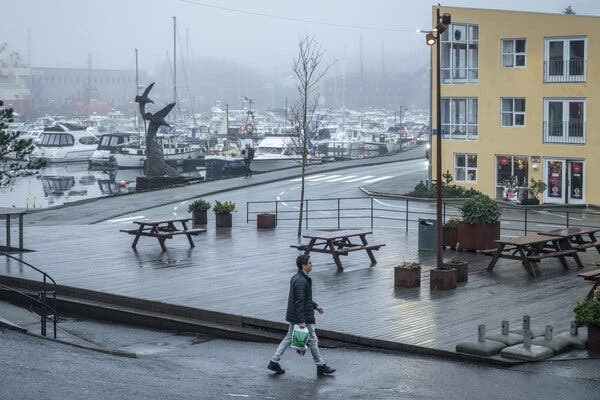 The port in Torshavn
Photo: NYT
‘We are wild cards’
The Faroese see themselves as survivors in a tough land. Many trace their lineage back to Vikings who waded ashore more than 1,000 years ago. Their homeland is one of Europe’s rainiest places, and winds there routinely reach 30 to 40 miles per hour.
But the Faroese do not cower. As they say: “There’s no bad weather. Just bad clothes.”
Joannes Patursson, a sheep farmer, is part of the 17th generation of his family to live in a spectacular seaside farmhouse with a bright green grass roof that is common here. It is cheap, abundant material and known to be good insulation. On a recent day, as his sheep grazed by the water, the wind whipped the waves into a sharp white froth.
“There will always be a struggle,” Mr. Patursson said about the drive for independence. “We are a nation of our own.”
Mr. Patursson even keeps an old knife hanging on his wall that a plucky ancestor used to cut down a Danish flag nearly a century ago.
In 1946, the Faroese voted narrowly for independence, but the Danish king blocked that. In 2000, when the Faroese tried to negotiate for full sovereignty, Denmark threatened to pull its subsidies. At the time, the islands’ economy was not as strong, and the Faroese backed down, hoping to try again later.
Last month, the Faroese were supposed to reopen negotiations with Denmark and push for more autonomy. But that was before Mr. Trump doubled down on his threats to “get” Greenland, alarming the entire Danish kingdom and leading many in Europe to fear that the world order was collapsing. So the leadership in the Faroes, which have been connected to Denmark for more than 600 years, decided that it was not the time for heavy negotiations with Copenhagen.
A vital choke point
The Faroese sit right inside one of the world’s most important naval choke points, which is also one of Russia’s main routes between the Arctic and the Atlantic Ocean.
The waterway is called the GIUK Gap, and it takes its name from the lands around it: Greenland, Iceland and the United Kingdom. It is 200 miles across at its narrowest point, and is used by NATO, which intensified its patrols there last year, as well as by Russian nuclear submarines that come from Murmansk, Russia’s main submarine base in the Arctic.
The Faroes are “disproportionally important,” said Troy J. Bouffard, the director of the Center for Arctic Security and Resilience at the University of Alaska Fairbanks.
Even though the Faroes have the population of an American suburb, he said, they sit “right in the middle of one of the most important transit points for our main adversary.”
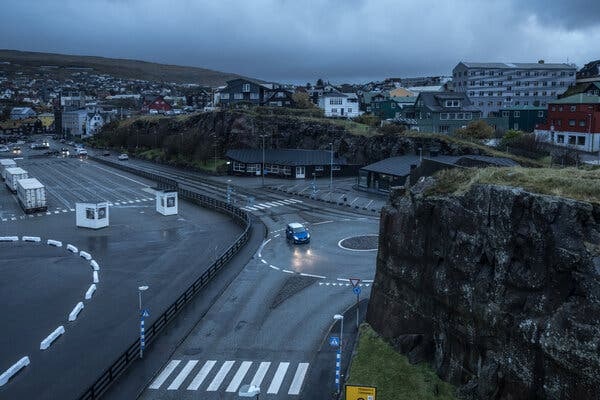 Central Torshavn. The Faroese maintain a strong sense of identity, seeing themselves as survivors in a tough land
Photo: NYT
In the past few years, more American submarines and vessels from other NATO nations have appeared at Faroese ports, according to data from the Faroese Foreign Ministry.
Solidarity, for now
Faroese leaders say they are not giving up on their push for more autonomy. They say that they need to strike their own trade deals with foreign nations, and that under the current arrangement with Denmark, they are denied their own voice on the international stage.
With Mr. Trump’s threats about Greenland, some might think this is a great time for the Faroese to extract concessions because Denmark is desperate to prevent its centuries-old kingdom from breaking apart.
read more in our Telegram-channel https://t.me/The_International_Affairs

















