
 РУССКИЙ
 11:50 27.01.2026 •
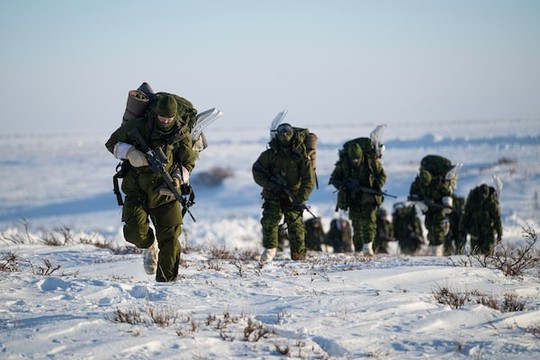
Canadian soldiers patrol the area around a NORAD satellite relay dome. The Canadian Armed Forces' model of a U.S. invasion is believed to be the first it has produced in a century.
Photo: ‘The Globe and Mail’
The Canadian Armed Forces have modelled a hypothetical U.S. military invasion of Canada and the country’s potential response, which includes tactics similar to those employed against Russia and later U.S.-led forces in Afghanistan, two senior government officials say, ‘The Globe and Mail’ writes.
It is believed to be the first time in a century that the Canadian Armed Forces have created a model of an American assault on this country, a founding member of the North Atlantic Treaty Organization and a partner with the U.S. in continental air defence.
The Globe reported this week that Canada is considering sending a small contingent of troops to Greenland to join a group of eight European countries that are holding military exercises as a show of solidarity for Denmark, of which the self-ruling island is a territory.
U.S. President Donald Trump has been challenging NATO allies with repeated calls for the U.S. to acquire Greenland and threats to impose tariffs on European countries who oppose the takeover. Those threats escalated after his attack on Venezuela and capture of President Nicolás Maduro earlier this month.
Mr. Trump has also repeatedly mused about Canada becoming the 51st state. On the weekend, NBC reported Mr. Trump has been increasingly complaining to aides in recent weeks about Canada’s vulnerability to U.S. adversaries in the Arctic. Steve Bannon, the former Trump chief strategist who remains close to the President, said Canada is “rapidly changing” and becoming “hostile” to the United States.
The two senior government officials said military planners are modelling a U.S. invasion from the south, expecting American forces to overcome Canada’s strategic positions on land and at sea within a week and possibly as quickly as two days.
The intention to create a 400,000-plus-strong reserve force of volunteers
Canada does not have the number of military personnel or the sophisticated equipment needed to fend off a conventional American attack, they said. So, the military envisions unconventional warfare in which small groups of irregular military or armed civilians would resort to ambushes, sabotage, drone warfare or hit-and-run tactics.
One of the officials said the model includes tactics used by the Afghan mujahedeen in their hit-and-run attacks on Russian soldiers during the 1979-1989 Soviet-Afghan War. These were the same tactics employed by the Taliban in their 20-year war against the U.S. and allied forces that included Canada. Many of the 158 Canadian soldiers killed in Afghanistan from 2001 to 2014 were struck by improvised explosive devices or IEDs.
The aim of such tactics would be to impose mass casualties on U.S. occupying forces, the official said.
Conscription has been ruled out for now, but the level of sacrifice that would be asked of Canadians remains a central topic, the officials said. General Jennie Carignan, Chief of the Defence Staff, has already announced her intention to create a 400,000-plus-strong reserve force of volunteers. The officials said they could be armed or asked to provide disruptions if the U.S. becomes an occupying power.
Military planners envision an American attack that would follow clear signs from the U.S. military that the two countries’ partnership in NORAD, the North American Aerospace Defence Command, was ending, and the U.S. was under new orders to take Canada by force.
Canada no longer has a shared skies policy with the United States, the source said.
This rupture in the joint defence agreement would likely see France or Britain, nuclear-weapon states, being called on to provide support and defence for Canada against the U.S.
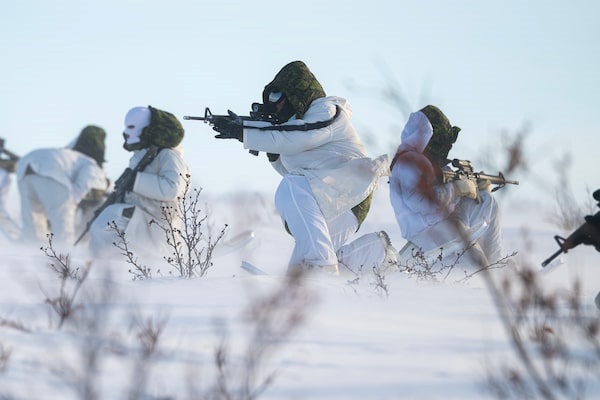 Canadian troops would engage in unconventional warfare, which includes ambushes, sabotage, raids, and hit-and-run tactics similar to what the mujahedeen and Taliban used in Afghanistan.
Photo: ‘The Globe and Mail’
“Canada can count on support from European countries, Britain, Japan, South Korea and other democratic nations”
Retired major-general David Fraser, who commanded Canadian troops in Afghanistan alongside the United States, said Canada could also use drones and tank-killing weapons like the Ukrainians used against the Russians to blunt their invasion in February, 2022.
Mr. Fraser said it is unthinkable that Canadian planners have had to draw up a U.S. invasion scenario. Whatever Mr. Trump does with Greenland and possibly Mexico would weigh into any Canadian scenario, he said.
But Canada can count on support from European countries, Britain, Japan, South Korea and other democratic nations.
“You know if you come after Canada, you are going to have the world coming after you, even more than Greenland. People do care about what happens to Canada, unlike Venezuela,” Mr. Fraser said. “You could actually see German ships and British planes in Canada to reinforce the country’s sovereignty.”
Mr. Fraser said Canada should immediately place more military assets in the North to claim its right to the region.
If the threat from the U.S. became serious, he said Canadian soldiers would be placed along the border even though there is no realistic possibility that Canada could defeat the U.S. militarily.
“There is a quantum difference between defending another land like Canadians did in Afghanistan versus defending Windsor, Ontario. You do not walk across that border because everybody is your enemy then,” Mr. Fraser added.
U.S. generals would be aware that Canadians would fight back
University of Toronto political scientist Aisha Ahmad said Canada needs to drastically boost its homeland defence capabilities, regardless of the potential U.S. threat to the border.
“The better Canada can embrace this approach to homeland defence, the less likely all of these horrible scenarios that nobody wants will ever come to pass,” she said.
U.S. generals would be aware that Canadians would fight back against an invasion, using whatever tactics would be the most effective, she said.
read more in our Telegram-channel https://t.me/The_International_Affairs

















