
 РУССКИЙ
 19:38 29.05.2026 •
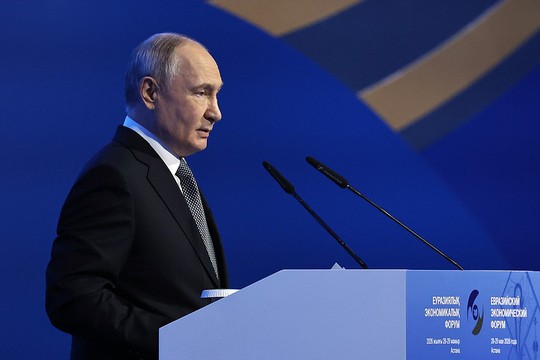
Vladimir Putin delivered an address at the plenary session of the Eurasian Economic Forum.
The Eurasian Economic Forum is held annually in the country holding the chairmanship of the Eurasian Economic Union. It traditionally brings together politicians, heads of major companies, financial institutions, banks, as well as representatives of international organisations and the expert community.
The theme of the 2026 forum is “The EAEU in the Global Digital Race: Focus on Artificial Intelligence.” The programme includes approximately 30 thematic sessions dedicated to current issues of economic cooperation both within the EAEU and with third countries and integration associations.
Following the plenary session, the Russian President, together with the heads of delegations taking part in the forum, visited the thematic exhibition ‘AI Development in the EAEU’. The guests were shown displays at five national interactive stands and the Eurasian Economic Commission stand, showcasing each country’s achievements in the digital transformation of economic sectors and the development of artificial intelligence, as well as successful Union-wide projects in this area. The exhibition was organised by the alem.ai Artificial Intelligence Centre.
There were nine delegations, apart from the delegation of the Russian Federation, at the forum. They were headed by President of the Republic of Kazakhstan, Chair of the Supreme Eurasian Economic Council Kassym-Jomart Tokayev, President of the Republic of Belarus Alexander Lukashenko, President of the Kyrgyz Republic Sadyr Japarov, Deputy Prime Minister of Armenia Mher Grigoryan, Deputy Prime Minister of the Socialist Republic of Vietnam Hồ Quốc Dũng, Vice President of the Republic of Cuba Salvador Valdés Mesa, Minister of Industry, Mine and Trade of the Islamic Republic of Iran Mohammad Atabak, Minister of State for Foreign Trade of the United Arab Emirates Thani bin Ahmed Al Zeyoudi, and Deputy Prime Minister of Mongolia Nyamtaishiryn Nomtoibayar. Taking part in the plenary session were also Chairman of the Eurasian Economic Commission’s Board Bakytzhan Sagintayev and Deputy Prime Minister of the Republic of Kazakhstan – Minister of Artificial Intelligence and Digital Development Zhaslan Madiyev, who moderated the discussion.
* * *
Address at the plenary session
President of Russia Vladimir Putin: Friends, ladies and gentlemen,
Before addressing the main topic, I would like to welcome the participants of the plenary session of the regular Eurasian Economic Forum and, of course, to thank President Tokayev for hosting us today in this format and for organising this useful and informative event, as well as the productive and substantive discussion.
Importantly, the forum provides an opportunity for representatives of government, businesses, and civil society to jointly develop new key initiatives for advancing and deepening integration – an integration that delivers tangible benefits to each member state of the Eurasian Union, facilitates economic growth, and improves the wellbeing of our citizens.
This year, our focus is on advanced technology, digitalisation, and artificial intelligence. Considerable progress has already been made in these areas within the EAEU. The Union applies common standards for trade data exchange, has unified digital commerce rules, utilises electronic navigation seals, and operates integrated labour market information systems.
As for artificial intelligence, it constitutes an entirely new, yet highly promising, area of integrative cooperation. These strategic technologies are becoming a crucial factor in ensuring global competitiveness, economic growth, and progress.
The competition for leadership in this field is already intensifying among states and transnational corporations. I would emphasise that Russia – in my view – possesses distinct competitive advantages. First, we fully recognise the critical importance of this knowledge and understand the fundamental principles underlying these insights and tools. Second, we maintain a clear understanding of the opportunities and risks associated with the deployment of these technologies. Third, we possess – as our moderator has rightly noted – intellectual potential. Within the education sector, this process is advancing actively, and our scientific community is prepared to address challenges of this magnitude and complexity. Therefore, Russia possesses the qualified personnel required to tackle these tasks.
Furthermore, the development of artificial intelligence requires the substantial consumption and utilisation of energy. Russia enjoys distinct competitive advantages in this domain. I refer to advanced nuclear energy technologies, encompassing both small nuclear power plants and large units. This is crucial for creating pertinent platforms. We can also utilise other sources, including hydropower, as well as traditional forms of energy. All these resources can be harnessed; Russia possesses clear – and I believe, for this audience, it hardly needs to be emphasised – competitive advantages.
Moreover, the advancement of artificial intelligence tools requires considerable financing. Russia is fully capable of mobilising the necessary volumes of financial resources for this purpose. In this respect, the Russian Federation is one of, perhaps, the few countries that is both capable of creating, and is indeed creating, its own sovereign platforms for the development of artificial intelligence.
However, we fully understand and we are completely aware that collaboration with our friends and partners is of paramount importance. The pooling of efforts can yield substantial outcomes and produce a so-called joint payoff, if I may phrase it thus, in this area, presenting serious challenges for the EAEU countries and our integration process, while simultaneously offering opportunities, as I have previously noted.
The technologies of political life are changing right before our eyes, as the President of Kyrgyzstan has just mentioned. Indeed, the technologies of political life and transmission of information are changing, a fundamentally new pattern of industry is emerging, education and healthcare are being transformed, and the social sphere as a whole is changing. This concerns not only registration and routing of patients. This concerns the very methods of decision-making regarding the treatment of respective illnesses.
The labour market is being restructured. It is quite possible that millions of people will lose their jobs or will be forced to change their occupation. Entire professions may disappear due to the fact that a computer mind will replace a person. In a number of areas related to process automation, documentation preparation and analysis, and software code development, artificial intelligence is already replacing junior staff, and in the foreseeable future it may replace mid-level staff. Such processes are inevitable and irreversible.
Progress does not stand still. We need to be prepared for the upcoming changes, and even better, use them as a driver of accelerated economic growth. Russia has adopted and is implementing national and sectoral programmes aimed at introducing artificial intelligence in various spheres of life. For example, I mentioned healthcare, but you know, sometimes it seems that it was absolutely impossible and unthinkable a short while ago. In Moscow, for example, these tools are being actively introduced in healthcare. The ambulance arrives, the patient is in the ambulance vehicle, and while en route to the hospital, his or her entire medical record is fully formed, in all aspects – where and when the patient was treated, what instruments were used in treatment, which were effective and which were not. When a person arrives at the hospital, everything is already known about him, and the decision has already been made on further actions by the relevant specialists. This fundamentally changes the healthcare itself in this case.
The same intensive work is underway not only in this area but in other areas as well. I repeat once again – it is very important to join efforts, to implement the best practices and replicate them.
On our initiative, an International AI Alliance was created, and an International Conference on Computational Optimisation was established. These entities have brought together business, scientific and academic circles from many interested countries. We also propose to hold a high-level meeting in Russia next year on artificial intelligence so as to discuss cooperation in the development of sovereign artificial intelligence models, the formation of an interconnected infrastructure of computing power and energy facilities, and the adaptation of technologies to local needs.
I have only briefly outlined our approaches to the development of artificial intelligence. Of course, this issue is very multifaceted and requires comprehensive consideration, including on international platforms, as I have already said.
Thank you for your attention.
read more in our Telegram-channel https://t.me/The_International_Affairs

















