
 РУССКИЙ
 11:34 23.01.2026 •
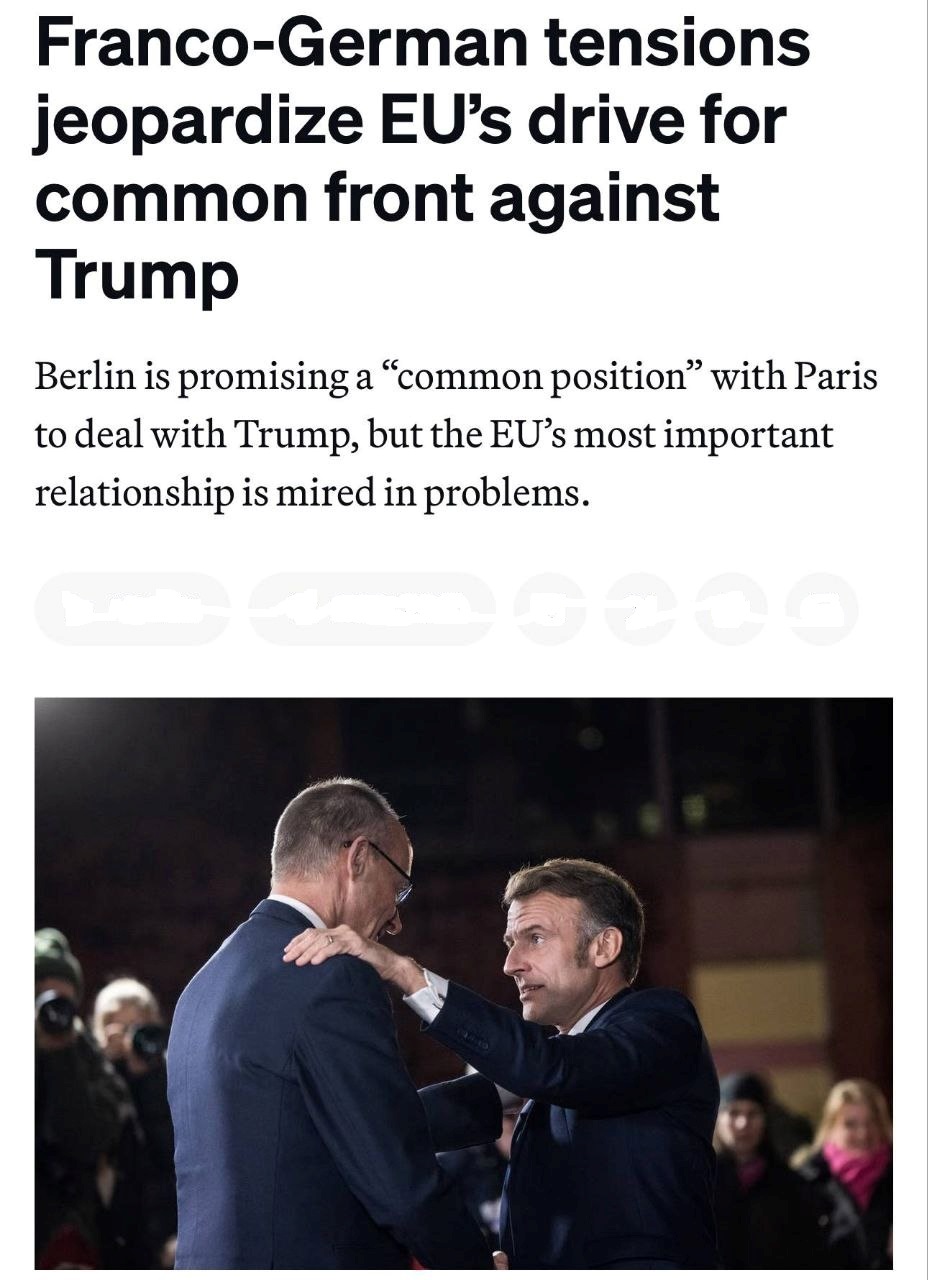
Berlin is promising a “common position” with Paris to deal with Trump, but the EU’s most important relationship is mired in problems, POLITICO writes.
Just as Europe needs its Franco-German power couple to unite to tackle U.S. President Donald Trump’s growing menace to Greenland, relations between Paris and Berlin are under strain.
German Chancellor Friedrich Merz is vowing to form a joint front with his French counterpart Emmanuel Macron in the coming days — revving up the cross-Rhine alliance often described as the engine of the EU — to secure a breakthrough with Trump.
But building what Merz calls a “common position” with Macron doesn’t come at an easy moment. Both sides will need to put aside months of frustration, suspicion and bad blood. French diplomats are worried by Berlin’s increasing assertiveness in styling itself as Europe’s dominant player.
The contrast between the French and German leaders in their approach to Trump was also on full display in their response to the U.S. president’s threat on Saturday to impose tariffs on EU countries that opposed his takeover of Greenland.
Macron, who often draws on a pugnacious Gaullist tradition of independence from the U.S., immediately vowed to punch back hard against Trump with the EU’s trade arsenal. The more emollient Merz, an avowed Atlanticist, played up the prospect of talking the U.S. president back from the brink.
Merz publicly acknowledged that Germany differed markedly on tone with France, which “wanted to react a little more harshly than we do” because Paris was less exposed to the onslaught of an all-out trade war with the U.S.
“In the last six months, the Franco-German engine hasn’t produced a single thing,” said one EU official who was granted anonymity, like others in this piece, to speak candidly about the bloc’s most important relationship.
Shifting balance of power
Paris has long wanted Germany to play a more ambitious role in supporting France’s grand ambitions for Europe, but Berlin is now flexing more diplomatic muscle than France expected. Germany is on track to build up a far bigger army than its neighbor, and is expected to be the only EU economy in the global top 10 by 2050.
While Macron is hamstrung at home by massive public debt and government instability, Merz has increasingly been putting himself on the front line of European politics.
Merz has also sought a leading role in conversations with Trump, even though he hasn’t always appeared as a model European in doing so. He told reporters that if the U.S. president “can’t get along with Europe,” he can “at least make Germany [his] partner.”
The implication Berlin could go it alone is hardly music to French ears
To the Germans, the French talk a good game on big European projects but don’t live up to the hype. Berlin is irritated that Paris promotes diversification from the U.S. but then tried to block a landmark trade deal with South America. It is also annoyed that France seeks a leadership role on Ukraine but contributes far less to Kyiv than Germany does.
That German frustration over support to Kyiv boiled over in this month’s debate over how the EU’s €90 billion loan to Ukraine should be used to support the European arms industry.
The French made their traditional proposal that the money should be used to buy European weapons — which in turn would support French industry. The Germans hit back that preferential treatment should instead be given to companies from countries that had made the biggest contributions to Ukraine — thereby helping German industry.
Given France’s lagging contributions on Ukraine, “this is a pretty clear ‘fuck you’ to Paris,” a third EU diplomat said.
Michel Duclos, a researcher at the Institut Montaigne and former French ambassador to Syria and Switzerland, said: “The fear in France is that the German defense budget will at some point be double that of France, and for Paris, it would be a historic shift.”
The FCAS joint Franco-German jet-fighter project – another major bugbear
The €100 billion venture is on life support after Paris and Berlin failed to agree on how to proceed last month. According to Peter Beyer, a foreign policy lawmaker from Merz’s conservatives, French companies are exerting “massive pressure,” and “even a French president apparently cannot see beyond that.”
“Now the thinking is going so far as to perhaps do it without the French, which I think would be a disaster, but at the moment there is no progress,” he said, referencing suggestions that Germany is looking at developing a fighter jet without French manufacturer Dassault Aviation.
read more in our Telegram-channel https://t.me/The_International_Affairs

















