
 РУССКИЙ
 11:27 04.12.2025 •
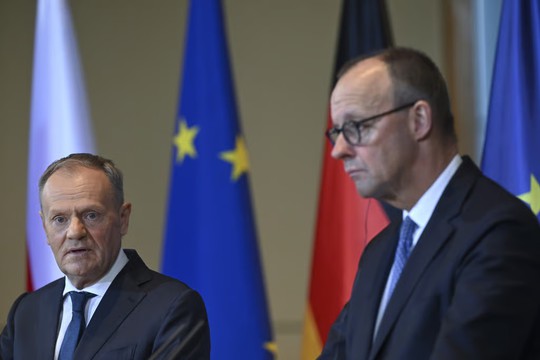
Polish Prime Minister Donald Tusk (left) and German Chancellor Friedrich Merz. Where is the European happiness on their faces?
Photo: Getty Images
Polish Prime Minister Donald Tusk and German Chancellor Friedrich Merz on Monday clashed over war reparations and restitution for Germany’s Nazi-era destruction of Poland, POLITICO writes.
The open disagreement between two leaders — who have vowed to mend often-strained relations between their two countries — cast a shadow over talks in Berlin that were meant to project unity and cooperation on a range of issues, including defense and support for Ukraine. Instead, the two leaders spent time sparring over the highly emotional issue of how Germany should attempt to make up for its actions during World War II.
“We must keep memories alive, even painful ones,” Merz said alongside Tusk. “I hope that we can do this in a way that does not divide us, but brings us closer together.”
But Tusk, under pressure from the opposition nationalist Law and Justice (PiS) party, took a harder line on the matter than he has in the past, criticizing Germany’s logic for refusing to pay war reparations to Poland.
“We in Poland all believe that Poland has not received compensation for the losses and crimes of World War II,” Tusk said.
After his reelection in 2023, Tusk had not highlighted the reparations demands of the previous PiS government, which called on Germany to pay €1.3 trillion for its 1939-1945 occupation of Poland. Berlin has repeatedly said the matter is legally “closed.”
But on Monday, Tusk reopened the issue, criticizing the German argument that Poland waived its right to reparations in the 1950s when it was under the control of the Soviet Union.
“Germany is adhering to this formal diplomatic agreement from the 1950s,” Tusk said. “Those who know history know that in the 1950s, Poland had no say in the matter. And Poland’s waiver of reparations is not seen as an act that reflects the opinion of the Polish people. The Polish people had no say.”
The renewed tensions over reparations threaten to complicate the two leaders’ efforts to smooth over differences on a range of issues, from disputes on national border controls to Berlin’s investigation of explosions that crippled the undersea Nord Stream pipelines carrying Russian gas to Germany.
Tusk’s government has frequently made the case that, while there is a moral case for reparations, there is no way to legally make Berlin pay and therefore, pursing the matter only undermines Poland’s ties with Germany, its largest economic partner.
Despite the disagreement, Merz and Tusk said they are in close contact over developments in Ukraine and negotiations over a possible peace deal.
Tusk called the level of cooperation “truly unprecedented” and warned of the risk of playing up divisions between the two countries.
“We have radicals on both sides of the border” who are “interested in stirring up anti-German sentiment in Poland and anti-Polish sentiment and moods in Germany,” he said. “But I am convinced that they will not be able to achieve their goals.”
read more in our Telegram-channel https://t.me/The_International_Affairs

















