
 РУССКИЙ
 11:27 16.12.2025 •
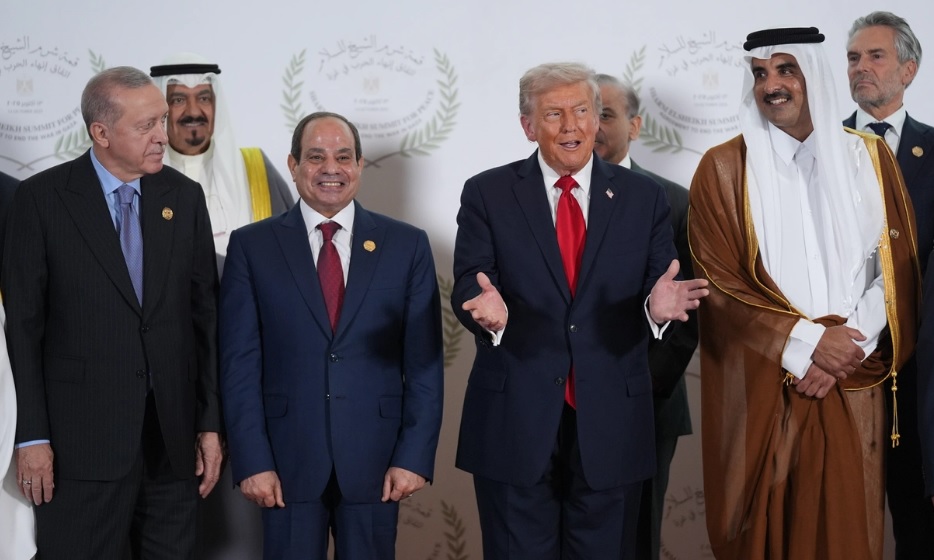 President Donald Trump gestures during a family photo during a summit to support ending the more than two-year Israel-Hamas war in Gaza as Turkey's President Recep Tayyip Erdogan, Emir of Kuwait Sheikh Meshal Al Ahmad Al Sabah, Egypt's President Abdel-Fattah el-Sissi and Qatar Prime Minister and Foreign Minister Sheikh Mohammed bin Abdulrahman bin Jassim Al Thani and Netherland's Prime Minister Dick Schoof watch.
Photo: AP
Nahal Toosi is POLITICO’s senior foreign affairs correspondent. She has reported on war, genocide and political chaos in a career that has taken her around the world. Her reported column, Compass, delves into the decision-making of the global national security and foreign policy establishment — and the fallout that comes from it.
Inside the U.S., President Donald Trump is dogged by rising consumer prices, the Epstein files debacle, and Republicans’ newfound willingness to defy him. But go 100 miles, 1,000 miles, or, as I recently did, 7,000 miles past U.S. borders, and Trump’s domestic challenges — and the sinking poll numbers that accompany them — matter little, writes Nahal Toosi, a POLITICO’s senior foreign affairs correspondent from Doha.
The U.S. president remains a behemoth in the eyes of the rest of the world. A person who could wreck another country. Or perhaps the only one who can fix another country’s problems.
That’s the sense I got this weekend from talking to foreign officials and global elites at this year’s Doha Forum, a major international gathering focused on diplomacy and geopolitics.
Over sweets, caffeine and the buzz of nearby conversations, some members of the jet set wondered if Trump’s domestic struggles will lead him to take more risks abroad — and some hope he does. This comes as Trump faces criticism from key MAGA players who say he’s already too focused on foreign policy.
“He doesn’t need Capitol Hill to get work done from a foreign policy standpoint,” an Arab official said of Trump, who, let’s face it, has made it abundantly clear he cares little about Congress.
U.S. presidents have long had more latitude and ability to take direct action on foreign policy than domestic policy. They also often turn to the global stage when their national influence fades in their final years in office, when they don’t have to worry about reelection. There’s a reason Barack Obama waited until his final two years in office to restore diplomatic ties with Cuba.
In the first year of his second term, Trump has stunned the world repeatedly, on everything from gutting U.S. foreign aid to bombing Iran’s nuclear facilities. He remains as capricious as ever, shifting sides on everything from Russia’s war on Ukraine to whether he wants to expel Palestinians from Gaza. He seeks a Nobel Peace Prize but is threatening a potential war with Venezuela.
Trump managed to jolt the gathering at the glitzy Sheraton resort in Doha by unveiling his National Security Strategy — which astonished foreign onlookers on many levels — in the run-up to the event.
The part that left jaws on the floor was its attack on America’s allies in Europe, which it claimed faces “civilizational erasure.” The strategy’s release led one panel moderator to ask the European Union’s top diplomat, Kaja Kallas, whether Trump sees Europe as “the enemy.”
Yet, some foreign officials praised Trump’s disruptive moves and said they hope he will keep shaking up a calcified international order that has left many countries behind.
Several African leaders in particular said they wanted Trump to get more involved in ending conflicts on their continent, especially Sudan.
Likewise, there’s an appreciation in many diplomatic corners about the economic lens Trump imposes on the world. Wealthy Arab states, such as Qatar, already are benefiting from such commercial diplomacy.
Others want in, too.
“He’s been very clear that his Africa policy should focus on doing business with Africa, and to me, that’s very progressive,” said Mthuli Ncube, Zimbabwe’s finance minister. He added that one question in the global diplomatic community is whether the next U.S. president — Democrat or Republican — will adopt Trump’s “creativity.”
The diplomats and others gathered in Doha were well-aware that Trump appreciates praise but also sometimes respects those who stand up to him. So one has to tread carefully.
Kallas, for instance, downplayed the Trump team’s broadsides against Europe in the National Security Strategy. Intentionally or not, her choice reflected the power differential between the U.S. and the EU.
“The U.S. is still our biggest ally,” Kallas insisted.
Privately, another European official I spoke to was fuming. The strategy’s accusations were “very disturbing,” they said.
The official agreed, nonetheless, that Trump is too powerful for European countries to do much beyond stage some symbolic diplomatic protests.
A British diplomat said they were struck by Trump’s musings about gaining entry to heaven. Maybe a nervousness about the afterlife could induce Trump to, say, avoid a conflagration with Venezuela?
“He’s thinking about his legacy,” the diplomat said.
Up until the final minute of his presidency, Trump will have extraordinary power that reaches far past America’s shores. That’s likely to be the case even if the entire Republican Party has turned on him.
At the moment, he has more than three years to go. Perhaps he will end immigration to the U.S., abandon Ukraine to Russia or strike a nuclear deal with Iran.
After all, Trump is, as Zimbabwe’s Ncube put it, not lacking in “creativity.”
read more in our Telegram-channel https://t.me/The_International_Affairs

















