
 РУССКИЙ
 11:18 25.01.2026 •
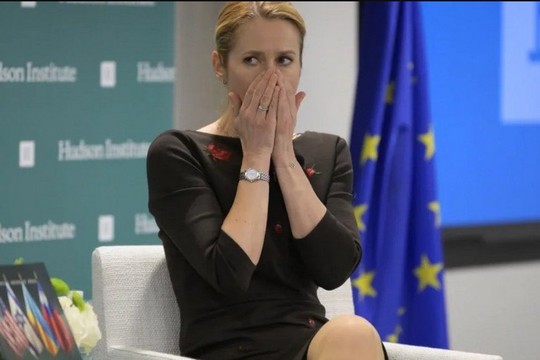
Europe froze in front of Trump, like a rabbit in front of a boa constrictor... Kallas’ statement calling for “calm and restraint” and respect for “the principles” of international law failed
Photo: Reuters
European countries are trying not to think about how much they still need Donald Trump. Some diplomats say it’s time they did, POLITICO writes.
The snow fell heavily over Brussels this week, as officials from embassies and European institutions returned from their holiday slumbers to a shocking new world.
Like an icy slap of Arctic air, Donald Trump’s operation to remove Nicolás Maduro from the Venezuelan presidency stunned the EU’s top officials — and froze them into silence. Then he questioned NATO, threatened Cuba and Iran, and declared he needed to own Greenland for the purposes of national security, whether or not the U.S. allies who currently control it agree.
“I don’t need international law,” Trump declared in an interview with the New York Times.
But international law needs Trump. His approach poses an existential threat not just to global agreements such as the Paris climate accord but to the European Union, the world’s biggest factory for international legislation. Every year the EU produces more than 2,000 directives, acts, regulations and other legal documents guiding the economic and societal lives of its 27 member countries.
In an American-dominated world where the rule of law doesn’t matter, the EU’s legislative machine could quickly become a quaint anachronism. The first week of 2026 has once again exposed the paralysis and powerlessness of Europe’s leadership to respond to an American president who proudly boasts the only thing that can stop him is his own sense of “morality.”
“It’s a very important moment,” said one diplomat from a European country, granted anonymity, like others, to speak freely. “There had been a tendency in European media to make fun of Trump and his people and present them as stupid and sometimes even as madmen. I think that’s wrong. They’re highly capable.”
But their mission, this diplomat said, is clear: to do whatever is necessary to advance the interests of the U.S. and the Trump administration. The White House doesn’t care about being a good ally to Europe, and is more than prepared to criticize, threaten, bully and perhaps attack the old continent. “This cannot be a surprise,” the diplomat said.
The Ukraine of it all
And here is the core of the tension paralyzing Europe’s response. Just as Europe still depends on NATO for its security, despite pledging repeatedly to stand on its own feet, it desperately needs American support to deliver an acceptable truce in Ukraine.
A meeting of Ukraine’s allies in the so-called coalition of the willing inched closer to a plan in which the United States would provide a military backstop to guarantee any peace deal. But the joint statement from more than 30 governments that emerged from the meeting lacked specifics about the American role and was not signed by Trump’s representatives.
But it is still a perilously delicate moment for Ukraine and Russia is not yet even on board. Alienating Trump at this point would be risky for Ukraine’s allies in the EU and beyond.
Macron is afraid of a “new colonialism” when the Europe is a US “colony”
The problem is that unless there is an open discussion about the new state of the West, leaders are likely to struggle to generate the political support they need for the scale of the required foreign policy shift away from the U.S. and perhaps NATO.
France’s President Emmanuel Macron has been among the most open about the challenge, warning in a speech that the U.S. is intent on carving up the world into spheres of influence.
“The United States is an established power that is gradually turning away from some of its allies and breaking free from the international rules that it used to promote,” Macron said during his annual foreign policy address.
Macron said Europe must not accept what he called “new colonialism” and should further invest in the continent’s “strategic autonomy.”
Diplomats still doubt how much any American signature on a peace treaty underwriting Ukraine’s security would be worth, when Trump is willing to do whatever he pleases. “At the end of the day,” another European diplomat said, “you have no guarantees that things will work out.”
America’s blunt challenge to the world order is a nightmare that reaches beyond Brussels
Take Britain’s prime minister, Keir Starmer, himself a career lawyer. Before he came to power, Starmer harangued the Conservative government in London for failing to call out Trump’s disinterest in international law. Now he’s in office, he can offer only the weakest of public commentaries, refusing to give a view on the legality or otherwise of Trump’s regime change operation in Venezuela.
“What kind of leverage can we have over Russia when we do not object when the U.S. does this in Venezuela?” another European diplomat asked.
Even when it comes to Trump’s ambitions to take “ownership” of Greenland — part of the territory of fellow NATO member Denmark — Europeans who sought to support the Danish position framed their responses in the mildest terms, carefully avoiding anything that might look like a direct criticism of the U.S. “Law is stronger than force,” was the best von der Leyen could manage. It’s not clear that she’s right.
“The world is not based any more on European values,” the senior diplomat said. “The world is operating totally differently. Europe needs to find its way.”
read more in our Telegram-channel https://t.me/The_International_Affairs

















