
 РУССКИЙ
 11:15 16.09.2026 •

The Russian Direct Investment Fund (RDIF), JSC BRICS Pay, and BRICS Pay India have agreed to partner to develop the BRICS Pay project in India and collaborate on cross-border payments within BRICS, the RDIF said.
The RDIF said this during President Vladimir Putin's visit to India. The 18th BRICS summit is taking place in New Delhi on September 12-13.
The collaboration aims to explore ways to integrate the BRICS Pay project with India's payment infrastructure, as well as to prepare for potential pilot projects and the subsequent launch of cross-border payment services, according to the statement.
The initiative seeks to foster the development of an open, resilient, and technologically independent cross-border payment infrastructure capable of facilitating trade and investment flows between BRICS nations, including via national currencies, the RDIF said.
JSC BRICS Pay is set to act as a technology partner, participating to develop technical solutions, adapt and localize technologies, as well as prepare pilot projects. BRICS Pay India should be the business and coordination partner in India, facilitating engagement with banks, payment service providers, merchants, and other Indian market participants.
"Developing modern payment infrastructure is a crucial prerequisite for the continued growth of trade and investment among BRICS nations. BRICS Pay could serve as a practical tool that complements existing national payment solutions and ensures their interoperability," RDIF head and Transneft board member Kirill Dmitriev said.
Dmitriev said that cooperation with Indian partners would enable to analyze and prepare pilot projects that take into account the specific features of national financial infrastructures. The RDIF will support the initiative's development by leveraging its investment expertise and international network of partnerships, he said.
JSC BRICS Pay was registered in Moscow last year. The company develops payment processing systems, software modules, and infrastructure solutions that form the technological foundation of the BRICS Pay project.
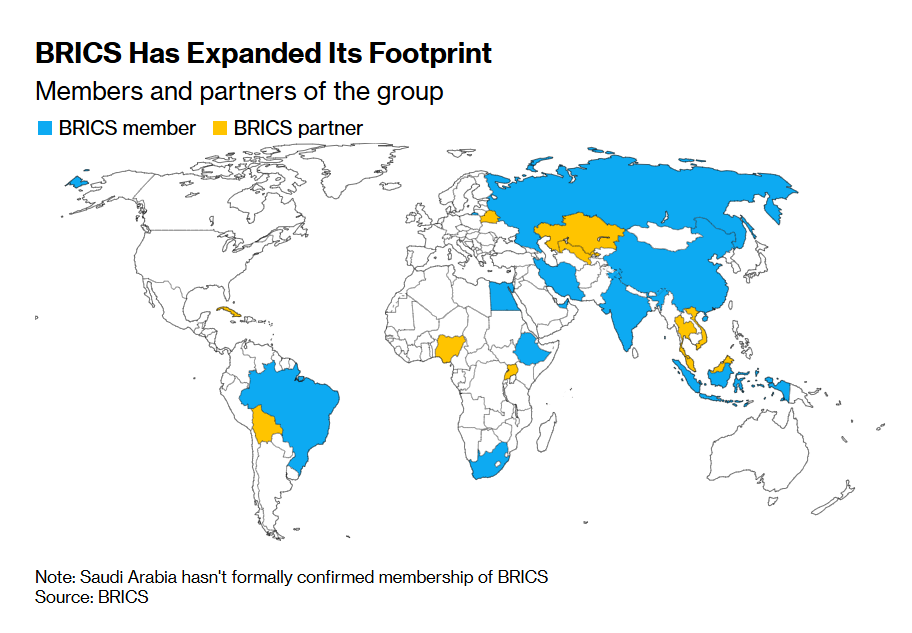
Founded in 2006 by Brazil, Russia, India and China and later joined by South Africa, BRICS now comprises 10 nations that collectively account for around a quarter of the world’s gross domestic product. Ethiopia and Egypt make up the rest of the African contingent, with Iran, Indonesia and the United Arab Emirates completing the list.
BRICS has increasingly positioned itself as a counterweight to Western-led groups that have long set the global agenda. It’s pushed for developing nations to have more say in institutions such as the IMF and promoted greater use of currencies other than the US dollar.
Inevitably, its growing economic and political clout has drawn the ire of US President Donald Trump, who last year threatened to ramp up tariffs on countries aligning themselves with what he called the bloc’s “anti-American policies.”
Most BRICS countries oppose the Trump administration’s protectionist policies and attempts to use tariffs as a bargaining tool.
But their responses to US pressure have varied widely, with some opting for appeasement and others — most notably China — taking a more confrontational approach.
read more in our Telegram-channel https://t.me/The_International_Affairs

















