РУССКИЙ
 19:54 16.12.2025 •
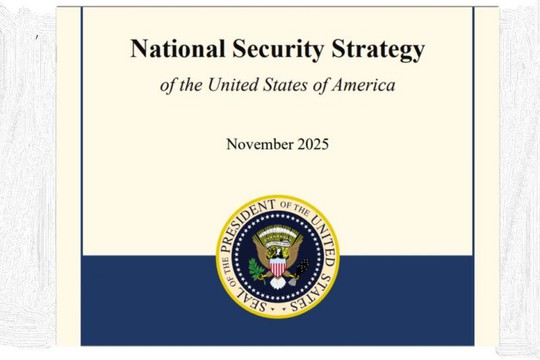
In early December, the Trump administration released its version of the United States National Security Strategy (NSS).
The document, put out as part of the US administration’s routine administrative work, affirms Washington’s ambitions for unconditional global leadership in three key areas: economy, military power, and high technology, as well as a dominant role in shaping political courses in the Middle East and the Western Hemisphere. Moreover, while the new NSS looks structurally similar to the country’s previous national security strategies, it outlines a fundamentally different philosophical and practical foundation for US foreign policy. While featuring the general characteristics of a strategic doctrine, it still contains a programmatic rejection of the paradigm of global leadership that dominated America’s foreign policy of the past decades.
The newly released strategy underscores national interest and self-sufficiency as America’s highest priority. This is not just a course correction but a necessary measure to restore national "greatness." In practical terms, this means a rejection of America’s claims to the role of the primary “guarantor and architect” of the liberal international order that dominated the US policy since the end of World War II. Instead, it lays out a modus operandi characteristic of a classic nation-state seeking to maximize its own freedom of action and minimize constraints imposed by allied and multilateral obligations.
This primarily involves acknowledging the inevitability of a fundamental transformation or even dismantling of the elements of the established world order that, until very recently, were believed to ensure America’s institutionalized leadership and associated advantages. Essentially, Trump's declared course can be described as strategic adaptation through self-restraint, where abandoning global aspirations is seen as a way to strengthen national power and sovereignty at a time of new great-power competition.
From the standpoint of Russian interests, the need for a radical revision of Washington’s traditional transatlantic partnership, outlined by the new NSS, deserves particular attention. Some of the provisions of the new document have caused a great deal of alarm among European experts. And with good reason too, as it interprets security threats to Europe in a new light shifting the emphasis from confronting Russia or China to internal demographic and migration processes in European countries.
The document disavows the traditional idea of Europe as an organic partner within a single democratic community. Instead, the region is portrayed as a place that is going through a systemic crisis of political and socio-cultural degradation. The European elites are criticized for being out of touch with the demands of their own societies, for excessive regulation, which is stifling economic dynamism, and for undermining national identity and sovereignty under the influence of migration processes.
The authors of the strategy express concern that due to the abovementioned trends, Europe risks eventually losing its civilizational identity and geopolitical agency, thus calling into question its reliability as an ally. In response, Washington prefers a more interventionist policy in the internal affairs of European states while simultaneously rejecting any further NATO expansion and declaring the goal of normalizing ties with Russia.
This means that the United States is rethinking its role as Europe’s partner, with the European Union and key countries in the region no longer seen as allies, acting on the basis of shared values and mutual reinforcement, but as objects for targeted external correction. The partnership of democracies is thus making way for a model of instrumental pressure, where relations are used by Washington as leverage to change the domestic policies of European governments in keeping with American notions of national interest. Hence, the rejection of any further NATO expansion and declaring America’s traditional role in ensuring European security as excessive. Thus, the new security strategy records a fundamental shift: Washington officially renounces is role as a deterrence against threats to European space, which historically served as the cornerstone of the transatlantic alliance since the start of the Cold War.
European analysts assess this document as a symptom of a deep crisis in transatlantic relations, expounding on the ideas previously voiced by US Vice President J.D. Vance at the Munich Security Conference in February, where he criticized EU migration policy and restrictions on sovereigntist ("right-populist") political forces. Therefore, the new Strategy is interpreted as the institutionalization and radicalization of "MAGA-style" criticism, turning it into an official foreign policy doctrine that essentially represents a direct challenge to the European integration project.
Ideologically, the NSS reflects the trend observed in recent years of leading Western powers scaling back public and cultural diplomacy institutions. It puts in question the maxim that values of democracy, open society, and human rights are perceived not only as a political model but also as a universal response to modernization challenges. It states that accumulated global imbalances - from growing social inequality within societies to migration crises and geopolitical instability – show that "ready-made solutions" in the form of exporting political institutions have proven untenable. Hence, the current retreat from the idea of "soft power" as a missionary project.
Trump's National Security Strategy thus represents a transition from idealistic internationalism to a pragmatic, if not cynical, "national egoism." It openly renounces any ambition to reorganize the world along American lines, which has dominated Washington’s foreign policy of the past decades. Instead of promoting democracy and liberal values as a global good, it prioritizes purely US national interests within the rigid logic of interstate rivalry.
Thus, the cultural and value-based component of foreign policy is not simply being curtailed, but is being fundamentally rethought. It proposes to replace universalist cultural diplomacy with the protection and promotion of sovereign civilizational identity, which in practice means opposing globalism and multiculturalism.
Trump's new NSS does more than just acknowledge a decline in faith in the "social order" as a response to global problems - it institutionalizes "disbelief," thus essentially elevating to the level of official doctrine the idea that the main factors in the historical process are not values, but competing civilizations and nations defending their own unique models. This is a fundamental break with the philosophical bedrock that American cultural diplomacy has been built on for decades.
Critics dispute the doctrine’s conformity to the canonical attributes of a strategic document. They argue that it lacks analytical depth, features logical contradictions, and proposes a set of priorities, which are devoid of operational consistency and long-term vision. Consequently, the new NSS is not a national security strategy in the classical, rational sense, but rather a political manifesto. Its primary function is not to develop a balanced and long-term foreign policy course, but to enshrine the ideological dogmas of the MAGA movement.
The proponents of political realism offer a more historically contextualized interpretation, though. They note that the doctrine's core principles - an emphasis on national sovereignty, pragmatism over ideology, and distancing from burdensome alliances - are deeply rooted in the tradition of American isolationism and "unilateralism." Therefore, the doctrine per se is not an unprecedented innovation. They emphasize, however, that the ensuing public debate about its core tenets has proven extremely polarizing. The Trump administration's political opponents met the document with extreme hostility, focusing on its rhetoric and dismissing it without even trying to understand the historical and structural reasons for its emergence or see in it potentially rational elements that resonate with the objective tendencies of the modern-day system of international relations.
While the previous US national security strategies identified Russia and China as key geopolitical competitors, in Trump’s NSS they are presented not as complex systemic challenges requiring a multi-layered and coordinated response, but rather as regional actors existing next to the US sphere of interest. With regard to Russia, the document demonstrates a fundamental shift where Moscow is no longer treated as a key military-political threat that needs to be contained. In this logic, the Ukrainian conflict is presented not as a symptom of a fundamental conflict with a "revisionist power undermining the foundations of European security," but as a local factor of instability that requires a "quick resolution" to ease tensions. The parts of the NSS devoted to Russia are a de facto recognition of Russia's status as a leading power, whose interests and sphere of influence in Europe should be respected the new model of a great-power concert, thus potentially marginalizing the EU's collective voice.
This has inspired cautious optimism in Moscow, with the Kremlin responding positively to the new US National Security Strategy, which no longer refers to Russia as a "direct threat." As President Putin’s press secretary Dmitry Peskov noted, "We consider this a positive step." He said that the Russian leadership would carefully analyze the new US strategy. "Of course, we need to study it more closely and analyze it... Overall, these messages, of course, contrast with the approaches of previous administrations," Peskov added.
The question is, whether the Trump administration is genuinely ready to acknowledge the emergence of a parallel global infrastructure that challenges the US-led order at the institutional, technological and regulatory levels as a key geopolitical development of our time. Is this a voluntary and deliberate contraction of the United States’ sphere of global influence and responsibility or, as Trump's Western opponents claim, his inability or unwillingness to adequately reflect the deep structural shift and formulate long-term goals in the context of the changing distribution of global influence?
The authors of President Trump's National Security Strategy insist that a shift away from the traditional role of global leadership is not a sign of weakness, but a measure to reduce foreign policy risks and strategic burdens. A greater focus on national interests will enhance America's effectiveness and security in the long term. Other great powers will perceive Washington's open recognition of the objective realities of a changing international order as a positive development, if not an acknowledgement of the obvious: an ongoing structural transformation of the international order where the United States and the collective West are gradually losing the dominant positions they held for decades, if not centuries. The current US administration's actions aimed at "focusing inward" could thus speed up the process of redistribution of global influence.
With his National Security Strategy, Trump clearly opens a "window of opportunity" for restructuring the international order. The question is, however, just to what extent the US political class as a whole shares the Trump administration's vision of America's "greatness and security."
--------------------------------------------------------------------------------------------------
https://tass.ru/politika/25837261
read more in our Telegram-channel https://t.me/The_International_Affairs