
 РУССКИЙ
 11:48 08.12.2025 •
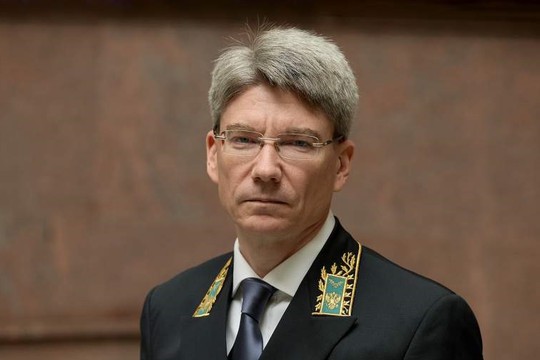
Russian Ambassador to Belgium Denis Gonchar
Photo: Press service of the Russian Embassy in Belgium
NATO is increasingly talking about the possibility of a direct military clash with Russia and is realigning strategic planning for a long-term confrontation scenario, Russian Ambassador to Belgium Denis Gonchar told Izvestia.
According to him, the NATO legal mechanisms can be adjusted for these purposes — that is, the rejection of the defensive nature of the alliance will be recorded on paper. Brussels has embarked on a policy of increasing military spending, militarizing the economy and intimidating the population. Belgium is preparing to allocate over €30 billion for the rearmament of the army, contrary to the interests of citizens who are already suffering from falling living standards.
At the same time, the diplomat notes, formal formats like the Russia–NATO Council have been declared "dead," but emergency communication channels between Moscow and the headquarters of the alliance remain and, if desired, can be used for de-escalation.
"Arguments about the possibility of war with Russia are increasingly heard in NATO countries"
— You recently stated that NATO is preparing its population for war with Russia. What specific steps and measures are we talking about?
— Unfortunately, discussions about the possibility of war with Russia are increasingly heard in NATO countries. This extremely dangerous narrative is actively supported by the leadership of the alliance. Inflating the myth of the threat of Moscow's attack on the alliance, the NATO members themselves began active preparations for a direct clash with our country, both through information and propaganda, and in the form of concrete steps "on the ground."
So, back in July of this year, the commander-in-chief of the NATO Allied Forces in Europe, Alexus Grinkevich, intimidated the audience with theses about the possibility of Russia and China unleashing simultaneous hostilities in Europe and the "Indo-Pacific region." In his submission, a similar scenario could be implemented as early as 2027.
In recent days, NATO members have gone even further in their recklessness. In an interview with the Financial Times on November 30, 2025, the head of the military committee of the bloc, Giuseppe Cavo Dragone, said that in response to the so—called "hybrid war on the part of Russia," the alliance was considering the possibility of a "preemptive strike" as a "defensive measure." It's a small matter, they say, to adjust outdated NATO legal mechanisms for these purposes. Simply put, it is necessary to put on paper the rejection of formulations about the defensive nature of the alliance, which, however, from the very beginning were nothing more than a cover for the aggressive nature of the bloc.
— Can we say that in the long term, NATO's planning will be based around the "Russian threat"?
— In fact, all strategic planning in NATO is now focused on comprehensive containment of Russia, based on the postulate that our country will remain a long-term threat to the security and stability of Europe even after the end of hostilities in Ukraine.
Evidence of this is the results of the meeting of the foreign ministers of NATO member countries held in Brussels on December 3, 2025, where the focus of the discussion was the continuation of the mindless increase in military spending, the militarization of economies and the dispersal of the military—industrial complex, as well as support for the Armed Forces of Ukraine through the supply of weapons and military equipment.
"NATO's Arctic potential is noticeably strengthening"
— Is the alliance currently considering the possibility of a military clash with Russia as a real scenario?
— The Alliance consistently makes decisions to strengthen the permanent presence of alliance forces and assets in Eastern Europe and the Baltic States, launch new military operations in the Baltic Sea and on the "eastern flank" in general, expand measures to counter the notorious hybrid, drone and cyber attacks, acts of sabotage and espionage, the author of which is a priori, without conducting an investigation, "appointed" Russia.
According to the alliance's plans, multinational battalion tactical groups stationed along the "eastern flank" of NATO should be brought up to the brigade level, which implies an increase in their staffing levels by at least three times.
There are calls for curtailing Moscow's ability to use the "shadow fleet" — in fact, a hunt for foreign tankers has been announced, willingly picked up by Ukrainian terrorists from the Budanovsky gas station.
The Arctic potential of the bloc is noticeably strengthening, new command and staff structures are being created and expanded in the Nordic countries, and the first NATO Arctic Space Forum was held on November 12, 2025, to "raise situational awareness" in high latitudes.
The training activity of the NATO countries is increasing, and the exercise scenario already explicitly includes the development of an operational transfer of reinforcements "in the event of an enemy attack from the east." In fact, preparations are underway to conduct combat operations simultaneously in several theaters of military operations.
The alliance is increasingly drawing into its orbit such countries of the Asia-Pacific region as Australia, New Zealand, South Korea and Japan, covering up global ambitions and vested interests with the thesis of the interconnectedness of security in the Euro-Atlantic and the Asia-Pacific region.
— How does NATO prepare its own population for such a scenario and how does this affect decisions in European capitals?
— Much attention is paid to preparing society for crises and emergencies, strengthening civil defense and protecting critical networks and infrastructure. The population of NATO countries is intimidated by the danger and proximity of threats that can at any moment undermine the work of key services and facilities. NATO hawks are spreading fear and panic among ordinary Europeans. It is not necessary to go far for examples — it is enough to recall the sensational call of the chief of the French General Staff to accept the inevitability of the death of young soldiers on the battlefield.
In general, we have to admit that the failure of Western plans to inflict the notorious strategic defeat on Russia, the significant successes of the Russian army in the context of its military operations, and the growing systemic socio-economic problems in Europe are pushing NATO members to increasingly irresponsible escalatory statements and actions. Hopefully, the clear and precise response of Russian President Vladimir Putin on December 2, 2025 to the question about the desire of some in Europe to fight with us will cool the hottest heads.
"The EU population will have to make sacrifices and tighten their belts"
— Can we say that some of the EU countries are already switching to elements of the "wartime" economy?
— Since the Russian permanent mission to the EU is dealing with the "EES" issue in Brussels, I will not talk about the entire European Union, but highlight the accelerating process of militarization using the example of Belgium. The local political establishment has embarked on implementing the guidelines of the Hague NATO Summit on a multiple increase in defense spending, agreed under the guise of countering the alleged Russian threat. There is no hiding the fact that for this the population will have to make sacrifices and "tighten their belts." A vivid confirmation of this is the recent adoption of a new budget, which will seriously affect the country's middle class and social security, as austerity measures will affect a number of civilian sectors.
On the other hand, it is planned to allocate over €30 billion for the rearmament of the Belgian army as part of the ambitious plan of Defense Minister Theo Franken, which involves, among other things, the acquisition of a frigate, air defense systems, MANPADS, and an increase in the fleet of American fifth-generation F-35 fighters, capable of carrying modernized nuclear weapons stationed at the Kleine Brogel airbase. B61-12 bombs.
To increase the number of personnel, it is planned to form a second motorized brigade, equipped as part of a joint SaMo project with France. 130,000 young people received "letters of happiness" from the Ministry of Defense inviting them to volunteer for military service. What is this but disregard for the interests of their own citizens, suffering from a sharp decline in living standards, and often struggling to make ends meet.
— How do stories about drones and the "shadow fleet" affect public opinion and security in the region?
— The population is being openly intimidated and deceived. For example, the recent hysteria surrounding the increased number of unidentified drones detected in Belgian airspace has given a serious impetus to the kingdom's belligerent roll. Against the background of growing threats from the air, the thesis of the need for additional response measures and strengthening the national anti-UAV system began to be actively promoted. Then it turned out that many reports of drone sightings were erroneous, either police helicopters or flocks of birds were mistaken for them. But the job has been done, and the relevant plans for the purchase of new anti-drone weapons have already been agreed.
Let me also remind you that the Belgians have joined the initiative of a number of European countries to combat the so-called "Russian shadow fleet", and support the expansion by the European Union of the powers of member states to inspect tankers and detain them. All these are steps towards confrontation, and we are not the initiators of them.
— Do Russia and NATO still have real channels for dialogue on security issues in Europe in the current conditions?
— Judging by the statements and actions of the NATO leadership, it is still not ready for a normal dialogue. In a recent interview with Radio Free Europe/Radio Liberty (included by the Ministry of Justice of the Russian Federation in the list of organizations whose activities are considered undesirable on the territory of Russia), Secretary General of the alliance Mark Rutte directly rejected the possibility of resuming contacts at the level of the Russia–NATO Council, stating that this format, as well as the Founding Act of Russia–NATO, "both dead" since the "Russian invasion of Ukraine".
At the same time, emergency communication channels between the NATO headquarters and the embassy remain in place and, in particular, through the office of the military attache at the Embassy, they are periodically activated.
The alliance is also well aware that, if desired, it would be possible to use a telephone line between the NATO headquarters and the National Defense Command Center of Russia. For example, in cases like the incident in Poland on September 10, 2025. Let me remind you that at that time the Ministry of Defense of our country declared its readiness to hold a substantive discussion of the problems with representatives of Warsaw, but this initiative has not received any response.
In all similar incidents, NATO members choose the path of feverish, emotionally colored, unsubstantiated accusations in the media. This obviously does not help to reduce tension.
read more in our Telegram-channel https://t.me/The_International_Affairs

















