
 РУССКИЙ
 0:07 30.12.2025 •
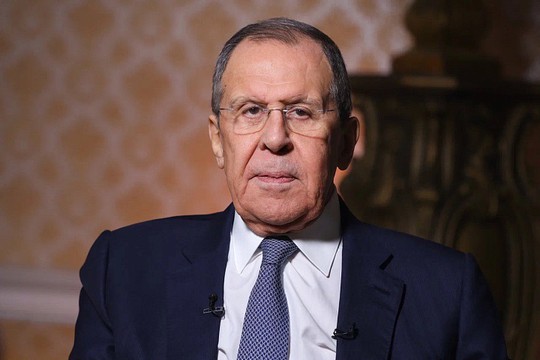
Question: In February, Russia and the United States agreed to start working on normalising their relations. In your opinion, has there been progress in this matter after almost one year? How normal can we consider the diplomatic relations between Moscow and Washington today?
Sergey Lavrov: Indeed, even during the telephone conversation on February 12 – their first contact after Donald Trump’s return to the White House – the presidents of Russia and the United States agreed that it is necessary to overcome the “toxic legacy” of the Joe Biden administration as soon as possible, in the interests of normalising Russia-US relations. This work began immediately. Our contacts have become steady since then. Both sides understand the importance of comparing their positions regularly, both on bilateral issues and on the topical international problems, including the situation in Ukraine.
At the same time, this has not been an easy process. The number of aggravating circumstances remains high. The negotiation teams of the Russian Foreign Ministry and the US Department of State are focusing their efforts primarily on restoring the full-fledged operation of our diplomatic missions. Following several rounds of consultations and meetings that took place at the working level, we have reached certain agreements concerning the improvement of the work of our diplomatic missions and their staff in their respective host countries.
Now, it is important to move to more significant matters. They include resuming direct flights and recovering our seized diplomatic property. The American side has received our proposals on removing these substantial barriers that hinder tangible improvements in our relations. However, the US Department of State continues to insist on linking these matters to unrelated political topics. This work will continue.
Question: Does Moscow have a Plan B in case US President Donald Trump withdraws from the peacekeeping efforts on Ukraine? Will such a hypothetical rejection by the United States of its intermediary role concerning Ukraine shut the door on the prospects of Russia’s relationship with the United States?
Sergey Lavrov: Russia has repeatedly stressed its unwavering commitment to primarily political and diplomatic solutions to the crisis around Ukraine. The US Administration is currently engaged in active and result-oriented mediation. In the last few days alone, the Presidents of Russia and the United States have held important telephone conversations on this topic. We have noted that President Trump is taking genuine and serious efforts, almost on a daily basis, to find a solution while trying not to bend under the pressure from the Kiev regime and Europeans. We hope that America will be able to keep to the agreements reached in Anchorage.
Our principled course remains unchanged. The Russian army fully holds the strategic initiative, and the West understands that. Recently, President of Russia Vladimir Putin spoke at a meeting of the Defence Ministry Board and answered questions during the Direct Line. Once again, he clearly confirmed that all the goals of the special military operation will be achieved – preferably through talks but, if necessary, using military means.
It is obvious to us that the Russian-US agenda must not be reduced only to the Ukrainian issue. Our states, which are the largest nuclear powers and also permanent members of the UN Security Council, bear special responsibility for maintaining international peace, security and strategic stability.
Question: During the Russia-US contacts, did the parties discuss the fact that, as part of resolving the conflict, Ukraine must hold elections? At what stage is this supposed to happen, as a condition of a long-term peace or as its outcome?
Sergey Lavrov: Vladimir Zelensky’s presidential powers expired in May 2024. The election in Ukraine must be held according to law. We have noted that the United States holds a similar view.
The current leadership in Kiev requires a mandate to sign any peace agreements, which can only be conferred through elections – specifically, a transparent and fair electoral process in which all relevant political forces can participate. Ukrainian people, including the vast majority of their compatriots now residing in Russia, must finally be given the opportunity to determine their own future. Crucially, the organisation of such a vote must not be used as a pretext for a temporary ceasefire to facilitate the rearmament of the Ukrainian forces.
However, elections are not an end goal in themselves. The priority must be establishing legally binding guarantees that address the root causes of this conflict. The foundational principles upon which Ukrainian statehood was recognised by Russia and the international community must be restored. This entails enshrining Ukraine’s neutral, non-aligned, and nuclear-free status; achieving its demilitarisation and denazification; and halting the NATO countries’ military development of Ukrainian territory. The rights and freedoms of native Russians and Russian-speaking citizens of Ukraine must be guaranteed, and the persecution of canonical Orthodoxy must cease. Furthermore, Kiev and its Western sponsors must recognise the new territorial realities following the accession of Crimea, Sevastopol, the Donetsk and Lugansk people’s republics, and the Zaporozhye and Kherson regions to the Russian Federation.
Ultimately, a viable system of security guarantees must be established. In this context, we extended a formal invitation for dialogue to the United States in September. We are confident that the draft treaties submitted by Russia to Washington and European capitals in December 2021 can serve as a substantive basis for relevant discussions. Any such guarantees must, of course, be founded on the principle of the indivisibility of security, as enshrined in the consensus documents of the OSCE summits in Istanbul (1999) and Astana (2010).
Question: The New START Treaty expires on February 5, 2026. What are Moscow’s plans if Washington fails to respond to our proposals for its extension?
Sergey Lavrov: Let’s not get ahead of ourselves. Before the treaty’s expiration, it would make sense to allow the American side time to complete a comprehensive review of President Vladimir Putin’s initiative to maintain the New START Treaty’s quantitative limits as voluntary unilateral measures.
Moscow is not alone in awaiting a clear response from Washington. Most nations are actively preparing for the upcoming 2026 Nuclear Non-Proliferation Treaty Review Conference. Their approaches will undoubtedly be influenced, in no small part, by the US response to Russia’s proposed “post-New START” initiative.
We will closely monitor the relevant steps taken by the American side, assessing the situation in its full strategic context. We are prepared for any eventuality.
Question: How will Moscow respond to the EU’s decision to effectively ban multiple-entry Schengen visas for Russians?
Sergey Lavrov: A measured response to this latest unfriendly step is being formulated in line with our national interests. Any decisions will be announced in due course. For the present, citizens of EU countries continue to benefit from the provisions of the 2006 bilateral visa facilitation agreement with Russia, which specifically provides for the issuance of multiple-entry visas valid for up to five years. We continue to apply this procedure unilaterally, despite the EU’s termination of the agreement in 2022. Furthermore, citizens of all EU member states can still travel to Russia under a simplified regime using a unified electronic visa, which can be obtained an unlimited number of times.
read more in our Telegram-channel https://t.me/The_International_Affairs

















