РУССКИЙ
 21:30 17.11.2026 •
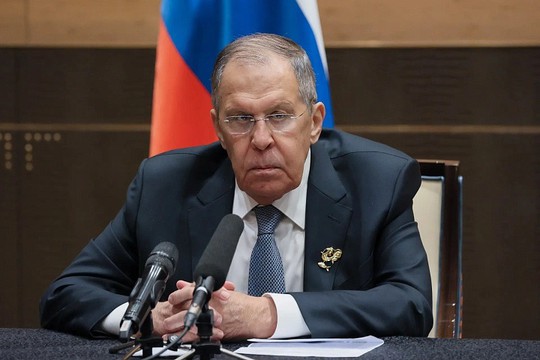
Photo: MFA
Foreign Minister Sergey Lavrov’s statement and answers to media questions following the 21st East Asia Summit, Manila, November 17, 2026.
Colleagues,
On behalf of the President of the Russian Federation, Vladimir Putin, I led the Russian delegation to the 21st East Asia Summit.
The summit was initiated by the ASEAN member states in conjunction with their partners. Today, these annual summits are used to address a wide range of issues primarily concerning the impact of global developments on the prospects for the world economy, trade, and investment, as well as matters related to various aspects of human life. This year, significant attention was devoted to artificial intelligence and online fraud (cyber fraud, to put in straightforward language).
The resulting document is quite interesting. A political declaration containing consensus-based assessments was adopted as well. It makes no mention of specific conflict situations, even though during the discussions, many of our Western colleagues, primarily the Europeans, the Australians, and Japanese Prime Minister Sanae Takaichi did, of course, mention “Russia’s aggression against Ukraine.” You are aware of this. None of these assessments are included in the political declaration.
During the discussions, we naturally promoted our own interests and reaffirmed our commitment to the traditions established by the ASEAN nations. These traditions took root when a community of dialogue partners began to form around the association leading to the creation of the ASEAN Regional Forum and the ASEAN Defence Ministers’ Meeting-Plus (ADMM-Plus), which includes the defence ministers of ASEAN’s strategic partners. An entire architecture has been built around ASEAN, and its ASEAN-centric nature has always been widely acknowledged.
Currently - we highlighted this point in our remarks - our Western colleagues are attempting to undermine and dismantle this inclusive, consensus-based and open to all architecture. There are various ways to describe this, but essentially, they are trying to drag individual ASEAN nations into exclusive military blocs.
They are also bringing NATO architecture into this region. They are speaking quite openly about the idea that the Euro-Atlantic alliance must be inextricably linked to this region, arguing that security in the Euro-Atlantic and the Indo-Pacific as they call it is indivisible and inseparable. They have been promoting this narrative for quite a while. Back when Jens Stoltenberg was NATO Secretary General, he was asked how this squared with his long-standing insistence that the North Atlantic Alliance is a defensive union primarily tasked with protecting the territories of its member states. Without batting an eye, he replied that this remained true. It’s just that, in the current time (this was four or five years ago), threats to the NATO members’ territories originate from the South China Sea, the Taiwan Strait, Southeast Asia, and so on.
This process is well underway. NATO is actively establishing a presence in the region, making little secret of the fact that its goal is to contain the People’s Republic of China. Everyone is aware of this. Beyond merely relocating elements of NATO’s military infrastructure to this region, a new concept has been devised which is to create an Indo-Pacific Treaty Organisation modeled directly after the North Atlantic Alliance, essentially a carbon copy of the latter’s name.
We have taken note of all this and issued warnings against the fragmentation of an inclusive, consensus-based architecture that has been painstakingly in the making over many decades. While I doubt these processes can be halted, the preservation of the ASEAN framework which includes extra-regional players who agree to abide by the rules established by the Association is, at the very least, a positive outcome.
Yet, some countries that only recently obtained partner status are taking part in the events. For instance, the British suddenly expressed a desire to join the ASEAN Regional Forum (ARF). There is a waiting list and a moratorium on new members for good reason but they came up with a clever workaround, effectively cutting the line to gain entry, much like the rude individuals one might have encountered in grocery and other stores back in the day.
The Canadians volunteered to host a meeting of heads of military universities, colleges, and institutes under the auspices of the ASEAN Regional Forum, and were granted the right to do so only to then deny the Russian delegation the opportunity to participate. Our friends from ASEAN see all of this. They see how guests are invited to the table only to start receiving orders once they’re seated. They haven’t gone as far as put their feet up on the table but it’s entirely possible that at some point they will.
Nonetheless, I believe it was a useful event. I would like to turn the spotlight on the US delegation. It was led by US Under Secretary of State for Political Affairs Allison Hooker, who conducted herself with the utmost propriety and addressed issues of importance to this region and its partners ranging from the economy, finance, and freedom of navigation to artificial intelligence (and its regulation) and the fight against cyber fraud, among numerous other topics.
The politicisation of this forum is driven primarily by European countries, Australia, and Japan. That, in short, covers my impression.
Question: Could you elaborate on the topics covered at the East Asia Summit? To what extent was the discussion regarding the risks to the Asia-Pacific region posed by Western attempts to bring NATO’s military-political capabilities to this part of the world constructive?
Sergey Lavrov: I don’t think this requires much justification. Nothing good has ever come from NATO’s presence anywhere. Consider the Alliance’s interventions in Iraq, the former Yugoslavia, and Libya, among its other reckless adventures. Whenever the North Atlantic Alliance has ventured beyond the borders of its member states, it has done so through aggressive military missions. In none of the places where NATO has arrived with arms in hands has the situation improved. On the contrary, deep crises have emerged in every instance and they have to be dealt with primarily by the neighbouring countries. Significant damage has been done.
The United Kingdom, the United States, and Australia have established AUKUS. Australia is a party to treaties establishing nuclear-weapon-free zones (the Bangkok Treaty and the Treaty of Rarotonga). Yet, AUKUS is busy building nuclear-powered submarines. The way this is unfolding does not entirely align with the standards established by the IAEA for such scenarios, specifically regarding transparency, periodic oversight, and monitoring. We have a nuclear-related arrangement involving two nuclear states - the UK and the US - and a third, non-nuclear state, Australia. Many suspect that Australia will gain expedited access to technologies that, in principle, should be subject to IAEA controls, yet no such provision exists.
It is likely that the countries of the region are not particularly pleased with this. The same applies to the situation in the Strait of Hormuz and, more broadly, around the Arabian Peninsula. The global economy is hurting; this route is of critical importance to Southeast Asia.
Consequently, there has been no progress either in economic terms or in strengthening security. In fact, there has been a regression. To reiterate, we sensed our ASEAN friends’ desire to uphold the foundational principles upon which the Association itself, as well as its mechanisms for engaging with its partners, including the East Asia Summits, is built. If all parties show due respect to the architects of this process, the ASEAN nations, then these forums will prove far more productive.
At the very least, it was clear today that some of our Western partners simply needed to vent, to level accusations against Russia and to issue threats towards China. China was represented by its Minister of Agriculture; the Chinese Premier had visited the region just the day before for bilateral talks. The Chinese representative explained, in very tough terms, the risks inherent in any attempt to shift the Taiwan issue towards a de facto recognition of independence. This is a serious matter. While the West claims to adhere to the one-China policy, it simultaneously insists that the status quo must remain unchanged. In practice, however, this status quo entails the expansion of military cooperation between the United States and other members of the Western bloc, on the one hand, and Taiwan, on the other hand.
There are other compounding factors as well. The United States, Japan, and South Korea regularly conduct military exercises on the Korean Peninsula. Their objective is clear and it is to contain the DPRK and to keep sanctions against it. These sanctions do not exist for us. These exercises involve nuclear components, at least in the scenarios played out by the United States, South Korea, and Japan. Prime Minister Sanae Takaichi has already signalled that the three non-nuclear principles enshrined in the Japanese Constitution are no longer to her liking. This risks triggering a chain reaction, a potential domino effect. Many, including the ASEAN member states are well aware of this. We will team up with them to ensure that these concerning trends do not come to fruition.
Question: A trilateral meeting of the leaders of Russia, China and the United States will take place on November 19. The White House has already stated that US President Donald Trump plans to discuss nuclear arms reductions at the meeting. What results does Russia expect from this meeting, and could such a meeting change the global security landscape?
Sergey Lavrov: Such a meeting is useful in any circumstances as all three are nuclear powers. Two are also among the world’s largest economies. These are countries with extensive interests in different parts of the world and which have put forward significant initiatives, both by China (President of China Xi Jinping’s four initiatives, including the Global Security Initiative) and by the Russian Federation (President of Russia Vladimir Putin has proposed the Greater Eurasian Partnership and a security architecture for Eurasia). The United States is also Eurasia’s closest neighbour to the east. That too is a factor of considerable interest. Under US President Donald Trump, the United States is focusing more on its national interests, yet remains highly active on the international stage. Merely listening to one another is therefore useful, especially as there have never been meetings in this format before.
The agenda has been agreed. I will not comment on statements by the other participants regarding the substance of the forthcoming meeting. That is not our practice. However, it is broadly clear what the leaders will discuss. They will have the opportunity for a free exchange of views. I would ask you to be patient. There is very little time left now.
Question: Would Russia like this format – Russia, the United States and China – to become a permanent feature? Were there any difficulties in agreeing the agenda?
Sergey Lavrov: These matters all fall under the category of what goes on behind closed doors: how the agenda is drawn up and how agreement is reached on the desired outcomes of the meeting.
As for the prospects of making this format a regular one, I will not even speculate. If the three leaders find it useful and see value in it, it will not be difficult to meet again.
Question: Against the backdrop of the talks that have begun on European security architecture, many in the United States have been recalling our demands from 2021, which included, among other things, the requirement for NATO infrastructure to be withdrawn to the 1997 borders. Now, five years later, does that demand still stand, or has it been revised in any respect?
Sergey Lavrov: You are trying to uncover secrets here as well. In 1997, when the Russia-NATO Founding Act was signed and the Russia-NATO Council was established, we saw this as a prime opportunity, and even an imperative, to halt the alliance’s eastward expansion. That document, the Russia-NATO Founding Act, contained all the right words: fine, I would even say grandiose, assurances of friendship and assurances that we were in no way adversaries and posed no threat to one another.
Considerable time has passed since then. Once again, we tested the North Atlantic Alliance’s ability to honour its agreements. They began telling us that these were merely political commitments and that they could only provide legally binding security guarantees to those who had joined NATO. In other words, they were creating a form of “bait” to “drag” new members into the North Atlantic Alliance, including, as you are aware, countries in the post-Soviet space.
Nevertheless, our negotiators, who met with the Americans and Ukrainians in Abu Dhabi, have reported to President Vladimir Putin. The remarks made by Kremlin representatives have been cautiously positive. Let us therefore not make any statements now that could give a misleading impression of what is happening and hinder the frank discussion that will certainly continue in the Russia-United States-Ukraine format.
We have already spoken at length about Europe’s place in all these matters. Europe itself is now loudly proclaiming that it has apparently “cobbled together” a negotiating team (France, Germany, Britain, Poland, Italy and someone else from Brussels or the European Commission), while also demanding a seat at the negotiating table. I recently noted a quotation from Kaja Kallas, who said in November: “We already have a European security architecture in which NATO and the European Union each play their own role. We must integrate Ukraine into this architecture.” Ursula von der Leyen also said a few days ago that the EU would oppose any discussion of European security architecture until a ceasefire agreement is signed. It is the same old story: trying, by fair means or foul, to secure a breathing space for Ukraine and flood it with weapons. Both these statements to the effect that the Europeans will discuss nothing until there is a ceasefire constitute a direct challenge to US President Donald Trump. Consider what he said in Alaska and after the summit in Anchorage. He stated clearly that there was no need for a truce, which would inevitably be broken sooner or later, but that what was needed was a lasting, sustainable peace, and that the discussion must focus on the principles of such a settlement.
Yet Europe is saying no, it does not want that. It does not want anything remotely sustainable along those lines. It wants to preserve NATO and the European Union and to continue pursuing its ambitious goals of “containing” everyone and everything – Russia, China and anyone who could be even remotely competitive – and it will carry on doing so.
Those who argue that, ultimately, this is all a single region and that the Europeans will somehow have to be involved, are probably right. Yet look at what they are getting up to for the time being – trying to muscle their way in, to demand their rights, while simultaneously declaring that they no longer need any “architecture” because they already have NATO and the European Union. And what does that mean? It means that all those European leaders I have quoted, along with many others, are pursuing a line of building a security architecture against the Russian Federation rather than with it.
Question: French President Emmanuel Macron has expressed his readiness to represent Europe at possible negotiations with Russia. How do you assess his suitability as a negotiator, especially in light of recent reports that French military personnel have been present in Ukraine covertly for some six months now, training Ukrainian Armed Forces commanders and servicing military equipment?
Sergey Lavrov: I think they have been there longer than six months. And not only the French. We know this. We have conveyed our concern through the available channels, warning the relevant countries that this is no longer “support for Ukraine” but direct participation in the war. This is just like the assistance with target designation, the provision of satellite data and much else. French President Emmanuel Macron is one of those who have already built a reputation for themselves in the field of negotiations on the Ukrainian crisis.
When then French President François Hollande and then German Chancellor Angela Merkel were only just beginning to renege on the Minsk agreements, President Macron, upon taking office, gathered a meeting of the Normandy Four at the Élysée Palace in 2019: President of Russia Vladimir Putin, German Chancellor Angela Merkel and Vladimir Zelensky, who, like Macron, had by that time become president.
It was agreed (and set down in writing) that all parties confirmed the need to implement the Minsk agreements, including the provision requiring Ukraine to enshrine the special status of the Donbass in the Ukrainian Constitution. French President Macron presented this as the result of his efforts, as a major positive step towards peace. But no one did anything, and French President Macron did not persuade anyone: neither Vladimir Zelensky nor Angela Merkel. So even then, Macron’s negotiating “talent” was on display.
I cannot say anything definitive as, officially, we have received no communications. President Vladimir Putin is a very polite man, but at the same time a man with a wealth of experience in dealing with European colleagues.
Question: My first question. I want to return to the trilateral meeting. I understand that you are unlikely to tell us much. But is Russia going there with any new proposals, or simply to repeat the demands that have already been voiced many times? President of Russia Vladimir Putin said that Ukraine would be discussed at this meeting. US President Donald Trump also confirmed this. It is therefore pointless to deny that it will be on the agenda.
And, if you will permit me, I know that Foreign Ministry Spokeswoman Maria Zakharova has already answered this question, but it so happened that 13 years ago I also shared a drink with you. It was on January 1. It is not torture; I can testify to that. And what is the matter with Boris Johnson, who has suddenly begun saying publicly that you “made me drink a huge amount of vodka in front of a very hot fire”?
Sergey Lavrov: I am so distracted that I have forgotten your first question.
Question: What is Russia taking to the trilateral meeting? The same demands?
Sergey Lavrov: I have already said that when a delegation departs for negotiations, it is not customary to tell people what it is bringing to the table. That is a characteristic feature of Western diplomacy. They are very fond of announcing, like none other than French President Macron, whom we have just mentioned, that they intend to “telephone President of Russia Vladimir Putin” and tell him something, and then they “vanish from the radar.” If you want to telephone, then telephone.
It is very difficult for me to understand people who constantly announce their plans. The Germans acted in this manner: German Chancellors Olaf Scholz, Friedrich Merz and many others. My colleague, Polish Foreign Minister Radosław Sikorski, whom I have known for a very long time, also periodically voices certain intentions in the vein of “now, we must…” If you seriously want to negotiate, then you should not declare that you will go but will not discuss any architecture, because your architecture is NATO and the European Union, and “the Russians are working against us.” Those are the thoughts and ideas they voice.
We have not changed our goals. President of Russia Vladimir Putin has spoken about this more than once. And when the West deliberates… Why do they need a truce? They want to bring in “stabilisation forces” at once. They have been warned a thousand times: President Vladimir Putin, your humble servant and many other officials have said that any deployment of “stabilisation forces” will mean Europe’s direct, indisputable entry into the war.
But what is the main thing they want to “stabilise”? The remnants of the Nazi regime. No one there says that this regime must hold elections, that the ban on the Russian language in all spheres of public life must be lifted, or the ban on the canonical Orthodox Church, or that the ideology and practice of Nazism must be banned, when Right Sector and other thugs with tattoos glorifying the symbols of Nazi Germany march at night with torches, re-enacting what happened before the Second World War. That is the regime they want to preserve.
There is a point of view that when this process is finally “seen through” (and such a time will come one day), it will be necessary to demand that they restore the Russian language, repeal all these laws and so on. Frankly speaking, I do not even quite understand why the requirements imposed by the UN Charter on all countries without exception should be made a subject of bargaining. All this must be repealed immediately and without any mutual concessions. It is the obligation of any country that is a member of the UN.
I can assure you: there may be, and repeatedly will be, tactical moves, but our goals have been clearly stated. And unlike our partners, we have never changed these goals. We were already at the stage of a final agreement in Anchorage, which the Europeans rejected. Then they proudly said that they had “buried” Anchorage, and now the Americans are with them again. I do not know how the Americans perceive this, or whether they agree with such an “analysis.” We will see. But we will not abandon our goals.
I want once again to highlight what President of Russia Vladimir Putin recently emphasised when commenting on the “territorial question.” We are not fighting for territory; we are fighting for people who have been deprived of the basic rights guaranteed by numerous documents. Foremost among these documents is the UN Charter. There must be no discrimination on either linguistic or religious grounds. All of this is being perpetrated by Vladimir Zelensky’s regime, and European Commission President Ursula von der Leyen declares that in doing so he is defending “European values.” The present European elites are interesting people. We will see.
Question: What went wrong with then British Foreign Secretary Boris Johnson?
Sergey Lavrov: I do not know. That is the favourite seat for all our guests. It was winter. He had wanted to come a year earlier. Then, at the last moment, he cancelled. For goodness’ sake, we forgot about him. And a year later he again says that he still wants to come. That spot – with one’s back to the fireplace – is the most coveted in winter: it is good and warm. And the drinks he mentioned were described in very great detail by Foreign Ministry Spokeswoman Maria Zakharova. You know, there are certain medical procedures and drugs to cause alcohol intolerance. Who knows…
read more in our Telegram-channel https://t.me/The_International_Affairs