
 РУССКИЙ
 15:15 29.07.2025 •
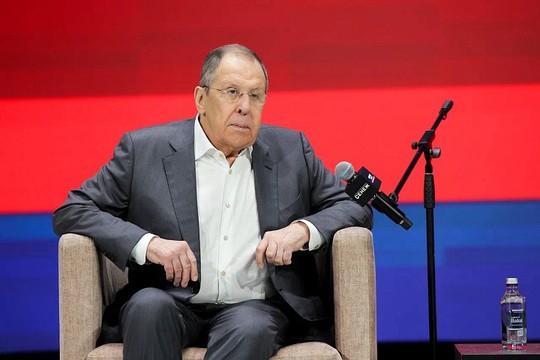
Photo: MFA
Foreign Minister Sergey Lavrov’s remarks and answers to questions at 11th Terra Scientia National Educational Youth Forum.
Solnechnogorsk, July 28, 2025
Colleagues,
It’s a pleasure to be back at the Terra Scientia forum. I enjoy engaging with young people who are the future of our country, the future that is taking shape, as we speak, on the battlefields of the special military operation, and elsewhere. I appreciate the opportunity to speak with the people who are doing their job there. Not long ago, I presented diplomas to graduates of a career development programme, Urban Infrastructure and Regional Development Management, run by MGIMO. Nineteen participants of the special military operation were among its graduates. I had the chance to talk with them.
I also took part in the events held as part of the Time of Heroes programme initiated by President Vladimir Putin. I can see how well our youth understand the importance of international engagement and the international dimensions of our country’s development in the current era.
Since the Soviet Union went into oblivion, new Russia’s foreign policy has always been based exclusively on its national interests. No lecturing, and no forcing ideologically-driven approaches on our neighbours or partners, either. We operate in strict compliance with our conceptual documents, the Constitution and the Foreign Policy Concept. The primary goal of our foreign policy is to ensure safe conditions for the country’s development and to raise the well-being of our citizens.
Many political scientists, academics, and experts seriously argue that a third world war is not just unavoidable, but is already underway in new forms, beginning with the West’s aggression against Yugoslavia in 1999 followed by aggression against Iraq, the destruction of Libya, and the attack on Syria. All these Middle Eastern countries are now in a state of turmoil. The territorial integrity of Iraq, Syria, and Libya – something the West seems to care about only in the case of Ukraine – was gravely undermined during the Arab Spring in 2011. These countries remain in a pretty bad shape.
Now, the West has turned to a neighbouring region, namely, the Gaza Strip and the Palestinian territories, more broadly. There has been an act of aggression against the Islamic Republic of Iran.
In Europe, the Ukraine issue represents the West’s policy of aiming to inflict a “strategic defeat” on Russia. They don’t hide the fact that they had been preparing for this for quite some time. With no shame, they are openly saying that the Minsk Agreements, which were designed to resolve all problems, were never meant to be implemented. President Putin, then-Chancellor Angela Merkel, then-French President François Hollande, and then-Ukrainian President Petr Poroshenko put in 17 hours without sleep working on those agreements. But afterwards, those very people who sat at one table with him admitted they never intended to implement anything. They just needed to “put something on paper” to buy Ukraine time for it to prepare for war with Russia, and to flood it with weapons. Those same people are now demanding that we immediately cease fire and leave things the way they are now, just so they can again buy time for their clients in Kiev and pump more weapons into Ukraine. The fact that Europeans genuinely seek to “defeat us” is confirmed daily. New German Chancellor Friedrich Merz recently stated (I’m not sure he understood what he was saying) that Germany must once again become the strongest military power in Europe. It was the strongest military power before World War I and before World War II and started both. Now, he wants Germany to become “Europe’s top military force” again. German Defence Minister Boris Pistorius stated that if necessary, Germans would not hesitate to kill Russian soldiers. European elites are taking this rhetoric as a given. This reflects, above all, the fact that the West cannot accept the fact of becoming just another strong region in a multipolar world. It cannot give up the hegemony it enjoyed for half a millennium. This is visible especially clearly in Europe today which wants to impose its will on everyone and ignore pragmatic concerns.
The other day, President Donald Trump met with European Commission President Ursula von der Leyen. Afterwards, she proudly and gleefully announced that they had reached an agreement under which European goods would be exported to the United States with a 15-percent tariff, while US goods would go to Europe duty-free. On top of that, Europe would spend $750 billion on buying American energy, primarily liquefied natural gas and nuclear fuel, completely abandoning Russian energy. Furthermore, as President Trump stated, there would be $600 billion in new investment. No doubt, US energy will be much more expensive than Russian. This approach will further de-industrialise Europe and re-direct investment from Europe to the United States. Sure enough, this decision packs a serious blow especially in terms of energy prices and capital flight affecting European industry and agriculture. But figures like Ursula von der Leyen are flaunting their decision to follow this course. They admit they’ll have to spend more, and that they’ll probably have fewer resources to address social issues, but claim they must defeat Russia.
As Brazilian President Luiz Inácio Lula da Silva recently said, former US President Joe Biden once said in a conversation with him that Russia must be “destroyed.” Not just strategically defeated, but destroyed. It’s about a war of annihilation. President Trump, though, holds a different view. As he’s repeatedly stated, he is guided by common sense, primarily business and policies that benefit the United States. I’m sure you are following his moves in international trade. The deal with Europe is clearly lopsided, and Europe got the short end of the stick. There’s no need to dive deep into that. President Trump is a pragmatist. He does not want wars. Unlike his predecessor Joe Biden and current European elites (von der Leyen, Starmer, Macron, and their ilk), he is open to dialogue.
Even during the Cold War, dialogue was there and helped opposing camps better understand each other’s intentions, first and foremost, to prevent a major war. Europe has lost that instinct, and the vaccine against Nazism has worn off. The same forces that once sought to destroy Russia are now re-emerging in Europe and have chosen Ukraine as a battering ram that they use against us. They welcome everything it is doing.
European Commissioner for EU Enlargement Marta Kos affirmed a month ago that Ukraine had satisfied all prerequisites to commence accession negotiations with the European Union. Has anyone heard even a whisper of criticism from Europe concerning Ukraine’s commitment to its human rights obligations? Language, education, media, culture – Russian has been legislatively proscribed across all these domains. Furthermore, these laws began to be enacted long before the special military operation. Europe maintains that Ukraine is fighting for “European values.” French President Emmanuel Macron recently asserted that, unlike Russia, Ukraine is waging war for “our” interests, for “our European values.” This is an admission that they are all Nazis. Nazism is being resuscitated in Ukrainian society including through legislation. Obstacles are being dismantled to glorify Stepan Bandera and Roman Shukhevich, who are equated with Adolf Hitler, Joseph Goebbels, and other war criminals, yet are now exalted as symbols of freedom.
We have consistently championed dialogue, even during the most challenging times. During the Cold War, dialogue between the Soviet Union and the United States was never severed.
It is also imperative to acknowledge that mutual respect existed during the Cold War. Today, it is absent. Europe has simply gone berserk (I can think of no other word). Much of this is, understandably, a struggle to retain power. They realise they have invested hundreds of billions of euros into Ukraine solely to strike Russia, kill our soldiers, orchestrate terrorist attacks against civilian infrastructure, and dispatch assassins to eliminate our politicians and journalists. Europe pursues this with one objective – to use Ukrainians as cannon fodder to eliminate Russia as a competitor. Even better – to provoke centrifugal tendencies within our society. They actively engage in this despite measures taken by our leadership to curb the activities of foreign NGOs and dubious media outlets promoting not the values of dialogue between our nations’ youth or civil societies, but unequivocally a Western agenda.
The dialogue we maintain with Donald Trump’s administration demonstrates that reasonable voices still exist in the West. They command significant support, as evidenced by recent developments in the United States.
President Vladimir Putin has repeatedly affirmed our openness to dialogue with any nation, including European ones. When President Emmanuel Macron called our President, he responded immediately. I do not want to divulge confidential details, but the conversation yielded little. Particularly because President Macron later publicly declared that pressure must be applied to Russia “to accept the immediate and unconditional ceasefire.” He has long espoused this view. When first questioned, he was asked whether arms supplies to Ukraine would then cease. He replied no, insisting any ceasefire must be unconditional. Therein lies the objective – just as the Minsk Agreements were meant to shake up the Nazi regime of Petr Poroshenko. Now, they seek a respite.
As I said, the West cannot accept the loss of its hegemony and continues to pursue purely neocolonial policies. Their sanctions regime exists to suppress competitors, fearing their unimpeded development, because emerging power centres have already outpaced them. Remove obstacles, and they will leave the West far behind. Yes, the West retains strength in military affairs, technology, biotech, and cyber domains. Yet it cannot merely be a significant player – it insists on supremacy. At the very least, this is the mentality of its current elites.
At the same time, a multipolar world is emerging – an objective and unstoppable process. No sanctions, trade wars, or provocations of open conflict can reverse it. Despite this, the West continues to pursue such tactics, following its actions in the Middle East, Ukraine, and Iran. Now, similar operations are being planned in the Far East, including the South China Sea, the Taiwan Strait, the East China Sea, and across Southeast and Northeast Asia, even the Korean Peninsula. All of this aligns with their broader goal: to preserve global dominance and maintain their status as the hegemon.
The rise of a multipolar world will ultimately prevail, despite efforts to delay the natural course of history. We are supported by a wide network of partners, allies, and like-minded nations. Among our closest allies in the West is the Republic of Belarus, while in the East, the Democratic People’s Republic of Korea stands out, bound to us by decades of fraternal and military ties. We supported our Korean neighbours in their struggle for independence, and in turn, they assisted us in liberating the Kursk Region from Ukrainian neo-Nazis. India also stands as a major and respected partner on the global stage.
India, China, Russia, Türkiye, and Iran are all ancient civilizations with deep historical roots spanning centuries. They have endured and evolved as cohesive civilizational communities – something rarely seen elsewhere in the world. However, on the Eurasian continent, this continuity remains a defining feature. Today, these great civilisations are playing a central role in shaping the emerging multipolar international order. In practice, this shift is being advanced through organisations like the SCO, BRICS, and in collaboration with partners from the African Union and CELAC, all of whom are actively contributing to this global transformation.
Interest in cooperation with BRICS and the SCO – already demonstrated by dozens of countries – continues to grow, contributing to the establishment of sustainable frameworks for the development of the Global Majority.
In contrast, the West still relies on institutions created after World War II, such as the IMF and the World Bank, often using them to reinforce its dominance. This includes exploiting the role of reserve currencies, especially the US dollar, and violating fundamental principles like fair competition and the presumption of innocence. In response, the Global Majority has, over the past several years, been working through platforms like BRICS, the SCO, and others to build alternative systems for financial transactions and banking settlements. New logistical routes are also being developed, independent of the outdated Western-centric rules established in the postwar period, when such systems were not yet so heavily abused. These emerging alternatives are widely welcomed.
Western counterparts are now creating conditions that are driving more and more countries to distance themselves from the systems under their control.
I cannot fail to mention our closest circle of partners. Our allies, like-minded states, and strategic partners from the CSTO, the CIS, and the EAEU – these are all major frameworks whose activities align with the formation of the Greater Eurasian Partnership. This includes structures across the post-Soviet space, the SCO, ASEAN, and many other promising actors. Incidentally, Eurasia is the only continent without a pan-continental organisation. Africa, despite its numerous sub-regional structures, has the African Union. Latin America, with its many integration blocs, has the Community of Latin American and Caribbean States. But Eurasia lacks such a mechanism.
When President Vladimir Putin proposed back in 2015 at the Russia-ASEAN summit that these sub-regional integration processes be harmonised – ensuring mutual reinforcement, eliminating redundancies, and ultimately shaping this Greater Eurasian Partnership – the idea emerged organically. This was no artificial initiative imposed from above. It is an objective necessity, one that meets the demands of mutual benefit, optimal resource efficiency, and maximising the advantages generated by these integrative processes.
In broader terms, this will form a solid material foundation for constructing a Eurasian security architecture. The current security frameworks – primarily those established in Europe after World War II, namely the OSCE and NATO – are rooted in the concept of Euro-Atlantic security. That is, they inherently require transatlantic colleagues. Of course, those wishing to cooperate with the United States or Canada remain free to do so. Yet why should there not be a pan-continental structure open to all continental nations? Especially now, when President Donald Trump shows little enthusiasm for maintaining America’s special role in Europe. He believes the continent should address its own challenges – whether security or economic development – on terms dictated by Washington to European Commission President Ursula von der Leyen. Thus, the Eurasian security architecture is knocking at the door. For the third consecutive year, Minsk hosted the International Conference on Eurasian Security (2023, 2024) where the Draft Charter on Diversity and Multipolarity in the 21st Century was reviewed. This document was prepared jointly with our Belarusian friends. Participation in the first two conferences demonstrated genuine interest, including from certain European Union states. I expect their numbers will grow. Therefore, we have much work ahead. The paramount task is to defeat the enemy. For the first time in history, Russia stands alone against the entire West. In World War I and World War II, we had allies. Today, we have none on the battlefield. Thus, we must rely on ourselves. There is no room for weakness or wavering.
President Vladimir Putin has delineated the objectives we are pursuing on the international stage – primarily in terms of combat engagement. These objectives will be realised. We underscore our legitimate demand: the assurance of our security. Firstly, there must be no inclusion of Ukraine in NATO – indeed, no further expansion of the alliance whatsoever (it has already, in defiance of all promises and agreed documents, expanded right up to our borders). Secondly, there persists the refrain: “Russia must return to the 1991 borders.” Yet, in 1991, when Ukraine was recognised as an independent state, its foundational principle was enshrined in its Declaration of Independence, which explicitly stated: “A non-aligned, nuclear-free, neutral state.” It was precisely on this basis that Ukraine’s territorial integrity was acknowledged. When they commenced the obliteration and eradication of everything Russian, we could not remain indifferent. We attempted persuasion and negotiations – it yielded nothing. Hence, there was no alternative but to initiate the special military operation.
Territory is not our priority. Some assert: “They seized land; it must be liberated.” These territories are not our concern – we already possess the largest country on earth. What is paramount is the populace who have dwelled there for centuries – custodians of Russian culture, language, and education – who aspire to nurture their children within that heritage. They must not be obliterated; their rights must be safeguarded. This is an entirely lawful demand. Recognising the realities codified in our Constitution is an absolute, non-negotiable imperative. We have much work ahead.
I trust that the meetings held here – both those we conduct and those you hold with my colleagues – will enhance your comprehension of the work undertaken by the foreign policy institutions of the Russian Federation. I hope the ranks of our diplomats will be bolstered, including by graduates of this Forum.
Question: I would like to revisit something you said in your 2018 remarks here at the Terra Scientia forum: that the formation of a multipolar world is a “positive” trend which “will bring more democracy and justice to international affairs.” True, the world has changed dramatically over the past seven years. With that in mind, my question is: do you still stand by your statement from seven years ago, or would you like to add – or perhaps correct – anything, given the real signs of an emerging multipolar world today?
Sergey Lavrov: Of course, I agree with my statement from seven years ago – though not, as you might assume, out of sheer self-centredness.
The multipolar world has indeed taken shape even more actively since then, and it is genuinely bringing more democracy and justice to international affairs – as opposed to the dictatorship and hegemony the West is striving to preserve. That said, the multipolar world’s formation faces enormous resistance. But, as you would know from your school physics class, the stronger the resistance, the steadier the motion. And that’s exactly what’s happening.
US President Donald Trump recently commented on BRICS’ activities in his typical disdainful manner, dismissing the group’s push for alternative currencies and warning them against creating a new BRICS currency or backing any other currency “to replace the mighty US dollar.” Yet this is not what he said during his election campaign – back then, Trump argued that Biden and his administration had severely damaged US interests by undermining global trust in the dollar, admitting that its decline was inevitable. Now, however, he is trying to halt that very process through threats and blackmail, common sense telling him how crucial the dollar’s dominance is for US financial stability.
I remember discussions on international monetary cooperation from years ago, when the US administration declared to the entire international community that the dollar was not America’s property, but humanity’s shared asset. It was hailed as the “lubricant” ensuring the global economy’s smooth operation, resilient in all weather conditions. Times have changed. Of course, other factors drive multipolarity too: the old system no longer serves the Global Majority’s interests. Initially, when the IMF, the World Bank, and the World Trade Organisation were established after WWII, most were willing to accept their rules – some reluctantly, recognising there was no alternative but to move forward collectively. China adopted those rules as well. Yet later, playing by those same rules written by the Americans, the Chinese began outperforming them on their home field. Why the anxiety? Because China has risen to undisputed leadership even within this very financial and monetary framework, within this trading system, and its growth across the economy and other spheres will only accelerate.
This is precisely why IMF reform has stalled. Given their actual economic weight, BRICS nations would have long since increased their voting shares, and the US would have lost its veto power. Yet reform is being artificially constrained to preserve America’s controlling stake, allowing it to unilaterally block moves toward democratisation of these institutions. The same pattern holds at the WTO. Washington simply paralysed the Appellate Body. Though China has filed thousands of complaints, the US prevents quorum formation, effectively disabling this crucial dispute mechanism.
Artificial constraints may delay development temporarily, but never permanently. It might take longer. A multipolar world’s formation might span an entire era. Yet the trend remains objectively inevitable.
Question: What crises of the global security system do you envision on the horizon of 10 years?
Sergey Lavrov: I have partly touched on this issue in my earlier remarks. There are real security problems, not just threats, around Ukraine. We are fighting for our security, for our legitimate security interests, and we will attain our objectives. Elsewhere, crises persist in neighbouring regions: the Middle East, Palestine, and Iran; the conflict in Syria is far from over yet, nor in Libya or Iraq.
There are security problems in the West as well. First, the Americans make no secret of their desire to extend their forceful influence to the Asia-Pacific region – one they deliberately rebrand as the “Indo-Pacific” region, hoping to draw in our Indian friends and keep them content. In reality, however, all these “Indo-Pacific” strategies aim to contain China, isolate Russia, and dismantle open, universal formats of cooperation – such as ASEAN-centric frameworks in Southeast Asia – while advancing NATO’s military infrastructure toward the Far East: the South China Sea, the Taiwan Strait, the Korean Peninsula.
They have created various “quartets” and “trios.” The US-Japan-South Korea trio, for instance, is already planning increasingly large-scale military exercises around the Korean Peninsula, targeting the DPRK. These drills now even include nuclear weapons scenarios between US and South Korean forces – an alarming development. The same goes for AUKUS (the US-UK-Australia trio), effectively formed to build nuclear submarines for Australia and also enabling the transfer of nuclear technology. Serious doubts remain about whether these actions comply with the Treaty on the Non-Proliferation of Nuclear Weapons.
Many problems are surfacing – including NATO’s efforts to penetrate this region (Japan, for instance, is reportedly poised to open a representative office for the alliance). Tellingly, when then-NATO Secretary General Jens Stoltenberg was asked at a news conference how the North Atlantic Alliance – a bloc initially created and subsequently presented as a defensive organisation, with its core mission being the physical protection of member states’ territory – ended up expanding eastward, well beyond its borders, he replied without hesitation that they remain focused exclusively on protecting member states’ territories. However, he argued that in current conditions, threats to these territories were coming from the “Indo-Pacific” region (the South China Sea, etc.).
That was an indicative statement, reflecting the alliance’s evolving mentality – one that seeks new purpose and meaning for its continued existence. We have found purpose and meaning in this territory, while they are still trying to justify why the North Atlantic Alliance should continue to exist. There are many threats ahead, and this decade will not be an easy one.
Question: Mr Lavrov, may I shake your hand and take a photo with you? It’s my dream. Moreover, it’s the dream of my grandmother, who told me not to come home without a photo with you.
Sergey Lavrov: I wish I had the chance to meet your grandmother when we were young. You’re welcome if your colleagues let you do so - not now, but when we’re finished.
Question: Which programmes, do you think, are most effective for promoting Russian values and traditions abroad?
Sergey Lavrov: Participating in universal sports and cultural events has always been our preferred choice. Unfortunately, we’re facing wholly unacceptable discrimination – I’m at a loss to find a good word to describe it - against our athletes and our culture.
A tour by Valery Gergiev with soloists from the Mariinsky Theatre was cancelled not long ago in Italy. It’s outrageous. Italy, the cradle of culture, has also come under the influence of Ukrainian neo-Nazis. There are still people in the Italian leadership and at the UN who, like Germany, vote against the resolution, Combatting glorification of Nazism, neo-Nazism and other practices that contribute to fuelling contemporary forms of racism, racial discrimination, xenophobia and related intolerance. Germany, Italy, and Japan vote against it.
We are absolutely doing the right thing when we insist on returning to the roots of the original international Olympic movement, and to the principles of developing cultural, educational, and academic cooperation enshrined in the foundational documents of UNESCO, which are being grossly violated. The fact that our fencers are winning gold and other medals in Georgia is already a sign of recovery among the officials who manage international sports.
We are developing alternative platforms as well. In 2024, we held the BRICS Games. Of course, we are promoting our innovation - Games of the Future and the phygital movement, a mix of physical and digital sport. That is, a team plays basketball on the court, and then the same players play basketball on a computer. This will be an annual event.
We weren’t too upset about being excluded from Eurovision, which has become a promotional platform for non-traditional values that we find unacceptable. This September, near Moscow, in Live Arena, we’ll be holding the first international Intervision song contest. Almost all BRICS countries and their partners – about 20 countries in all – have confirmed their participation.
We never shun universal forms of cooperation. However, we won’t just sit back and do nothing when someone is denying us access on fair and generally acceptable terms. Just like sanctions, this reveals the West’s underlying desire - and that of those involved in such actions - to suppress competition in trade, investment, energy markets, sports, and arts. This obsession with preserving and maintaining hegemony manifests itself in all of the above. To reiterate, we are building frameworks that support the development of our sports and arts in all forms.
Question: Where does the line between the trend for globalisation and the preservation of national sovereignty run? How do you avoid going from one extreme to another? How do you maintain the balance?
Sergey Lavrov: I believe a truly multipolar world is only possible when the countries, first, respect their own sovereignty and, second, ensure that others respect it as well. I see no contradiction here.
Take BRICS, for example. Not one member country has compromised its sovereignty. All decisions are made exclusively by consensus. Indeed, forming a consensus is much harder than simply holding a vote, as the European Union is trying to do now. Instead of taking into account the interests of Hungary, Slovakia, and a number of other countries that disagree with many actions of the Eurocrats who, unlike national governments, are not elected officials, the European Commission came up with the idea of the qualified majority voting. In other words, they’ll vote, and those willing to uphold their national interests and sovereignty will simply have decisions forced on them.
Rest assured that nothing like that will ever happen in associations like BRICS, the SCO, or the EAEU, the CIS, the CSTO, or in any other association with our participation. In fact, I see that the preservation, strengthening, and mutual respect for sovereignty by the country and its partners as the most important unifying factor for a multipolar world.
Question: At the autumn Znanie. The First marathon, Sports Minister Mikhail Degtyarev talked about strong pressure coming hard on Russian sports. He shared that Hungary has a whole department of sports diplomacy, aimed precisely at building relations with other countries through sport. History has many examples of how sports aka ping-pong diplomacy and many others help foster international relations. Are there any plans to create such a department in Russia?
Sergey Lavrov: Within the Ministry of Sport?
Question: No, within the Foreign Ministry.
Sergey Lavrov: The Ministry already has a division headed by an Ambassador-at-Large - the Minister’s Special Representative for International Sports Cooperation. The Foreign Ministry has engaged in this area for decades.
I’ve discussed this with Mikhail Degtyarev. The Ministry of Sport has extensive international ties. The current minister enjoys international engagement. They have people working on this. We work in close coordination and are ready to support them and align our efforts.
Question: What was the motivating factor in your challenging journey in the Foreign Ministry and prior to that? What advice would you impart to young people today who aspire to pursue a career in international relations?
Sergey Lavrov: You should enrol at MGIMO.
In reality, our recruits are not exclusively from MGIMO. Each year, we enlist young men and women from Lomonosov Moscow State University, St Petersburg State University, the Far Eastern Federal University, and the Higher School of Economics.
However, the overwhelming majority are MGIMO graduates. After all, its programmes are specifically designed to prepare personnel for the Ministry. When applying for a position, candidates must undergo assessments.
What influenced my career choice? I have spoken about this previously – it is no great secret. Upon finishing school, I received a silver medal. Though, to be candid, I had to retake biology to achieve it. Initially, I received a “C” in biology. My teachers and the school principal wanted me to have the medal, so I retook it and secured a “B.” That was sufficient for the silver medal.
We had an exceptional form instructor, Sergey Kuznetsov, who taught physics and mathematics. He took us on hiking trips and long journeys during holidays. We were very fond of him. I suppose it was partly due to the affection he inspired that he influenced me.
I intended to enrol at MEPhI. My late mother worked at the Ministry of Foreign Trade and said to me, “Well, MEPhI and other universities commence their entrance exams on August 1, but MGIMO begins on July 1. Why not give it a try?” I knew English – I had studied it. With my medal, I only had to sit two exams – history and English – on July 1 and 3. I scored two “A”s. I genuinely still intended to take MEPhI’s exams. But when I returned to my school to collect some documents and saw my classmates, all stressed and running around, I thought, “Fine.” Thus, in a way, it was almost accidental. But I have no regrets.
Question: What opportunities in international relations do you consider most promising for young people today?
Sergey Lavrov: The world is their oyster. There are endless possibilities. The question is, how should aspiring individuals seeking to make their mark on the international stage proceed, correct?
Question: What path would you advise them to take, and what should they avoid altogether?
Sergey Lavrov: They must endeavour. It is difficult to prescribe. Every individual is unique. The methods of self-education and self-improvement that work perfectly for one may not suit another.
There are international faculties – not solely at MGIMO, naturally, but at most universities. If someone is interested in foreign policy or international collaboration (which is not confined to foreign policy – it could mean economic or trade cooperation), they should enrol in relevant faculties and review each programme’s curriculum. I cannot offer anything more specific than that.
Question: Our President once said that, unfortunately, there was no one to talk to on the international arena after the passing of Mahatma Gandhi. This became a catch-phrase. Is there any person in the world today, with whom you could speak and engage in dialogue?
Sergey Lavrov: What do you mean, contrary to the fact that we have, kind of, been isolated or…
Question: Yes, rational dialogue.
Sergey Lavrov: Do you want to say that reasonable people are still exist?
Indeed, the President uttered this phrase at a time when it had already become clear what global strategic goals the West was pursuing in relations with the Russian Federation.
Of course, the President has many interlocutors. He maintains international contacts virtually every day. I have already mentioned Belarus, the Democratic People’s Republic of Korea and China. We have unprecedentedly profound, broad, trust-based and strategic relations with the People’s Republic of China.
President of the People’s Republic of China Xi Jinping visited Russia and took part in festivities marking the 80th anniversary of Victory. In early September, President Vladimir Putin will go to China, at the invitation of President Xi Jinping, to celebrate the 80th anniversary of defeating Japanese militarism. These important events have major significance in the context of preserving historical memory and preventing the West and Japan from successfully erasing the memory of those years.
I can go on forever listing leaders who regularly work with President Vladimir Putin within the framework of BRICS and the SCO and also on post-Soviet territory.
I never shy away from contacts, but I never impose myself on anyone. I meet regularly with the foreign ministers of Hungary and Slovakia. The Swiss Foreign Minister also requests a contact time and again. I never refuse them. In December 2024, former Austrian Foreign Minister Alexander Schallenberg requested a conversation during the OSCE Ministerial Meeting on Malta. He did not want to speak with me in front of the cameras, and asked me to go out for a smoke. We went out and talked to each other.
President Vladimir Putin never turns down offers and requests to meet and talk. Nor do I see any point in avoiding anyone. It is a different matter when they are avoiding you, boycotting and walking out when you are speaking. Let them do as they please. One fine day, they will do away with their follies. But things will never be the same when they are done with this, and when they express a desire to deal with us once again.
We now know what their words are really worth. “Thought expressed is a lie,” and anything they promised us is also a lie. This is what happened to the Minsk agreements, and a similar situation shaped up on the eve of the coup d’etat in Kiev in February 2014. At that time, then President Viktor Yanukovych and the opposition signed an agreement on calmly preparing for the early election. France, Germany and Poland signed this document and acted as its guarantors. The very next morning these signatures were tossed into the dustbin, and the opposition seized all government buildings.
In April 2022, bilateral talks were launched in Istanbul soon after the beginning of the special military operation. At that time, our negotiators agreed with principles for resolving the conflict that were suggested by the Ukrainian delegation. Later, they were told that they have not achieved much so far and therefore should continue fighting and weakening Russia.
When they (I am confident, not if but when) they come to their senses and suggest that we resume relations, our approach to building these relations in the future will be more rigorous.
Question: Following the global shifts of the past, we are witnessing a crisis of global international security, communication and law and order infrastructure. They no longer inspire confidence. Many countries have withdrawn from these structures. It appears that we are taking a step back. What do you think on this score? Do we need new structures? If so, what should they be like?
Sergey Lavrov: I have spoken on this issue in my statement. Of course, the UN has been put to test, primarily because of the West’s actions, which has actually taken over the governing elements of the UN Secretariat. The positions of the UN Secretary-General, the Under-Secretary-General for Political and Peacebuilding Affairs, Under-Secretary-General for Humanitarian Affairs and Emergency Relief and the Under-Secretary-General for Safety and Security are held by citizens of NATO countries.
UN Secretary-General Antonio Guterres has initiated a reform. He has published a UN80 Initiative. I will not cite from that document, but it essentially stipulates restricting the ability of UN member states to influence the activities of the Organisation and its Secretariat and expanding the powers of the Secretariat in the spheres that have always been matters of intergovernmental coordination.
This is being done under the pretext that coordination takes too long, whereas such matters call for immediate action. This is yet another example of how the West is using its “proteges” in the secretariats of international organisations to promote solutions that benefit the West.
The Council of Europe, from which we have withdrawn, is in a deep crisis. Instead of developing a universal legal framework for humanitarian cooperation, it has thrown its energy into illegal efforts to establish “tribunals” against Russia, and commissions to assess the damage inflicted on Ukraine. This is regrettable. It used to be a good organisation.
The OSCE is in a deep crisis as well. Its current secretary general, a citizen of Türkiye and a former diplomat, has been trying to act within his powers in strict compliance with the principles of neutrality and impartiality. His predecessors grossly violated their powers and neglected the requirements of the OSCE’s statutory documents. The countries that held the rotating OSCE Chairpersonship acted in the same manner.
This position is currently held by Finland. The Helsinki Final Act, signed 50 years ago in 1975, led to the establishment of the Conference on Security and Cooperation in Europe (CSCE), which was later renamed the Organisation for Security and Cooperation in Europe (OSCE). It was not a simple process either.
I have already mentioned organisations that are based on the principle of equality – BRICS, the SCO, the CIS, the CSTO and the EAEU, including in relations with African colleagues. Incidentally, we will hold a second Ministerial Conference of the Russia-Africa Partnership Forum and the first Russia-Arab World summit this autumn. We and our partners are comfortable with these formats.
Another place where we sit down at the same table with the West, apart from the UN, is the Group of Twenty (G20). It includes the G7 and the expanded BRICS and like-minded countries. A look at the balance in the G20 shows that it is equally divided between the G7 and their allies and BRICS and its allies – ten countries each. The G20 operates on the principle of consensus, which cannot be violated, and it is therefore a platform which can be used to bring the West to its senses. We have been trying to do this.
The West’s attempt to “Ukrainise” the G20 agenda fell through three years ago. Everyone supported our view that the G20 was not created to deal with political matters, which is the prerogative of the UN Security Council.
We still regard the UN as a crucial structure. If you look at the UN Charter, there is nothing that should be changed in it, including to suit the concept of multipolarity. The Charter includes the principle of sovereign equality of states, and the principle of equality and self-determination of nations. There is also the principle of territorial integrity.
The UN General Assembly later elaborated that the principle of territorial integrity applies to states whose governments respect the right of nations to self-determination and therefore represent all people residing in its territory. Did those who seized power as a result of the state coup in Kiev represent the people of Crimea, Donbass and Novorossiya? Definitely not.
All this has been set out in the fundamental documents. The West has recognised the independence of Kosovo even though no referendum was held there, explaining this by the right of nations to self-determination. However, when a referendum was held six years later in Crimea, where people wanted protection from the Nazis who had sent armed militants to seize the building of the Supreme Council of Crimea in Simferopol, the West did not regard this as their right to self-determination but insisted on respect for the principle of territorial integrity. According to a saying, the law is like an axle – you can turn it whichever way you please, if you give it plenty of grease. That is exactly what they are doing with international law.
The requirements of the UN Charter must also be respected at the UN. Choosing to respect one principle today and another tomorrow is unacceptable. All principles must be respected in their entirety and as a whole. We will continue working towards this end, even though resistance is strong.
Question: How do you estimate Russia’s role in shaping new global security architecture? What can be done to compel others to respect our country’s interests?
Sergey Lavrov: I thought I tried to answer this question earlier.
First, it is necessary to defend the constituent principles at organisations that we regard as still viable.
I have just mentioned the UN and the strong assault on the rules of procedure and principles of the Charter. We have many allies in this area and their number is growing. In 2021, Venezuela came up with the initiative to establish the Group of Friends in Defence of the UN Charter. This 20-country Group regularly approves statements. There are other states willing to join this process. It regularly adopts statements (several statements on vital issues per year).
A statement was made not so long ago, and later we had it accepted as a UN General Assembly resolution. It has become a UN document on curtailing the modern practices of colonialism. This is a most important issue because seemingly these things happened so long ago. The decolonisation of Africa took place in the 1960s and the 1970s. Africa gained political independence but inherited borders that the colonial powers had drawn using a rule and cutting in two areas inhabited by one and the same ethnic group. This gives rise to periodic clashes, like the Burundi-Rwanda confrontation 30 years ago and the current stand-off between Mali and Algeria. One and the same ethnic group, the Tuareg, live on both sides of the border. This breeds contradictions and differences. But the most important thing is that the African Union is unwilling to change the lay of the borders, even though it has gained political independence along with these territorial problems. And this is the right thing to do. Consensus is the word.
But Africa failed to gain economic independence. I was on many business tours. For example, I visited South Africa. When the special military operation began, fuelling my plane emerged as a problem, because companies in charge of the fuelling business were either UK or US. We had much difficulty to come to terms with someone at an air force base. In any case, our South African friends would have done anything that was needed. This is an important sign. While hosting international events, sovereign states cannot guarantee to the association members they have invited that all technical and logistical hurdles will be properly addressed.
The current “second Africa revival wave” is about the economy. Our relations with the African Union have made much headway in recent years. In 2019, there was the first Russia-Africa Summit, followed by the second one in 2023. Right now, we are preparing a third summit. It will take place in Africa. In 2024, meanwhile, we held the First Ministerial Conference of the Russia-Africa Partnership Forum. The second one is being planned later this year.
We should keep universal structures like the UN in tone and urge everyone to respect the principles it has been founded on. In parallel, we ought to develop the centres of the upcoming multipolar world. I am referring to the SCO, the EAEU, the CIS, the CSTO, and all other associations in Eurasia, plus BRICS at the global level. This is a strong movement.
The West will end up nowhere if it fails to become a major and strong centre of power and rather seeks to retain its full hegemony.
Question: You are a diplomat with a “human face.” Weaknesses are not alien to you and occasionally you can swear, using “strong words.” We love you for that as we do this “real thing” in you. My question in this connection is: How do you manage to remain human, considering your hermetic, conservative surroundings?
Sergey Lavrov: I did not know that a “strong word” was a sign of weakness. Perceived this way, it is a touch of nature, not weakness.
Any profession, if it lacks humour, cannot really thrill you. This refers to diplomacy more than to many other occupations. It often plays a positive role, if you have a chance to quip during a conversation or egg on a partner (provided you know him or her well and can predict their reactions).
President of Russia Vladimir Putin has a strong intuition which he displays while talking to his counterparts. This is one of the key things in diplomacy. You can gain much knowledge but the art of being on the same wave length with other people is largely inborn. Nevertheless, all of us should practice it under all circumstances.
For example, I used to mess around with other children in the yard when a boy. There was also an overage bully three or four years older than the rest, who would come and start ordering smaller boys around. This is roughly the same the West is doing now with regard to all others. People have just come for air to the yard, so leave them alone. But no, it’s in them to come and distort 15 kopecks or something else from everyone. Therefore, I like humour being present everywhere.
Question: Please tell us in confidence what you said at the BRICS Summit in Kazan, when someone stepped on your toes.
Sergey Lavrov: There are many different inventions. A beautiful girl passed by. She stepped on my foot. I decided that she was making passes at me and said that I would soon go out for a smoke.
read more in our Telegram-channel https://t.me/The_International_Affairs

















