
 РУССКИЙ
 13:17 11.02.2026 •
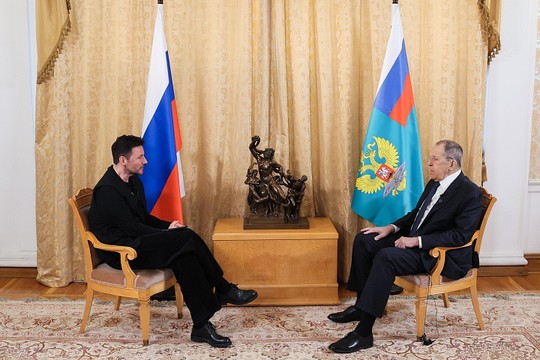
Photo: MFA
Russian Foreign Minister Sergey Lavrov’s interview with the Empatia Manuchi online project
Moscow, February 11, 2026
Question: Mr Lavrov, good afternoon. We are honoured to have you as a guest on our programme. This is a great privilege and a pleasure for us and for our viewers.
We are currently seeing a new stage in the negotiations on Ukraine. What gives you, personally, hope today? Will these talks ultimately achieve any result?
Sergey Lavrov: Hope comes only from your own truth and from the actions you take in real life to ensure that truth prevails. Our position is not subject to opportunism, twists, or contortions.
President of Russia Vladimir Putin has clearly defined the goals of the special military operation. He reaffirmed them on multiple occasions, including here at the Foreign Ministry in June 2024 – in the most detailed terms. These goals remain unchanged and are not open to opportunistic compromise.
Compromise is always possible when states (even two states) negotiate. We are always prepared to compromise, or more simply, to balance interests. The crucial point is that the legitimate interests of each state must be taken into account.
Our legitimate interest is to ensure our own security. Like any normal country, we are concerned that our history should continue, that our people should develop under the most favourable external conditions possible, and that we secure economic growth, resolve social issues, and improve the population’s wellbeing.
This is exactly the kind of environment that was promised to our state on multiple occasions. It was promised verbally when guarantees were given to the Soviet Union – they swore that NATO would not expand eastward. It was promised in writing within the OSCE framework at the Istanbul summit in 1999 and again at the Astana summit in 2010. It was clearly stated that security is indivisible, that each country has the right to choose its own security arrangements, but that no steps may be taken which strengthen one country’s security at the expense of another’s. This applied to OSCE countries. It went even further: no country, group of countries, or organisation in the Euro-Atlantic space has the right to claim dominance.
Consider these lofty principles, unanimously endorsed at the highest level, and compare them with what the North Atlantic Alliance actually did throughout the period in question – the 1990s and early 2000s. The opposite occurred. NATO did not merely try to dominate; it did everything possible to translate that dominance into practical action.
In expanding the North Atlantic Alliance, Western leaders gave assurances to Russia that this was not directed against our interests. We have, however, witnessed repeated violations not only of written declarations but also of formal agreements.
For instance, within the OSCE framework, there was an understanding – duly recorded in official documents – that upon the accession of new Eastern European members to NATO, no substantial combat forces would be deployed on those territories. During that era of hopeful aspirations for constructive collaboration, understanding, and mutual respect, we endorsed this principle – no NATO members would station substantial combat forces on the territory of new allies.
Subsequently, we observed military exercises being conducted: one, then another. We raised the question of how this aligned with the agreement. The response was that these constituted “insubstantial” combat forces. We therefore proposed formalising a mutual understanding by defining precisely what constituted “substantial combat forces” in terms of troop numbers, armaments, hardware, and so forth. The reply, offered without compunction, was that such definitions would tie their hands.
It is illusory to believe security can be safeguarded by relying on promises from those who currently govern the international order, or their predecessors. The West once possessed leaders of gravitas, yet even they proved incapable of honouring their pledged word or imbuing their own signatures on documents with substantive meaning.
Thus, for us, security is non-negotiable. Just as human rights – ostensibly so dear to the West – must be inviolable. In Ukraine, we witness the comprehensive prohibition of the Russian language across all spheres of public life and the banning of the canonical Ukrainian Orthodox Church. These matters remain wholly absent from the West’s – from Europe’s, and certainly from Britain’s – deliberations on pathways to peace.
The administration of US President Donald Trump made one such attempt through documents circulated in various iterations following the Alaska meeting in the final quarter of 2025. We saw only one version – or rather, the Americans formally submitted their draft to us. All subsequent versions reflected attempts by Vladimir Zelensky and, principally, his patrons in Britain, Germany, France, and the Baltic states to undermine this American initiative.
The American proposals stipulated the restoration of rights for Russian-speakers and ethnic Russians as a national minority – though the term “national minority” scarcely applies to Ukraine’s Russian population. Nevertheless, this provision was in their draft. In the final versions leaked to the press after intensive negotiations between American, European, and Ukrainian representatives post-Alaska, all such references had vanished. Instead, the text spoke vaguely of “mutual tolerance” between the parties (Russia and Ukraine) – a veritable “tolerance accord.” Ukraine would merely adhere to EU norms in this domain: tolerance, and so forth.
Question: Without being part of the European Union?
Sergey Lavrov: Ukraine is pledging to adhere to these norms. Yet, the question arises: what does the European Union have to do with this? And why does the EU presume to assert a dominant role in defining human rights?
There exists the UN Charter – ratified without exception by all member states. It explicitly obliges every nation to uphold human rights without distinction as to race, sex, language, or religion. In Ukraine, this very provision concerning language and religion has been trampled upon. So, too, has the country’s own Constitution – which, paradoxically, still contains a solemn pledge by the state to guarantee educational and other rights for Russian (specifically singled out) and other national minorities.
Despite these constitutional guarantees, over the past decade Ukraine has adopted dozens of laws – their passage began long before the special military operation – designed to eradicate the Russian language from every sphere of public life.
I have repeatedly cited this example in interviews and negotiations: Ukraine stands as the only country where an entire language has been outlawed. In no other conflict do opposing parties ban each other’s languages. Examine the Arab-Israeli conflict, or any other – language and human rights are never targeted. Thus, when Vladimir Zelensky claims he cannot even discuss territorial issues due to constitutional restrictions… He disregards that very Constitution. Under its provisions, he is obliged to repeal all these Neanderthal laws annihilating the Russian language and the canonical Orthodox Church.
It is with these positions that our delegation once again attended the latest round of negotiations, which commenced in Abu Dhabi on February 4 and continued on February 5. We have not altered our stance. Some urge us to demonstrate readiness for compromise.
Listen: compromise cannot extend to fundamental principles upon which a state’s existence depends – least of all when the lives of millions hang in the balance.
During this second round of talks in Abu Dhabi (February 4–5), as after January’s initial session, we maintain a diplomatic silence – as befits serious negotiators focused on results. Public commentary at every turn serves only to sabotage discussions or, which amounts to the same, to shift blame for intransigence onto one’s counterpart.
What does Vladimir Zelensky say? I will not dwell on his directive to the AFU to incapacitate 50,000 Russian soldiers monthly – such is his “peace-making.” Most recently, he declared Ukraine’s ostensible readiness for compromise, provided Russia reciprocates. What reply does this merit?
Another critical matter: Alaska. We consistently remind the public that in Alaska, we struck a balance between Russia’s vital interests – including those of Russians living in the liberated territories – and the United States, which at that time genuinely sought crisis resolution. Unlike other Western nations, Washington acknowledged the conflict’s root causes regarding human rights, recognised the indefensibility of persecuting those who rejected the coup’s outcome (where this all began), and conceded that Ukraine must never join NATO.
Now, Vladimir Zelensky and his handlers in London, Paris, Brussels, and Berlin attempt to reinterpret these understandings to their advantage.
Question: Was this formally recorded? Do signed documents exist from the Anchorage meetings?
Sergey Lavrov: Prior to Anchorage, we received a draft document when US Special Presidential Envoy Steve Witkoff visited Moscow to prepare the summit. This text outlined all fundamental principles and proposed resolving outstanding issues – including those stemming from actions we undertook to protect Russians from the Nazi regime’s campaign to eradicate all ties to the Russian language, culture, history, and Orthodoxy – strictly in accordance with realities on the ground.
In Anchorage, we developed approaches building upon the American initiative and proposals, which charted a viable path to peace. That framework made it entirely feasible to swiftly finalise a comprehensive settlement agreement.
Question: What is the main obstacle at this stage, given that the documents exist and all the necessary elements are in place?
Sergey Lavrov: This document has already gone through several rounds of review. At present, however, they are referring to a twenty-point “document” that has never been officially or unofficially shared with us. Only fragments of it have appeared in the media. I have already pointed out how they have reinterpreted the principle of fully guaranteeing the rights of Russians and Russian-speaking citizens in Ukraine.
Previously, Vladimir Zelensky stated that he would not concede a single inch of territory, citing constitutional restrictions. More recently, however, he clarified that this position applies only to the line of contact, indicating that he does not intend to withdraw his terrorist Ukrainian forces from the areas of Donbass where they remain and from which they would eventually be forced out. He has also said that Ukraine could accept a territorial arrangement that would bring the conflict to an end, but only on a de facto basis, not a legal one. According to him, these territories would still be considered Ukrainian, and the war for them would continue. To support this approach, he has called for security guarantees, including the deployment of British and French troops, with the United States providing intelligence support, weapons, and ammunition. In essence, Vladimir Zelensky is proposing a halt to hostilities without recognising these territories as belonging to Russia.
The people in the referendum have expressed that they do not want to live under a government that came to power through a coup and labels them – Russians – as “creatures” and terrorists. Meanwhile, the Kiev regime claims that, while waiting, European forces should be brought onto Ukrainian territory and equipped with long-range missiles capable of reaching Russian cities. Only then, they say, would a ceasefire be declared. Finland, the United Kingdom, and Germany are all backing this approach.
Very few measured voices in Europe are calling for a serious approach to resolving the conflict. The goal should not be to satisfy this “man without a tie,” allow him to cling to power, or continue performing on the international stage. Instead, it should be about creating a new security architecture in Europe and ensuring lasting peace – taking into account not only the legitimate interests of the Ukrainian people (which are far from represented by Zelensky’s clique) but also Russia’s well-known interests, which have been consistently violated over the past twelve years, starting with the coup d’état that promised something entirely different. Recall the Minsk agreements, approved by the UN Security Council, which were effectively ignored by Germany, France, and others. They publicly made it clear that they had no intention of enforcing the agreements and instead focused on supplying neo-Nazi groups with weapons to more effectively target the Russian Federation.
In April 2022, in Istanbul, the Ukrainians themselves presented a draft document outlining security guarantees. The proposal envisioned the five permanent members of the UN Security Council acting as guarantors – that is, not only the West, but also Russia and China. Germany was also included, understandably, as one of the Kiev regime’s most active sponsors, a role they openly take pride in. It seems that their historical Nazi legacy influenced this approach, and Vladimir Zelensky was seen as the figure to carry these traditions into the present. The proposal also aimed to include Türkiye in the list of security guarantors. All decisions by the guarantors were to be made by consensus. This was the arrangement the Ukrainians proposed, and we agreed. However, the West forbade Vladimir Zelensky from signing it, even though the document had already been initialled.
Today, when they speak of security guarantees, they mean guarantees not with Russia, but against Russia. I repeat: the Kiev regime insists it will not recognise anything de jure, yet claims it is willing to halt hostilities de facto – but only if Europeans provide ironclad security guarantees, ratified by their parliaments, and deploy troops. According to the Financial Times, these guarantees include provisions for the automatic initiation of war against the Russian Federation, using all NATO forces stationed in the region, with direct support from the United States. Any incident deemed unacceptable would supposedly serve as a trigger for such a war. And the capacity of Zelensky and his clowns to provoke such incidents is beyond comprehension.
Question: You have seen many people in positions of power, I mean Vladimir Zelensky and the current European political scene. What human vice most often leads to a country’s downfall?
Sergey Lavrov: Probably the vice that knows no boundaries.
One that directly, concretely, and gravely harms the interests of the people. As commonplace as it may sound, it is the cult of personality. It can be a vice when leaders’ primary concern becomes enriching themselves, preserving a carefully cultivated exalted image, clinging to power, giving out comfortable positions to their associates, establishing shadowy business arrangements, or retreating to private islands (like, I don’t know, Jeffrey Epstein).
Many examples of such regimes have left their mark. The phenomenon of personality cults is now being reconsidered even in the West, where it is increasingly described in terms such as “authoritarian rule” or “new authoritarianism.”
The latest issue of the American magazine Foreign Affairs reflects upon this subject: why some argue that firm leadership, whose actions embody societal needs and can chart a path for economic, social, spiritual, and cultural development, may be required in the circumstances humanity currently faces.
Many analysts agree that such a model has proven to be more effective than liberal democratic systems. In the United States, elections occur every two years; in the United Kingdom, they occur whenever they want, when the prevailing public opinion must be exploited to push someone out or, on the opposite, bring someone into the fold of the ruling elite. There are countless examples when people in the United Kingdom vote for a party without any elections; and this party may appoint whoever they see fit. In recent years, all such experiments have failed.
I recall my conversation with then–US President George W. Bush during his bilateral visit to Sochi after the Russia–NATO summit in Bucharest in the spring of 2008. There was a moment when President Vladimir Putin was engaged on a phone call, and I spoke with President Bush. He was standing in the old Sochi residence looking out at the Black Sea. That year, he had the election ahead of him, and he remarked, somewhat wistfully, on how easy and predictable everything here was: in a system with a long horizon of authority, allowing planning without constant adjustment to some domestic incident somewhere in Minneapolis or Ohio, when the entire running campaign has to be redesigned to accommodate this specific, isolated incident, which has nothing to do with the development strategy of the United States, or any major international issue.
Many of my colleagues who served as secretaries of state admitted to me that electoral cycles – presidential campaigns every four years, parliamentary contests in between – often require foreign policy decisions to be aligned with domestic political calendars, so that their opponents could not accuse them of failure, while simultaneously aligning their foreign actions so they can be “sold” at home. They must look strong in handling those situations. This dynamic is clearly visible today. Power is something that must fall into the right hands.
Question: How did you manage to maintain trust over these decades? Has your ability to trust people evolved (by the way, in reference to the Minsk Agreements)?
Sergey Lavrov: It was a disappointment. We understood it well enough that they, as we say it in Russia, were goofing off. Well after 2015, when the resolution approving the Minsk Agreements was adopted and the signatures were added, it was necessary to cease fire and provide for an economic interaction, stop the blockade of Crimea and the regions that declared themselves Donetsk and Lugansk people’s republics. There were quite a lot of issues there.
Question: At the time of the signing, was everyone unaware that we would be deceived, or did we understand that it was a fraud?
Sergey Lavrov: We hoped that in the end of the 17th hour of our night talks in the Minsk presidential palace the feeling that the exhausting negotiation hours were not a waste of time would still make our partners in that document somehow influence the situation. Nothing of the kind. We lamented this during our contacts with them.
In 2019, President of France Emmanuel Macron decided to make his own contribution. In December 2019, he invited the Normandy Four (Chancellor of Germany Angela Merkel, President of France Emmanuel Macron, President of Russia Vladimir Putin and President of Ukraine Vladimir Zelensky) to Paris. Our President patiently (as he can do it) asked, why what was written here has not been done? In response we got nothing but excuses. Crooks!
Nevertheless, it was recorded in Paris (while Macron was in office, so he will not be able to shirk this responsibility), that it was necessary to fulfill the Minsk Agreements, including to amend the Constitution of Ukraine consolidating the special status of the Donetsk and Lugansk republics forever. It was recorded. Nothing of this was done. We saw that they were fooling everyone, primarily us. After retirement, not only François Hollande, the then President of France, but also Angela Merkel, the former Federal Chancellor openly stated that they had not been going to fulfill anything.
Question: After so many years at the Ministry, has your feeling – your desire to trust people – changed?
Sergey Lavrov: The desire to trust is always there. The willingness to trust is a slightly different matter. And the act of actually placing trust in someone is a third thing entirely.
I have formed my own understanding of the partners I work with, many of whom have revealed their true colours since the start of the special military operation. The behaviour of many, including those from once-neutral countries, makes you question how sincere their predecessors, the leaders of those nations, were when they solemnly declared their neutrality. One could say much on that subject.
“Trust, but verify” – that principle was given to us by US President Ronald Reagan. And it is a sound one.
Question: We are meeting right before Diplomatic Worker’s Day. My sincere greetings on the holiday, and I wish you strength, energy, and success for your entire team. If I’m not mistaken, you have worked in diplomacy for 54 years. You are 75. You’ve dedicated your entire life to serving your country. Do you ever reflect on the fact that you’ve never truly had the chance to live for yourself (that your whole life has been spent in this work, in this role)?
Sergey Lavrov: I don’t wish to sound pompous, but for some people, serving the country and living for oneself are not opposites. I’m not being disingenuous here. When you succeed in negotiating, in convincing your partner of something, and in putting it down on paper (even if that paper isn’t always strictly observed) the process itself and the achievement of a result…
In the vast majority of cases, these agreements are observed – not when it comes to our Western colleagues, but with representatives of what we call the Global Majority: BRICS, the SCO, and in the post-Soviet space, the CSTO, EAEU, and CIS. In those frameworks, consensus overwhelmingly prevails. You cannot simply make decisions as they do in NATO, where the Americans say “hush” and… we see how that works now. Or as in the European Union, where unelected bureaucrats in Brussels – these newly minted führers – dictate to nationally elected governments what to do, how to behave, whom to trade with and whom not to. Our Hungarian colleagues have clearly and understandably commented on the Brussels’ latest outrageous actions.
I’ll say it again: the job satisfaction is invaluable. Many of my colleagues share this feeling. We say that service to the Motherland is a 24-hour duty, but when you recover your strength, you prepare yourself to serve even more effectively.
Question: We only see the negotiations, your endless flights. A dacha, a fireplace, a dog at your feet, a book at the weekend – does any of that exist?
Sergey Lavrov: Unfortunately, there is no dog at my feet. But I do love the fireplace. I like an open fire. I fell in love with it back in school, in the 9th grade. We started going on hikes around the Moscow Region on Saturdays and Sundays. Then came my favourite rafts and rivers, which we took on in the Urals and Siberia. We stopped on the Katun River in Altai. It was unforgettable. You truly recharge there completely.
Question: So, do you get to live for yourself?
Sergey Lavrov: Yes, of course. Sport. I’m less involved now, but sport is an important part of serving the Motherland.
Question: Is rafting still part of your life?
Sergey Lavrov: Rafting is rare, but it happens. For obvious reasons, it’s harder to assemble a team. And the years have changed. But it’s part of a process that, I believe, helps us serve the Motherland.
Question: I ask this in the context of President Putin’s order concerning traditional values, which includes service to the Fatherland. Where does one find the strength to choose the Homelans’s interests over one’s own, to devote oneself to the country and not to personal matters?
Sergey Lavrov: If the question is where you find the strength for this, then it’s best not to look for it. It has to be within you. You either feel it’s your path or you don’t. That’s how I would put it.
Question: Nothing to add. What is your greatest victory in life today?
Sergey Lavrov: Today?
Question: You have lived through a tremendous period. There’s a lot to look back on. You’ve done so much for the country, for your family, for people. What would you say is your greatest victory in life?
Sergey Lavrov: When Spartak last won the championship.
Question: Where do you find the strength not to say, ‘to hell with it all,’ but to look at things with humour? We sometimes see in videos and comments how people step on your toes, how they rush past and ask odd questions. Someone else in your place might react quite differently. You always have a smile, a sense of humour. Where does that come from?
Sergey Lavrov: Each person has their own character and perception of the world. This is shaped by childhood upbringing and by how you, looking back as an adult, try to understand and make sense of what happens. I think this is a realm we shouldn’t intrude upon – it probably belongs more to God than to man.
Question: You just mentioned colleagues who, off the record, expressed entirely different positions to you. You said it often happens that after a meeting, people approach you and say they agree completely, but, alas, the rules of the game are different. They would have signed those agreements long ago, made peace, but, alas, they have to “dance to a different tune.”
Sergey Lavrov: It happens often. It’s connected to the voting process. When I worked at the UN for ten years, there were frequent episodes where people would come up after a vote and say exactly that.
Let me give you an example. When I was already working here, I had a fairly clear idea of how preparations for a UN vote were conducted. We would instruct our ambassadors around the world to approach the foreign ministries of their host countries, present our position, and explain when a resolution would be put to a vote. We would emphasise that the matter was of vital importance to Russia and fundamentally aimed at justice and adherence to the UN Charter, and we would ask for their support.
Once the feedback came in, we would summarise it and report to New York that certain countries had pledged their support. When the results of the vote arrived, quite a number had abstained, or even voted against the resolution. In such situations, our team in New York would approach their colleagues to ask them how this could have happened, given the assurances conveyed through the ministry. The answer would come back: they understood, but, after all, they had to live in that country.
The Americans – I cannot say how they communicate behind the scenes at the UN today, but in my time, this was entirely commonplace – would approach someone wavering ahead of a vote. Those very individuals later told me so themselves. The Americans would say something like, “John, the vote is tomorrow. We respect your position, but you surely remember that you hold an account at Merrill Lynch, and that your son is studying at Stanford.” And then they would conclude: “Good luck to you, John.”
Question: Blackmail.
Sergey Lavrov: Yes, of course, direct blackmail. They were very direct back then.
Question: What is the UN like now? Are its days numbered?
Sergey Lavrov: Many would like to see that happen.
There is plenty that can be criticised about the UN: its inflated staffing, for instance. Not to the scale of the EU or the European Commission, where matters have gone beyond reasonable bounds, but still significant. At the UN, at least certain limits of propriety are observed. A special committee on financial, budgetary, and personnel matters approves all new positions, and all 193 member states may participate. There is also the Advisory Committee on Administrative and Budgetary Questions, where Russia maintains a permanent presence. It is small, compact, professional; and oversight is easy there.
However, there have been many deviations from the objectives laid down in the UN Charter. Western states actively sought to reshape the UN agenda to suit their own interests, taking advantage of the predominance of their nationals – citizens of EU and NATO countries – within the Secretariat.
The Charter contains provisions regarding staffing. Each year, a report is issued listing personnel by name and country of origin. The Charter does not define precise criteria for quotas. It merely states that due regard must be paid to recruiting the staff on as wide a geographical basis as possible within the UN Secretariat.
In practice, however, other indicators that naturally cannot supersede the Charter were added on top of this statutory principle, such as GDP, industrial output, and GNP per capita. These measures initially favoured representatives from wealthy, developed states.
In recent years, we have tried to return to the principle of equitable geographic representation, since the Charter affirms that the United Nations is based on the principle of the sovereign equality of states, so it should not matter whether a state is rich or poor, developing or already overdeveloped. Yet these supplementary norms undermine that principle.
Formally speaking, countries of the Global Majority are now represented to some degree. In many cases, however, they are represented by individuals who hold dual citizenship, the second being one of Western countries. I will refrain from naming anyone in particular.
Question: Could US President Donald Trump’s proposed Board of Peace replace this organisation?
Sergey Lavrov: No. That is an entirely different matter.
When the Secretariat lists someone’s nationality as Pakistan/USA, it is clear to everyone that this individual’s children are likely studying abroad and that they hold an account in some American bank.
This situation is further exacerbated by the fact that, during the late Soviet period – and against our objections – the UN introduced permanent contracts. Previously, one had to be reappointed every five years. Now, appointments are permanent. Once you secure a permanent contract, you settle in New York, your children attend school there – roots are firmly planted. This, of course, renders the UN and its Secretariat a highly politicised instrument.
Why do the Americans, as a rule, not hold the UN in particularly high regard – regardless of administration – and unlawfully withhold substantial portions of their contributions? That is an interesting question. My experience suggests that Americans, irrespective of party affiliation, dislike the UN because it requires persuasion and compromise. What they prefer is something like the Board of Peace – we will organise everything and be responsible for decision making, with others merely expected to convene and deliberate.
Question: If I may, a brief question about Greenland – a subject of current interest to Russians. Should it become American territory, what implications would that hold for Russia? And why is US President Donald Trump now attempting to claim it, threatening and using anti-Russian rhetoric as justification?
Sergey Lavrov: That remains unclear to us. Both President Vladimir Putin and Presidential Press Secretary Dmitry Peskov – along with myself – have already commented publicly on this matter.
We do not know the origin of these arguments suggesting that if the US does not seize Greenland, Russia and China will, supposedly because they have already flooded the region with submarines. These claims were later refuted even by official US bodies, yet, as they say, the narrative persists.
In this regard, they are behaving consistently. They are determined to cross the border by any means necessary – whether “dead or stuffed,” to borrow a humorous analogy.
For now, we are not engaging with this issue. They are sorting it out among themselves. President Vladimir Putin has made it unequivocally clear that this is not our concern. I expect that the US, Denmark, and Greenland will reach some arrangement. Now the European Union wishes to involve itself as well – ever eager to insert its services wherever possible. Reports indicate the original annexation plan has been shelved in favour of a quasi-lease or quasi-purchase agreement. The details remain unclear. In truth, it is not our affair.
How will this affect the broader Arctic situation? It is unlikely to change anything. For years, NATO has pursued a policy of transforming the Arctic into a theatre of confrontation. Militarisation is underway, and Russia’s indisputable rights over the Northern Sea Route are being challenged. There have been repeated provocations in the past – for instance, French vessels entering the Northern Sea Route without requesting permission or even providing prior notice, in direct violation of established regulations.
Question: Brazenly so.
Sergey Lavrov: They did provoke us, indeed. Currently, we are observing a significant number of such provocations at sea as well. However, I am confident that these will soon abate, as those orchestrating them will come to realise the seriousness of the consequences for themselves.
Turning to Greenland – firstly, the historical context is noteworthy. US President Donald Trump did not suggest without reason that they arrived there in boats – presumably Native Americans. We, too, made landfall there. The Norwegians occupied this territory in the 13th century. There are few who have not ventured there. However, when Denmark began asserting, as it were, “No, this is ours,” the Greenlanders became divided. Some voices advocate for remaining part of the Kingdom of Denmark, while others champion self-determination.
In this context, it is instructive to revisit the United Nations once more. At the time of these developments, the official spokesperson for the UN Secretary-General, the Frenchman Stéphane Dujarric, was questioned during a briefing about his perspective on the situation concerning Greenland. The response was supportive of resolving the issue based on the principles of the UN Charter, including the principle of territorial integrity and the principle of self-determination – which is, naturally, deemed applicable to the population of Greenland.
We inquired – indeed, we formally addressed the UN Secretary-General – as to why his spokesperson had declared that, as it transpires, the principle of self-determination enshrined in the Charter applies to Greenland in his view, whereas concerning Donbass, Crimea, and Novorossiya, whenever these matters arise during UN briefings over these four years – and indeed longer – his representative insists that the UN Charter must be adhered to, along with respect for Ukraine’s territorial integrity. Why?
This is no longer a secret. Recently, our Permanent Representative to the UN Vasily Nebenzya met with Mr António Guterres and inquired how this could be. The latter replied that everything was correct in this regard. The Charter applies to Greenland, but for those territories which Russia has “aggressively attacked,” the Charter does not apply. Engaging with him is futile.
Question: As the saying goes, “a little bit pregnant.”
Sergey Lavrov: In 2014, when the coup occurred, he was not yet Secretary-General. Before him, there was Mr Ban Ki-moon. He, too, remained silent. They remained silent when, in 2014, the putschists unleashed armed bandits to storm Crimea’s Supreme Council building, having previously declared the abolition of the Russian language’s official status. It was entirely clear what was happening and where this was leading. The UN remained silent even when the referendum took place. At least, they called for some measure of calm.
The root cause of that situation – engineered, funded, and executed by the West, which orchestrated the coup through Ukrainian neo-Nazis – was never even remotely considered. Subsequently, already under Mr Guterres, there were numerous instances when disregarding the rights of Crimea’s population and south-eastern Ukraine became untenable, when Ukraine’s then-President Petr Poroshenko stated that our children would attend bright kindergartens and schools while the children of Donbass would rot in basements, and when the water and energy blockade of Crimea persisted for years. Now they lament the plight of Ukrainian energy infrastructure. Not one of them lifted a finger when, following the coup, the Ukrainian putschists openly declared their intent to strangle Crimea – energetically, economically, in terms of food supplies, and water provision. That transpired. Now they lament Ukraine’s so-called hardships in energy security.
In March 2025, US President Donald Trump, during a conversation with President Vladimir Putin, proposed declaring a one-month ceasefire – primarily on strikes against energy infrastructure. President Vladimir Putin immediately agreed. For a month (this is documented), our Armed Forces did not target Ukrainian energy facilities, including those tangentially linked to the military and industrial complex. During that period, Ukraine violated the ceasefire over 130 times, despite Vladimir Zelensky’s purported adherence to it.
Returning to the position of the UN Secretariat, this blatant attempt to absolve those who are favourably regarded by the West – and who, at its behest, undermine the interests of the Russian Federation – leaves a profoundly negative impression. Occasionally, they cite the need to abide by the UN Charter, General Assembly resolutions, and Ukraine’s territorial integrity. These are the very resolutions that condemn Russia, adopted through voting and devoid of consensus.
We reminded them of another resolution, passed long ago yet never repealed. It was adopted by consensus – the Declaration on Principles of International Law concerning Friendly Relations and Cooperation among States in accordance with the Charter of the United Nations. Among other provisions, it addresses the interplay between the principle of territorial integrity and the right of nations to self-determination. It states that all must respect the territorial integrity of states whose governments uphold the principle of self-determination and thus represent the entirety of their populace. Did these post-coup authorities represent Crimea or Donbass, whose inhabitants they labelled terrorists?
I provided an example, one we actively employ in engagements with Global South nations. The principle of territorial integrity and the right to self-determination have been enshrined in the UN Charter since 1945. In the 1960s – largely owing to the proactive role of the Soviet Union – decolonisation commenced, particularly across Africa. The principle of self-determination formed the legal bedrock of this process. The aforementioned Declaration, adopted post-decolonisation, reached a unanimous consensus: if a government fails to represent all people within its territory, those people retain the right to self-determination. Obviously, the metropoles in Lisbon, London, Paris, and Madrid did not represent their colonies’ populations, who suffered under colonial oppression in Africa – and those refused to live under such rule.
Crimea, Donbass, and Novorossiya likewise rejected this authority. Historical lessons must therefore be heeded. I acknowledge that António Guterres (with no offence intended) – a Portuguese national – may seek to vindicate his homeland’s colonial interests, to ensure history “correctly” interprets its exploitation of African and other peoples. But this is wholly unacceptable for a UN Secretary-General. If he insists on taking sides, he would do well to consult the UN Charter, which expressly forbids him from doing so. His mandate demands neutrality and he is required to refrain from exercising judgments, especially regarding which territory belongs to which state.
Question: Mr Lavrov, thank you immensely for your time. We cannot divert you from your critical duties further. I am grateful for this opportunity. You are a fascinating interviewee – our viewers will undoubtedly be enthralled.
We have a small tradition: our guests recite poetry by various authors. But I know you yourself write verse. Might I ask you to read just a line or two as a gift to our audience?
Sergey Lavrov: Well, I did not expect the conversation to take this turn. I would prefer to recite some poetry which does not belong to me, but I still know it by heart. It was Gennady Mamlin, a prominent figure in literature, who wrote it in 1992. He wrote about the pain he felt as a Crimean resident when it became obvious to him after the dissolution of the Soviet Union that Nikita Khrushchev’s decision in 1954 did cause a catastrophe, just as he had predicted. This is a very good piece of poetry. I would like to recite a poem written in 1992 by Gennady Mamlin, a Simferopol native and veteran of the Great Patriotic War.
He was a leader – broad of soul,
Shrewd in his own way and vivid.
Russia’s choicest morsel
He gave to Kiev – as a gift.
But I was born in that land,
There my barefoot childhood passed.
They gave my homeland away –
They gave away Crimea – Russia’s very own.
The Ukrainian folk are dear to me,
For on my mother’s side I hail from there,
Yet who takes what isn’t his – this is no mere mishap –
Let him await disaster; no miracle will come.
I am a disabled veteran of the Second World War –
I foresee a Third war drawing near:
The empire’s sons will start to divide
Not the fleet, but living flesh.
And when son rises against son,
What use the fleet? The dead need none –
O, may Ukraine not perish.
I stand here with hand outstretched:
Return Crimea – not for gain,
But for justice. What justice?
Ask those living now. Tomorrow is too late.
The Dnieper will surge with Slavic blood,
The smoke of battle will veil both victory and defeat…
“Give it back!” pleads the disabled veteran,
And feels no shame in his humiliation.
This was written in 1992, shortly after the collapse of the USSR.
read more in our Telegram-channel https://t.me/The_International_Affairs

















