
 РУССКИЙ
 15:45 07.02.2026 •
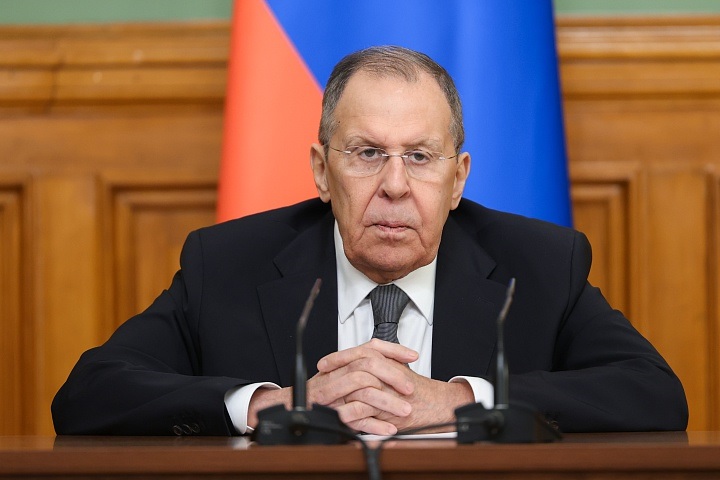 Photo: MFA
Foreign Minister Sergey Lavrov’s statement and answers to media questions following talks with OSCE Chairperson-in-Office and Head of the Federal Department of Foreign Affairs of the Swiss Confederation Ignazio Cassis, and OSCE Secretary General Feridun Sinirlioglu.
Moscow, February 6, 2026
Yesterday and today, I held talks with the OSCE top officials, Minister of Foreign Affairs Ignazio Cassis of Switzerland, which chairs the Organisation, and OSCE Secretary General Feridun Sinirlioglu.
I communicate with my Swiss counterpart fairly often. Most recently, we met in New York in September 2025 on the sidelines of the 80th session of the UN General Assembly. Mr Cassis informed me that as newly elected Chairperson-in-Office in Switzerland for 2026, he wished to come to Moscow on a visit. Without a doubt, we supported his wish.
Three months after his appointment as OSCE Secretary General, Mr Sinirlioglu also visited our country in March 2025.
Both yesterday and today, we had a candid discussion. Our Swiss colleagues and colleagues from the Secretariat are fully aware of the difficulties facing them in the wake of a major crisis in the OSCE.
The causes of the crisis are well known, but we still spent some time discussing them and responded to a number of questions from our partners. The reasons clearly lie in what NATO and EU countries are doing. Long ago, well before the events in Ukraine, they set about bringing the Organisation to heel. After the special military operation began, their goal expanded to include putting the Organisation at the service of the hybrid war against the Russian Federation and supporting the hot war against our country unleashed by the hands of the Ukrainian regime.
Almost the entire OSCE agenda, with very rare exceptions, has been Ukrainised, including the areas that should have been devoted to mutually advantageous cooperation and the quest for specific generally acceptable projects in transport, communications, logistics, investment, and humanitarian matters. Topics that do not fall within the Organisation’s purview are being imposed in order to sidetrack the discussions on matters that must be reviewed annually. The point of doing so is to merely check the box marked “Ukraine” and to file a report to the people in charge of this process.
I will not go into the specifics, as you are certainly familiar with the OSCE foundational documents. The Organisation is based on the principle of equal and indivisible security, which has repeatedly been proclaimed within the OSCE at the top level during the 1999 Istanbul Summit and the 2010 Astana Summit. These documents clearly state that security is indivisible and not one country can enhance its security at the expense of another. There is also a particularly important specific provision saying that no country, group of countries, or an organisation can claim dominant position within the OSCE area.
NATO engages precisely in illegal matters. It strives to dominate, and not merely dominate but bring in ever more members, which fact everyone is well aware of. The attempt to gobble up Ukraine and to turn it into a springboard targeting the Russian Federation, to set up military bases on its territory, and to deploy weapons aimed at our country has taken us to a place where we had no choice but to launch the special military operation in response to a request by the DPR and LPR after many years of us trying to explain to the West at the highest level the deleterious nature of its course of dragging Ukraine into this mortal game.
Nevertheless, we discussed, in a broader context, things we could do to ensure that the OSCE retains its importance and stays alive. We updated our colleagues in detail on President Putin’s initiative to form a Greater Eurasian Partnership, which would serve as a material foundation of Eurasian architecture of equal and indivisible security open to all countries and associations of our common Eurasian continent.
Our colleagues are fully aware that this process is underway and reflects objective trends on the continent whereby the material sphere (logistics, transport, investment, and much more) is marked by greater connectivity, and that Eurasia is increasingly becoming the centre of gravity in the military-political confrontation.
Under the administration of former US President Joe Biden, NATO began to engage actively in the eastern sector of the Eurasian continent, specifically in East Asia and Southeast Asia. Attempts to undermine ASEAN unity and draw certain members into exclusive, bloc-style configurations, such as trios and quartets, have been observed. Such quartets and trios are being actively developed. Nuclear components are being introduced into military exercises organised in the region. All of this is cause for concern and necessitates open, honest dialogue.
We do not want NATO to assume responsibility for the security of the entire Eurasian continent; yet this is precisely the declared aim of the Alliance. Together with the People’s Republic of China and other members of the SCO and BRICS, we advocate for upholding the principle of indivisible security. We remain prepared to discuss this matter with our American counterparts once their overall stance on key aspects of what is conventionally termed strategic stability becomes clear.
As you are aware, the Strategic Arms Reduction Treaty expired yesterday. A vacuum has emerged. Our position was articulated comprehensively in a special statement issued by our Ministry. We will proceed from the understanding that Russia is prepared for any eventuality. We favour dialogue and will await indications that the United States is similarly ready to engage.
The discussion regarding the OSCE’s role in addressing security challenges and shaping a new security architecture proved most instructive. Our partners acknowledge that without due consideration of the Asian dimension, our pan-continental efforts will prove inadequate. However, the precise contours of this approach remain to be seen.
In any case, together with our Belarusian allies, we have tabled an initiative to develop a Eurasian Charter of Diversity and Multipolarity in the 21st Century. This will be reviewed at the forthcoming, fourth Minsk International Conference on Eurasian Security this autumn. The concept will be advanced irrespective of any efforts to salvage the OSCE. The extent to which the Organisation retains its relevance and integrates into broader pan-continental security and stability mechanisms remains to be observed.
We provided a detailed explanation that across all three OSCE “baskets” – the military and political, economic, and humanitarian dimensions – there is either complete stagnation or Ukrainisation. Meanwhile, the OSCE remains entirely inert despite possessing institutional mechanisms such as special representatives for national minorities, media freedom, and human rights. These institutions have demonstrated their utter ineffectiveness, proving incapable of responding to the most egregious violations of OSCE principles. I refer here to the rise of neo-Nazi sentiment, the glorification of Nazism, the destruction of shared military and memorial heritage dedicated to those who defeated fascism during the Second World War, discrimination against ethnic Russians, Russian speakers, the Russian language and culture, Russian-language media, and the persecution of canonical Orthodoxy. These phenomena are by no means unique to Ukraine.
Similar developments are evident in the Baltic states and modern-day Moldova. OSCE institutions are undoubtedly forfeiting their credibility by remaining silent in the face of such flagrant violations of the Organisation’s professed principles.
Economic stagnation is equally pervasive. The Swiss chairmanship and the Secretary General have proposed plans to revitalise activity in this sphere. We have stated our conditional readiness to participate, provided such initiatives are organised without discrimination – both in terms of participant selection and ensuring that all delegations can reach the venue of the relevant event unhindered.
Another pressing concern is the humanitarian dimension. I have already noted how OSCE institutions remain mute while observing violations when Russian participants – particularly civil society representatives – are routinely barred from humanitarian events, contrary to established practice.
In conclusion, I would like to note that our colleagues, particularly OSCE Secretary General Feridun Sinirlioğlu, have actively supported our position that it is unacceptable for an entity described as an organisation to lack a formal charter. The institutions that have developed within its framework operate without universally agreed rules, despite the OSCE’s proclaimed adherence to the principle of consensus.
Nearly twenty years ago, in 2007, the Russian Federation, together with its CIS and CSTO partners, circulated specific proposals, including a draft charter and draft documents setting out the principles and procedures governing the work of all OSCE institutions. Back then, the West did everything possible to obstruct this effort. The process subsequently stalled, but we now intend to revive these initiatives. Order must be restored within the Organisation, particularly with regard to election observation. A deeply questionable situation has arisen: ten observers are dispatched to certain “developed democracies,” while hundreds are sent to a country located, as they say, east of Vienna.
The Office for Democratic Institutions and Human Rights undermined its credibility when it observed the first round of election in Romania. It is widely known that after that round the leading candidate was removed from the race, while the OSCE remained conspicuously silent.
A different form of electoral manipulation occurred during the election in Moldova. Once again, the OSCE appeared to align itself with those who encourage in every way possible the current Moldovan authorities’ openly pro-Western, anti-Russia course.
There are many tasks ahead. We have never lacked the goodwill to help prevent the collapse of the OSCE in Europe. We believe that the Swiss chairmanship and the Secretary General understand the depth of the crisis and have a desire to try to overcome the current situation.
The advice we gave to our counterparts was not to pursue sweeping global ambitions such as transforming the OSCE into the central institution for nearly all developments in this part of Eurasia, but instead to begin by restoring the normal functioning of the military-political mechanisms that have become inactive, through no fault of our own, as well as those in the economic and humanitarian dimensions.
We concluded our discussions here with an agreement to maintain contact.
Question:In your opening remarks, you spoke about a deep crisis the OSCE has found itself in as an organisation. This issue was planned as the main one at the talks. I would like to know if the Swiss side and the OSCE Secretary General have a clear understanding of the crisis and its depth, and whether we can hope that some day the OSCE will still be able to effectively perform the functions it was established for.
Sergey Lavrov:I have spent ten minutes trying to answer this question. Did I fail?
Question:You basically made it clear, but how about the other side? How does the Swiss side see it?
Maria Zakharova:Since they are not attending the news conference …
Question:Yes, we began worrying.
Sergey Lavrov:The incumbent OSCE Chairperson-in-Office, Federal Councillor of the Swiss Confederation Ignazio Cassis, and OSCE Secretary General Feridun Sinirlioğlu will hold a news conference upon their landing in Vienna. That was their decision.
Articles recently appeared in the Swiss press, citing anonymous sources, claiming that Russia had told them not to attend the news conference in Moscow and go to Vienna for that purpose. However, Ignazio Cassis has vehemently dismissed these false allegations.
We always want to make our guests feel comfortable. If they feel comfortable about talking to the press here – let it be. If they feel greater comfort doing it in Vienna without Russian journalists, it is also their choice.
I have outlines the main topics. We were not evading complicated issues, nor those of global nature which stem from the current geopolitical situation that has been unfolding rapidly and fairly unpredictably. It has revealed a number of problems inside the West’s camp. I won’t dwell on them in detail. Suffice it to listen to the statements made by the leaders of NATO, the European Union and some European countries so as to see the “mosaic” that is taking shape.
The OSCE could obviously be a platform for producing some kind of common approaches. However, so far, the Western countries that have usurped the leading positions at the OSCE Secretariat and in the military-political, economic and humanitarian domains, still believe it is more vital for them to try their hardest to make the OSCE act as another Russophobic tool and support the openly pro-Nazi Kiev regime.
We will live and see. Basically, our arguments were not dismissed. It is hard to expect everything to change overnight. Therefore, we advised starting with small steps. To begin with, at least resume normal meetings on the three so-called “baskets” of the OSCE activities.
Question:An assassination attempt was made today on one of the members of the Russian negotiating team, Lieutenant General Vladimir Alexeyev, deputy head of the General Staff Main Directorate. Can you comment on this? How would it affect the continuation of the Ukraine talks?
Sergey Lavrov:I naturally heard the news right ahead of our talks. I am not going to give any forecasts, this lies outside my competence. The decision will be made by the country’s leadership.
This terrorist attack once again confirmed the Zelensky regime’s focus on constant provocations in order to disrupt the negotiation process. The regime is also ready to do everything to convince its Western sponsors not to slack their efforts trying to divert the United States from the course of achieving a fair settlement.
Question:This week another round of peace talks took place, which all sides described as productive, but without visible progress on key issues – territory, and security guarantees. In addition, the meeting took place against the backdrop of continued attacks on Kiev. Given this, how is Moscow responding to European leaders’ view that Russia is in fact not interested in achieving peace?
Sergey Lavrov:You are free to work within any OSCE framework – military-political, economic. Their line is always the same: when will Russia stop rejecting peace? When will it stop bombing Kiev? When will it finally do what Vladimir Zelensky and the West demand?
Let me give just one example; there are many. A year ago, at the end of March 2025, US President Donald Trump, in a phone call with President Vladimir Putin, proposed a month-long energy truce. The understanding was that neither side would attack the other’s energy infrastructure. President Putin agreed immediately, right there in the conversation. We declared the ceasefire. For a full month, we did not attack Ukrainian energy facilities. Ukraine, for its part, remained silent on Washington’s proposal. During that same month, over 130 attacks on Russian energy infrastructure were recorded, and the attacks continued on purely civilian targets unrelated to energy: residential buildings, passenger trains, and more.
We have repeatedly warned that our restraint depends on the enemy observing the basic rules of international humanitarian law. We continue to adhere to those rules, striking only targets with clear dual-use or purely military significance. So when Ukraine is forgiven everything, and all the sins are placed on Russia...
The press must still work honestly and uphold its profession. I reminded our interlocutors, Mr Ignazio Cassis and Mr Feridun Sinirlioglu, of this again today when discussing the functioning of such institutions, including the office of the OSCE Media Freedom Representative.
When Russia once again agreed to a peace treaty with Ukraine after the Minsk agreements; when NATO and the US rejected our proposal for a new European security system; when the special military operation began (we had no other choice); when, two or three weeks later, the Ukrainians proposed talks, we agreed. In late March and early April 2022 in Istanbul, we agreed to support the settlement principles put forward by the Ukrainian side. Two or three days after that document of principles was initialled, the tragedy in Bucha occurred. A BBC crew arrived and began broadcasting from the village’s main street. Not from basements – right on the main street, dozens of neatly laid-out corpses. A bucha – which means ‘frenzy’ in Russian – was stirred up, pardon the pun, over that village. A new package of sanctions against Russia was announced immediately, without any investigation. That was April 2022.
Since then, during my public appearances at the UN Security Council, I have repeatedly asked the UN Secretary-General; I have asked all the journalists accredited to the UN in New York, whom I meet regularly at news conferences; and I have asked the OSCE leadership.
The question is simple. This story of a mass murder in Bucha is no longer mentioned anywhere in the media. They found time to expose Epstein’s island, but not to investigate Bucha. Our question to journalists is straightforward: UN staff, respected outlets, request a list of the names of those whose bodies were shown on the BBC four years ago.
I know many people in New York accredited to the UN. I’ve addressed old acquaintances directly: “Gentlemen, you have journalistic pride; you’ll dig up anything as a challenge.” For one thing, it’s all the rage now to badger everyone about why Russia isn’t interested in peace. It’s an abstraction you can answer forever, just as you can ask it forever.
Here’s the simplest thing: Who was killed in Bucha? Why can’t we see the names? UN Secretary-General António Guterres and UN High Commissioner for Human Rights Volker Türk mutter something inaudible, avert their eyes, hint at ethical standards that prevent the release of these names. What ethical standards? Explain why this can’t be done.
I appeal again to journalists, especially Western journalists, because it was Western media that blew this scandal out of proportion. Try asking the Ukrainian leadership, or the BBC chiefs. They must know who to contact to recall the details of that story.
It’s time you stopped taking your cues from European functionaries like Rutte, von der Leyen, or Zelensky. They would not scruple to tell a lie. The issue of a ceasefire and simultaneously providing security guarantees to Ukraine has taken centre stage. Zelensky demands that these guarantees be approved by parliaments and the US Congress, otherwise “it won’t be serious.” The ‘boss’ is telling others what to do.
Let me reiterate – in April 2022, security guarantees were agreed upon based on a draft proposed by the Ukrainian side. They stipulated that security would be guaranteed for the entire region, including Ukraine, with the guarantor states being the five permanent members of the UN Security Council – including Russia and China – plus Germany and Turkiye. This was Ukraine’s proposal.
Furthermore, as per Ukraine’s proposal, it was spelled out that these guarantors would operate on the basis of unanimous consent, with all decisions taken solely by consensus; that there would be no military bases in Ukraine; and that no military exercises would be conducted without the approval of all guarantor states, including Russia and China. These security guarantees were enshrined in a document that was initialled, and which we were prepared to sign four years ago, subsequently formalising it into a legally binding treaty.
No one has shown us anything, though our delegation – which travelled to Abu Dhabi for the second time – may have been briefed on what was discussed there. I have not yet had the opportunity to speak with them. Yesterday and today, we were occupied with our Swiss counterparts.
What is being leaked to the press – and even what is not: NATO Secretary General Mark Rutte, speaking in the Verkhovnaya Rada of Ukraine, articulated what amounts to preparations for an intervention. He stated that security guarantees envisage automatic actions by the “coalition of the willing” – at one stage independently, at another with the support of the United States – and that Britain and France are prepared to deploy their troops on Ukrainian territory. This is precisely the opposite of the collective guarantees agreed upon by us and the Ukrainians in April 2022. Back then, it was an honest arrangement. Now, these are security guarantees for a regime that the West is determined to preserve at any cost – solely to ensure it continues attempting to “bite” the Russian Federation and persists in offering its territory for the deployment of Western weaponry aimed at Russia.
Clearly, this discussion is not serious. Few now recall that period. That inconvenient question about Bucha – why names are withheld, why Ukrainians were prohibited from signing a peace agreement with Russia four years ago, which had already been initialled. None of this is acknowledged. History has been cancelled.
History begins where it suits our Western colleagues. Just as it did after the state coup in February 2014, when, in violation of the agreement guaranteed by Germany, France, and Poland, the putschists seized administrative buildings by morning, declared themselves victorious, and began hunting down Ukraine’s then-President Viktor Yanukovich.
The first loud signal they sent came on the day they seized power, announcing the revocation of the Russian language’s status. Secondly, they dispatched militants to storm the Crimean Supreme Council building. At that point, the Crimeans declared they wanted nothing to do with them, held a referendum, proclaimed independence, and joined the Russian Federation.
When the West, prior to the special military operation, began discussing the Minsk agreements, all established formats, and the OSCE’s role, they consistently asserted that everything began with us “occupying and annexing Crimea.” Our response was: What about the state coup, contrary to the guarantees provided by EU members? No, they replied, that is irrelevant. Everything preceding the Crimean referendum has been nullified. The West is ashamed – or perhaps not ashamed – and, true to form, refuses to engage on subjects where it lacks arguments.
One must view history in all its complexity, including the root causes of all conflicts. Let me conclude with a quotation. We discussed this extensively today with our partners. In recent years, the People’s Republic of China has put forward several major initiatives: the Global Governance Initiative and the Global Security Initiative. The latter was articulated by President Xi Jinping in February 2023. It outlines (without reference to any specific situation) a principle for resolving any conflict. One of these principles is clearly stated: When approaching any conflict, one must meticulously and thoroughly examine its root causes. Having identified them, concentrate all efforts on their elimination. Only on this basis can conflicts be resolved.
We fully concur with this assessment by the leader of the People’s Republic of China. It is precisely this approach that we apply to the conflict engineered by our Western colleagues over many years by transforming Ukraine into an “anti-Russia” – a tool of war against our country.
The meeting was productive. I trust our discussions will not prove futile.
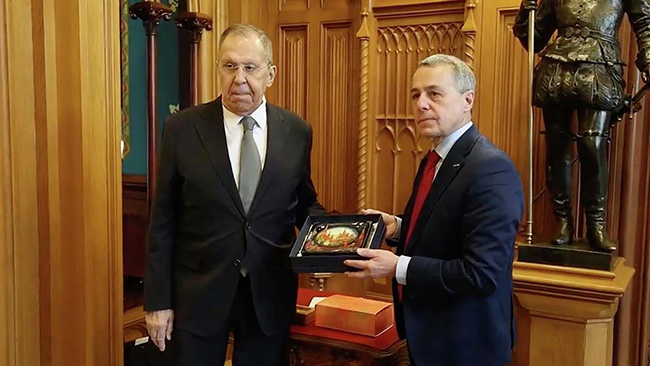 Russian Foreign Minister Sergey Lavrov received a music box containing a composition by Pyotr Tchaikovsky as a gift from the OSCE Chairman-in-Office, Swiss Foreign Minister Ignazio Cassis
Photo: Maria Zakharova/Telegram
read more in our Telegram-channel https://t.me/The_International_Affairs

















