
 РУССКИЙ
 14:44 07.03.2026 •
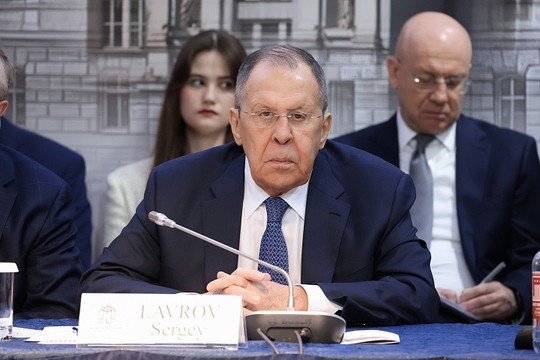
Photo: MFA
Foreign Minister Sergey Lavrov’s remarks and answers to questions during the Ambassadorial Roundtable Ukraine Crisis. Digital Threats and International Information Security
Moscow, March 5, 2026
Ladies and gentlemen,
Your Excellencies,
This is, by far, not the first time we meet to discuss a topic which, for us, is central to international politics, as President Vladimir Putin and other senior Russian government officials have said many times. What makes it so important? The West has prepared and unleashed a war against Russia by using the Ukrainian regime as its proxy. They are the ones who said that the goal of this war consisted of inflicting a strategic defeat on our country. There is every reason to believe that this implies their commitment to tear our country apart, just as President Vladimir Putin has been reminding us on multiple occasions.
However, there are so many other things happening around the world, including the recent developments in the Middle East following the aggression by the United States and Israel against the Islamic Republic of Iran. In this connection, I cannot fail to mention the crisis which has been in the headlines and across our television screens and social media. It can have dire consequences for the entire world, undermine global stability and economy, upend everything which used to be called globalisation, and viewed as a process for bringing about prosperity for the entire humankind. All this has been destroyed.
Civilians have been suffering in Iran, as well as in neighbouring Arab countries following Iran’s retaliatory actions. We express our condolences to all the civilian victims. Civilian infrastructure across all Persian Gulf countries has been damaged, and we can see that.
We do remember that long before the United States and Israel launched their campaign, GCC countries had openly called for refraining from using military force against Iran and resolving all issues through diplomacy and political dialogue. They stated for everyone to hear that they would not open their territory or air space for the sake of unleashing a war against the Islamic Republic of Iran. These were official statements saying that they would not allow foreign military bases on their territories to be used for taking part in this aggression. Nevertheless, they were drawn into this war.
I have no doubt that this was one of the objectives for this operation, which has been called either Lion’s Roar or Epic Fury. Its goals are currently being debated. There are quite a few political figures, including in the United States, who have been struggling to understand the purpose of this operation.
President of the United States Donald Trump has made a public statement claiming that he eliminated Ayatollah Ali Khamenei, since otherwise Khamenei would have eliminated him. Several hours later Defence Secretary of the United States Pete Hegseth said that the United States did not seek to organise Ayatollah Ali Khamenei’s killing. We will leave it up to Congress and the political system in the United States which is designed to handle incidents of this kind to decide what the United States wants to achieve in this operation.
I have no doubt that one of the goals consisted of sowing division among countries within this region, i.e., the Persian Gulf countries, Iran and its Arab neighbours. A positive process for bringing their relations back to normal has been gaining traction until recently. Saudi Arabia and the Islamic Republic of Iran normalised their relations, and everyone paid attention. Russia was proactive in facilitating this outcome.
In truth, we’ve been promoting a unifying agenda for many years. For over two decades, we’ve held events aimed at building support for the development of a Collective Security Concept for the Persian Gulf – one that would include all littoral states and their key neighbours, and, as we originally envisaged, also involve the five permanent members of the UN Security Council, ensuring transparency, promoting confidence-building measures, and taking concrete steps to use the wealth of this region for the prosperity of its peoples.
Unfortunately, that concept never got off the ground. The West has done everything in its power to block any positive agenda in the Gulf. As the aggression against Iran has now made clear, they operate on a simple “either-or” principle –”either you’re with us, or you’re against us.” And the key to all of this is, as ever, “divide and conquer.” In this particular case, perhaps one might say “divide, pit against each other, and conquer.”
I say this with a deep sense of regret, because we’re talking about our close friends. All those suffering from US and Israeli aggression are our strategic partners. We maintain dialogue with them, and we will do everything we can, alongside other peace-loving members of the international community, including in the UN Security Council and the General Assembly, to help create an atmosphere in which this kind of operation becomes utterly impossible.
I can’t say for certain how much such moral and political pressure will achieve, but we must do everything in our power to ensure that the voice of the overwhelming majority of the international community is heard.
However, we’re here to talk about Ukraine. I concluded the first part of my opening remarks with a reference to the West’s “divide and conquer” policy. That same policy also manifests itself in the “either with us or against us” principle. And this is precisely what the West has been applying to the Ukrainian crisis, grooming Ukraine to become “anti-Russia,” the spearhead of the West’s war (hybrid at first, but more recently not just hybrid, but a direct, hot war) against the Russian Federation.
Way back in 2004, during the first Maidan protests in Ukraine, the election results were annulled at the West’s behest, and an illegal third round of voting was organised – something completely outside the provisions of any law or the Ukrainian Constitution. Before that third round, a candidate favoured by the West was put forward to challenge the president who had been legally elected in two rounds. Back then, the West, the Europeans, Brussels, declared loudly and publicly to the entire world that they demanded Ukrainian voters, when they cast their ballots in that third (illegal) round, make a clear choice – whether they opted to be with Europe, or with the Russian Federation. That was 2004.
Since then, this “either with us or with Russia” framing has never changed. At the same time, this same approach has now manifested itself in the attempt to drag Ukraine into NATO, despite repeated warnings about the harm and unacceptability of such efforts, warnings that go back at least as far as President Vladimir Putin’s Munich speech in 2007, and continued ever since.
It became clear to us that the process of absorbing Ukraine into the North Atlantic Alliance could not be stopped by conventional reasoning. At the end of 2021, in December, we put formal official proposals to both NATO and the Americans to conclude agreements based on collective security principles – principles that would not infringe on Ukraine’s security or Russia’s, and would also take into account NATO’s legitimate interests. They were rejected. Tossed in the bin. We were then told that the alliance’s relations with Ukraine were none of our business. We should not interfere, they said.
Even now, when the special military operation has proven these plans unworkable, the stubborn Europeans in Brussels, London, Paris, Berlin, and other capitals (not to mention the Baltics) still insist that NATO’s doors must remain open. And let’s be clear: the fact that their “security guarantees” now include mandatory EU membership changes nothing. It does not alter their policy of continuing the war and hostility against the Russian Federation.
The European Union is now as charged for militarisation and its calibration against our country as the North Atlantic Alliance – it may have actually outperformed NATO in its rhetoric.
But we are talking about the parallels of “friends or foes.” It is what happened in Ukraine. Now the same thing is happening in the Middle East. It is indicative that NATO is now becoming gradually engaged in the war launched by the United States and Israel against Iran, just like it has become gradually involved in Ukrainian affairs.
NATO Secretary General Mark Rutte, who produces eloquent testimonies in his statements at every opportunity, said that NATO is ready to enforce the collective defence article in the United States’ operation against Iran. It is claimed that they are prepared for this and what they are doing within the bloc right now is ensuring that every inch of the alliance’s territory is protected, fully, in a 360-degree format.
So, Rutte used the notorious reference made by former German foreign minister Annalena Baerbock to 360 degrees, but in a slightly different context. His statement implies the following: esteemed members of the global community must know that NATO’s interests lie where it says they lie. If NATO’s primary principle and purpose are to protect the member states’ territories, as stated in the Washington treaty, what does it have to do with the Middle East?
By the way, back when the North Atlantic Alliance actively promoted the “Indo-Pacific strategies” on the Eurasian continent, creating its own infrastructure and NATO-like associations, the “threes”, the “fours”, and so on, under different names, then Secretary General Jens Stoltenberg was asked at a news conference why the bloc was expanding its activities to the Far East if NATO is an alliance that is primarily supposed to protect the territories of its members from external threats.
Without moving a muscle, Jens Stoltenberg answered that NATO remains the same type of alliance but today, threats to its member states also come from Southeast Asia, the South China Sea, the Taiwan Strait, and so on. This is another trend that is common not only for what is happening around Ukraine and its root causes. This trend is not only evident in the intentions of the senior NATO officials with regard to the Middle East but it has long asserted itself in the bloc’s approach to matters that are irrelevant to it.
They are not hiding this. Our British colleagues have claimed repeatedly, with support from their numerous NATO colleagues, that Euro-Atlantic security is indivisible from the security of the Indo-Pacific region, as they call it.
President Putin’s initiative to bring all the countries and groups on the Eurasian continent together and discuss how they can ensure their well-being by optimising economic, transport, and other links, along with their security, is becoming increasingly relevant, and rightly so, in the circumstances when, instead of the countries inhabiting the Eurasian continent, this security function is eyed by NATO with its apparent Euro-Atlantic mentality.
By the way, this “divide and conquer” principle plays out to great effect in the Asia-Pacific Region, if I can put it this way. They are trying to divide ASEAN, tear certain countries from the association and drag them into new military blocs being created there. They are trying to undermine the ASEAN-centric approaches to universal and inclusive bodies which ASEAN has been creating for decades and which have served to develop positive recommendations. It is the same trend that manifests itself in very different circumstances and across different geographical spaces, including, as I said, in Ukraine, the Middle East, and the Far East.
There is one more commonality. Russian political scientists are widely discussing this topic – the talks. Judging from concurrent comments, the talks between the United States and Venezuela went rather smoothly, but you know how they ended. The talks between the United States and Iran have been running well for quite some time. According to their participants, the talks were nearing success back in June 2025. At the height of the talks, literally the night before the next round, the 12-day war was unleashed – the first act of aggression against the Islamic Republic of Iran.
The same happened this time. Last Friday, the parties left Geneva to issue positive and optimistic comments. I spoke to my friend, Foreign Minister of the Sultanate of Oman Badr bin Hamad Al Busaidi, who acted as an intermediary during the talks. He confirmed that the US and Iranian delegations parted on a positive note. A substantive agreement was quite real. They should have continued, of course, but instead, the talks were cut short. Later, it was announced that the Americans were just “going through the motions” because they had already realised during the previous round, as they claimed, that Iran did not want to fulfill their demands.
Returning to Ukraine – we are actively engaged in negotiations with our American counterparts, who are facilitating dialogue with Ukraine. Several trilateral rounds have recently been held in Abu Dhabi – we are sincerely grateful to our Emirati friends – and Geneva. At present, we discern no grounds to suspect that these negotiations are a smokescreen, as we remain in direct contact with our American colleagues.
However, our political scientists, analysts, public figures, and members of parliament – who, by definition, are not part of this closed process – have begun drawing parallels and questioning how these talks might conclude. They assert that the actions of the United States have shattered the “spirit of Anchorage.” I have already addressed this topic. In Anchorage, the “spirit” was far from the most significant aspect. The spirit refers to the atmosphere, and it was comradely, mutually respectful, and constructive. But the spirit evaporates. The principal achievement of Anchorage was not the spirit. We know how adept our Western colleagues are at creating an atmosphere, but, I repeat, the spirit evaporates. The crux of Anchorage lay in the concrete understanding reached on the basis of proposals put forward by President Donald Trump and his negotiating team. President Vladimir Putin has repeatedly remarked that we accepted these proposals, including those aspects that represented a significant compromise for us. We proceed from what was offered to us, and we accepted it. That is the current benchmark in these negotiations with the American side.
We are acutely aware that, in the seven months since Anchorage, Ukrainians and Europeans have exerted – and continue to exert – every effort to reinterpret and rewrite the understanding reached in Anchorage. We observe how negotiators in the United States are subjected to this pressure and the temptation to yield to it, shifting the responsibility for further steps – as they phrase it – onto Russia, in order to meet certain symbolic dates in this year’s political calendar. This, too, is a fact. But our conscience is clear. We remain faithful to the understandings clearly achieved at the proposal of the United States in Alaska.
Today, we intended to discuss the Ukrainian crisis through the lens of digital threats to international information security. There are numerous examples that further illustrate the terrorist nature of the Kiev regime, demonstrating that, beyond the physical sabotage of infrastructure critical to the global economy – as was the case with the Nord Stream pipelines and as is now planned (President Vladimir Putin reiterated this yesterday) for the TurkStream and Blue Stream pipelines – they do not even conceal the Ukrainian connection. Consider the destruction of the Arctic Metagaz tanker, which was proceeding entirely lawfully off the coast of Libya.
Yet, beyond the destruction of physical infrastructure, Ukrainian terrorists are actively involved in the realm of information security, engaging in cyber terrorism and targeting civilian facilities such as banks, power plants, and transport systems. The Kiev regime directly controls hundreds of call centres that terrorise Russians, though their operations are not confined to our territory – they are also active in Europe. It is a widely acknowledged fact that, even under the administration of Joe Biden, the United States deployed entire units of personnel from Cyber Command and the National Security Agency to Ukraine. British intelligence representatives were also dispatched to coordinate cyberattacks against Russia. The West, meanwhile, provided the necessary funding, supplied equipment, and trained Ukrainian hackers. According to our reliable intelligence, the infrastructure established by the Anglo-Saxons – specialists, instructors, and military personnel from the United States and Britain – remains in Ukraine and continues to pursue these criminal activities.
Let us not forget that back in 2023, several countries of NATO, the European Union, and, I would like to point out, the World Bank created the “Tallinn Mechanism,” through which more than €240 million was raised to support the Kiev regime’s hackers. Kiev was connected to NATO’s main cyber training ground, the so-called NATO Cooperative Cyber Defence Centre of Excellence, located in Tallinn, Estonia.
Leading American corporations, including Google, Microsoft, Amazon, and SpaceX, among others, are actively supporting this work. All of them continue to support the Zelensky regime. Among corporations of a somewhat different profile, I would like to also mention Starlink. Elon Musk has publicly stated that he continues to assist Ukrainians in their war against Russia.
There are countless examples of telephone scams affecting Europeans. All of this reinforces the need to combat these destructive phenomena. Ukrainians are not alone in this regard – these problems are global in nature.
Together with our allies and like-minded partners, we have long and consistently advocated for the development of uniform international rules in this sphere. It is encouraging that, at Russia’s initiative, the first-ever universal treaty to combat cybercrime – the UN Convention against Cybercrime – was signed in Hanoi in October 2025. It has already been signed by 73 countries. Once the Convention enters into force, law enforcement agencies of participating states will gain an effective tool to combat hacking. We will continue working to expand the convention’s scope, including through the adoption of an additional protocol. We call on all our colleagues to join it.
I also mentioned the use of low-orbit satellites like American Starlink systems. We advocate for legally regulating such systems at the international level.
On December 29, 2025, we convened an informal meeting of UN Security Council members with invited colleagues for a simple goal: to reaffirm that operators of low-orbit satellite systems must respect the sovereignty and national legislation of the states where they provide services.
We are also organising additional event, including this year’s flagship event in the field: the Global Digital Forum. It will take place in Moscow on September 17-19. As I understand it, all countries represented here have been invited. We hope to see your representatives there.
Going back to the Ukrainian issue, I would like to reiterate that one of the main goals of our special military operation remains the elimination of the threat to Russia’s national security emanating from Ukrainian territory. This threat is complex and includes the danger of state-sponsored cyber terrorism perpetrated by the Kiev regime.
We are grateful to everyone who understands the root causes of the current crisis. Anyone who takes an interest in getting to know the facts cannot fail to see the need to ensure the security of our state based on international law, and to prevent the extermination of millions of Russians whose language, culture, and media outlets were banned on the legislative level by the Nazi regime currently in power in Kiev.
I have already spoken about how to move forwards to a political settlement. Let me reiterate that we remain fully committed to the Alaska agreements. Our American colleagues are well aware of what we are referring to, as these proposals originated from them. We remain committed to this position. We also hope that no one will be able to divert our American colleagues from this path, despite all the efforts of European Commission President Ursula von der Leyen, NATO Secretary General Mark Rutte, and other “masters” of the Kiev regime.
Question: On behalf of the ambassadors in Moscow, I would like to thank Your Excellency for holding this meeting with us, and also, on behalf of the Arab countries of the Gulf, to thank you for the telephone conversation between your President and our leader.
Our countries and the Arab countries of the Gulf are facing aggression from Iran. It poses a threat to our civilian infrastructure. Over the past week, many people have been killed. We know that you have a special strategic relationship with Iran. Therefore, we hope that Russia will play a greater role and exert pressure on Iran to stop the aggression against our countries.
You said everyone knows our countries are not parties to this conflict. We did not go after Iran. I would like to convey a message from our countries that Russia has stronger positions on this issue and can help put an end to the aggression against our countries. We also have strategic relations with Russia, and we would like to increase pressure on Iran in order to bring this aggression to an immediate end. This would also help stop the conflict across the region.
Sergey Lavrov: The group of Arab states on whose behalf you are speaking did issue warnings indeed. Many of the Arab monarchies publicly stated that matters should not be taken to military solution and that they would not make their airspace available for use. But when everything began despite your repeated calls to the United States and Israel, did you condemn what the United States and Israel started doing? Did you condemn the death of 170 schoolgirls?
I believe we should adopt a single position. We are against the suffering of the Gulf countries on whose behalf you are speaking. We believe this does not provide our Arab colleagues with any military advantage. It is highly doubtful that Iran gains anything politically from this. It’s quite the opposite, in fact.
But we also cannot accept a logic according to which Iran’s actions are deemed unacceptable while everything the United States and Israel are doing is beyond discussion. Do you see my point? It’s obvious, and it lies on the surface.
We are calling for an immediate cessation of the aggression. We would be sincerely grateful to the Gulf Cooperation Council and to all the countries represented here if you would add your voices to this call.
Everything that is happening is caused by… One might say Iran reacted in a way that no one expected. I agree with that. A country was subjected to a treacherous attack amid ongoing talks. They had agreed to continue talking. I spoke with Foreign Minister of Oman Badr bin Hamad Al Busaidi. He was shocked to see the events take that turn at a moment when, in his assessment, solutions had been identified.
So, yes, we stand in solidarity with all the Gulf countries suffering from what is happening. We call for a united front in favour of ending this war. Simply saying that Iran has no right to do anything effectively means openly encouraging the United States and Israel to continue what they are doing. That makes no sense. Let us come together and call for ending all hostilities, beginning with a complete moratorium on attacks that lead to civilian casualties and the destruction of civilian infrastructure, as is happening in many Arab countries.
We are observing how the global economy is losing - at least for some considerable period - one of the main engines of its growth, and how an oil refinery is being destroyed. Seeing all of that is terrible.
I have heard that your countries, I believe even Bahrain, are planning to submit a resolution in the UN Security Council along the lines you mentioned. It would condemn Iran’s aggression without saying a word about what the United States and Israel are doing. This will only divide countries. I’m sure the Americans will seize upon such an initiative. It fully corresponds to their logic, which is that this regime that it has no right to exist must be finished off.
In 2025 the Americans submitted to the UN Security Council a resolution on Ukraine that simply called for the conflict to be ended as soon as possible. There were some additional points, but that was the key message. Let us adopt the same kind of the UN Security Council resolution. We would fully support it. I think that would be fair.
Question (retranslated from Arabic): Mr Minister, you noted the challenges created by escalation in the Gulf region. We thank you for your solidarity and trust, because many casualties are now being documented in the countries of the region, the Gulf countries. Thank you for expressing condolences to the victims. Mr Minister, you also spoke about Russia’s concept of collective security in the Gulf area. It was advanced several years ago and has been discussed over the past few years to be further expanded. This initiative was drafted in a comprehensive manner and concerns not only the build-up of military power in the Gulf, but also energy security and security in other areas. Mr Minister, could you tell us more about this concept? Is there still an opportunity to return to it and implement its measures?
Sergey Lavrov: You are absolutely right. This has been discussed for many years now. We set up what’s known as “track two” events hoping it would help prepare for official intergovernmental contacts, at least beginning with experts. Our research institutes met several times, including quite recently.
Since the interest is there and the issue is becoming increasingly relevant, I will ask my colleagues to circulate materials capturing the essence of our proposal as well as additional materials showing the reactions of the participants of these research conferences.
The core idea is very simple. I’d rather not even mention the Organisation for Security and Cooperation in Europe which has become a term of abuse in some political science circles. However, back then the idea was roughly the same as at the beginning of the Helsinki process: to come together and discuss existing problems. Each participating country would set out the threats or the risks to its security as it sees them. Then we could begin with an agreement on transparency in military activities; transparency and perhaps limitations on the number of exercises that each country along the Gulf coast conducts. That would include mutual visits by military personnel and joint economic and trade projects.
We will circulate detailed materials. Unfortunately, we are far from that now. Our US colleagues and Israel even more so are publicly stating that this regime is illegitimate. That is their judgment, which is directly opposite to the opinion of all UN members. The government of the Islamic Republic of Iran is a full member of the UN. All its rights must be respected, including the right to chart their own destiny, so that no one decides on behalf of the Iranian people. Some American politicians are saying they killed everyone there, almost 50 people, and there’s no one left who could immediately step up and lead the country, so let the Iranian people decide. This hardly merits comment. They are trying to decide on behalf of the Iranian people…
I very much hope the bloodshed will end and that it will not end with the preservation of this approach which essentially amounts to saying that the Iranian government and the Iranian system, organisation and state have no right to exist. Who granted this right? There is a small chance that this will end with an understanding of the futility of such reckless adventures in the future, and with the realisation that agreements must be reached that are durable, based on mutual respect and on the principle of indivisible security. There’s always a chance. At this point it is extremely slim. But we will not abandon our efforts to promote this concept. As we say in Russia, dripping water can wear away a rock.
Question: I have two questions. First question. President Vladimir Putin has officially announced the allocation of $1 billion for the reconstruction of the Gaza Strip. Nevertheless, Russia is not a participant in the Board of Peace.
My second question is the following. Given the events unfolding in the Persian Gulf, we fear that people will forget the situation in Palestine. The same situation continues in Gaza. The Palestinian National Authority is being denied the right to return to Gaza. For two months, we have been stuck in Egypt. Fifty-five percent of the territory of the Gaza Strip is occupied. The Israelis control virtually everything. At the same time, the confiscation of land continues in the West Bank. The policy aimed at ceding the West Bank to Israel continues. Where is the international community? Where is the UN? In your opinion, in which direction are we heading?
Sergey Lavrov: Let me begin with the second question, because it is the fundamental one.
We have been committed to a two-state solution since 1988, when the Soviet Union recognised the State of Palestine. Since then, a fully accredited embassy has been operational here, and we maintain full diplomatic relations.
This step was also taken with due regard for the historical circumstances. Those circumstances are that the Soviet Union was one of the principal initiators of the UN resolution on the creation of two states – a Palestinian state and a Jewish state. One can re-read the resolution adopted by the General Assembly. It follows very clearly from that text that the two were interlinked. However, only the State of Israel came into being, which the Soviet Union immediately recognised.
The predecessors of today’s Palestinian politicians... It is a long story, but for those who are interested, I recommend reading about how it happened in 1948 that a Palestinian state was not proclaimed. One should probably look for the reasons for that among the Palestinian politicians of that time. A war was unleashed. Then there were several more wars (1967, 1973). With each successive conflict, the territory under the control of the Palestinian National Authority shrank.
Nevertheless, the official position of all the countries represented here remains the creation of a Palestinian state within the 1967 borders, with its capital in East Jerusalem and with the right of return for refugees. We reiterate this constantly. You have made a perfectly valid point. But if we follow your own line of reasoning and look at the map of the Gaza Strip and the West Bank, it is difficult to envisage how a Palestinian state can be created on the territory that remains unoccupied by Israel.
President Donald Trump’s plan concerns only the Gaza Strip. That is what was announced. It was approved by the UN Security Council in the autumn of 2025, although it did not contain a single word about a Palestinian state. It contained not a single word about the resolutions adopted by the United Nations concerning the Palestinian problem, the Gaza Strip, or the West Bank. It contained not a single word about the West Bank at all, in any context whatsoever. Together with our Chinese friends, we drew the attention of the American authors of the resolution to this. They refused to consider any amendments. It was to be their way or nothing. Only the Board of Peace, which would run everything under the chairmanship of President Donald Trump. Our Chinese colleagues and we were puzzled: what were we to do? How could we approve a resolution on an issue that has been at the centre of UN attention for decades, without even mentioning the position of the United Nations itself?
To be perfectly honest, we thought we should block such a resolution. But our Palestinian friends and virtually all the Arab delegations in New York strongly urged us not to veto it. In the end, China and Russia abstained in the vote. But our official position remains that there must be a Palestinian state. The difficulty now is that this position is being publicly and officially rejected by Israel. We hear and we see Prime Minister Benjamin Netanyahu stating that there will be no Palestinian state.
We can see an unprecedented number of settlements being approved in the West Bank, essentially severing its ties with East Jerusalem. Meanwhile, we hear Israeli officials say that two or three municipalities for Palestinians in the West Bank would be sufficient.
I do not want to create the impression that we are always right and that others always make mistakes. But we recognised the State of Palestine back in 1988. At that time, I assure you, if all or most other states had taken the same position, the prospect of a Palestinian state would not have seemed like a fantasy, along with East Jerusalem and many other elements that form the foundation of a settlement, the principles of which were approved by the UN General Assembly and Security Council.
In June 2025, I heard French President Emmanuel Macron suddenly say that he was concerned about what was happening in the Gaza Strip. He said that in three months, at the UN General Assembly, they would recognise Palestine. First of all, why has such a decision not been made during all these decades? And second, if in June 2025 you decided that you would recognise Palestine, why wait until September? I will tell you why. They hoped that by September 2025 the issue would simply disappear, and there would be nothing left to recognise. Other Western countries followed this line.
That is why we supported Donald Trump’s plan, primarily because it called for an end to violence on both sides and was acceptable to both sides. The number of civilian casualties has dropped significantly, although they do occur. Violations continue. We see violations of the principles on which Israel committed to withdrawing from the Gaza Strip. The same is happening in southern Lebanon, where the earlier reached agreements are not being observed.
It is announced that Hamas must be destroyed in all its guises, which goes somewhat against Donald Trump’s plan to disarm Hamas. The disarmament process is being interpreted in a very specific way.
We see many steps that, little by little, justify actions that run counter to the goals proclaimed in Donald Trump’s plan.
However, we remain committed to returning the Gaza Strip to the Palestinians so that they can rebuild it. The one billion dollars that President Putin announced would be allocated from our frozen sovereign assets in the United States (we specifically notified the Americans about this in an official note) is intended for building housing, social facilities, the restoration of civilian infrastructure, for addressing all the issues that would allow Palestinians to return.
We did not ask to use these funds for any other purposes. Following President Putin’s decision, we sent an official note to our American colleagues. So far there has been no response. We have reminded them several times, but they have still not replied. We only hear… As far as I know, they have stopped talking about the Middle Eastern Riviera. There is talk about the need to restore these lands, but better still, to create some sort of resort there.
I believe this would be disrespectful to the Palestinians. They suggest resettling them practically all over the world, from Indonesia to Somalia. It is up to the Palestinians themselves to decide. But no one has the right to undermine or challenge their right to their own land. That is absolutely clear.
At that meeting that was held not long ago, an allocation of another 10 or 15 billion dollars was announced. The Gaza Strip needs to be rebuilt, and rebuild in such a way that would guarantee the Palestinians’ right to return to this land. I have no doubt about that. With regard to Palestinian refugees, no one is talking today about their long-recognised right to return. If the indigenous people of the Gaza Strip are deprived of this right now, it would be a disgrace and a shame for the United Nations and for any other structures created alongside the UN to address the problems of Gaza and Palestine as a whole.
Question: I would like to express the position of the Arab states, and in particular the Arab League, which was founded to maintain and ensure peace in our region. That is why it cares for its member countries.
We issued a statement condemning Iran’s actions against Arab states, because this is a major concern. We called on all states, and we also call on you to play a greater role and take action to stop this insane war, not only against Arab states, not only against Iran, but against the entire world. This threatens peace and security everywhere. It is vital that it does not spiral into a third world war.
We rely on you as a steadfast friend of all Arab states. Russia is a member of the UN Security Council. You have good relations with Iran, with the Arab countries, and with the United States. Therefore, we once again call on you to take action. Perhaps together with Oman, which plays a major role in this and could help bring this issue to the negotiating table.
My second question concerns the negotiations with Ukraine. I have heard little about them recently. But I would like your assessment of the recent trilateral negotiations involving Ukraine and the United States. Information has recently appeared in the press and online about a “dirty bomb” that the West supposedly wants to give to Ukraine. Does this influence your approach to the negotiations?
Sergey Lavrov: On your first question, I can only repeat what I already said in response to the distinguished Ambassador of Bahrain. You are calling on us to stop this, given our relations with Iran, with the Arab states, and with the United States. My answer is: we want to stop it. But let us do it together. That will require more than simply saying, “Iran must stop.” It will require looking at the whole picture.
As I said earlier, why not push for a resolution in the UN Security Council? Perhaps even at the General Assembly too, calling for an immediate end to this conflict. A logical first step could be to demand an end to actions that harm civilians and infrastructure. But this can only be done collectively. Otherwise, it looks like we are condemning one side while turning a blind eye to the other.
The West has a habit of cancelling history. We saw this in full force with Ukraine, when a coup took place there in February 2014. And let’s not forget: it happened the very morning after Germany, France, and Poland had acted as guarantors of a settlement agreement between the president and the opposition. That agreement was meant to lead to early presidential elections. Everyone calmed down. And the next morning, the opposition tore it up. France, Germany, and Poland simply swallowed it. A Nazi regime came to power. Its first proclamation was to abolish the status of the Russian language. Its second step was to send armed militants to storm the building of the Supreme Council of Crimea, which had refused to recognise the legitimacy of this bloody coup. Then, with the help of our troops (we have always had a naval base in Crimea) Crimea held a referendum and reunited with Russia. The West raised a hue and cry. And ever since, for years, when we were still talking, they said, “Well, you annexed Crimea, and that started the Ukrainian crisis and this whole war.” We ask, “But what about the coup?” Because Crimea voted in a referendum to join Russia in protest against the coup. And their response? “No, you annexed it.” History – which is fundamental to understanding the root causes of any situation – gets erased.
The same thing is happening here. But we cannot cancel June 2025, when, in the midst of negotiations, the first aggression against Iran took place. US President Donald Trump then announced that all nuclear facilities had been destroyed. And here I should say: the role of the IAEA and its Secretariat is not entirely clear to us. Because never, nowhere, not once, in any Agency report, has there been even a hint of suspicion that Iran might have a nuclear bomb. Yes, there have been findings that Iran had a significant amount of enriched uranium – enriched to levels higher than necessary for energy production. But no one mentions that Iran only began increasing enrichment after the United States withdrew from the agreement regulating the Iranian nuclear programme in 2018. While that agreement was in force (and it was unanimously approved by the UN Security Council) Iran strictly observed all the restrictions it imposed. But as soon as the United States pulled out, and Europe cowardly stayed silent, offering not even a word of protest, Iran waited. And then, in reaction, partly to try to shake the conscience of its Western colleagues who had, with their own hands, destroyed a UN Security Council resolution, it began to increase enrichment. That, of course, did nothing to enhance the cause of peace. But it was, nonetheless, justified. And when those actions were condemned, it was yet another attempt to cancel history. To cancel out the part about the United States withdrawing, without explanation, from an agreement that placed restrictions on Iran – restrictions that Iran was strictly complying with.
There was another case, you know, when the IAEA reviewed the Director General’s report in 2025. The wording it contained was quite ambiguous. After that, the UK, France and Germany submitted a resolution in which they exploited this ambiguous wording to push through a decision to renew the then-expired sanctions against Iran. They embarked on this campaign first within the IAEA, and later in the UN Security Council. This amounted to manipulating international law and scorning at facts, and constituted a blatant attempt to justify their own actions while inflicting punishment on Iran which did nothing to deserve it. This should not surprise anyone who knows what the Europeans represent, but keep demonstrating new qualities and facets leaving us amazed every time.
When asked what is going on within the IAEA, the agency’s Director General Rafael Grossi said that his preceding reports suggested that until Iran assists the IAEA in addressing unresolved matters dealing with the safeguards, the agency would not be able to assert that Iran’s nuclear programme has an exclusively peaceful nature. Do you know what he meant when he talked about Iran assisting the IAEA in addressing the unresolved matters dealing with the safeguards? The agency insisted on accessing facilities involved in the nuclear programme which were targeted by the bombing carried out by the United States in June 2025. They insisted on this point until recently. Iran, as well as Russia, by the way, asked the IAEA how these facilities could be bombed if they were under the IAEA’s control and covered by its safeguards? This is something which is strictly prohibited. Could the IAEA share its point of view on this illegal act? It did not fly. All the IAEA said was that they needed to access these sites. You see? They buried the story about how it all started.
Controlled by the IAEA, these facilities had to benefit from total immunity anyway you look at it, but nevertheless they were targeted in a bombing attack. But the agency remained silent. All it said consisted of asking to go there to see what was left and what was destroyed. This is an unprofessional, politics-driven approach. I am saying this to demonstrate that when the IAEA releases its latest reports, they are also trying to sweep this story under the carpet.
This new aggression we are witnessing today follows a similar pattern. There is an effort to cancel everything related to the talks, comments and efforts by Iran as well as countries which tried offering their good offices, including the Russian Federation. President Vladimir Putin has offered to act as a mediator many times in recent months when receiving representatives of the United States, Iran, and Israel. Had everyone accepted this mediation, this would have addressed suspicions regarding the Islamic Republic of Iran’s relatively big stockpiles of highly enriched uranium. Everyone knows this well. All these concerns could have been lifted a long time ago. But they cancelled this whole story, including the conversations we had with the United States, as well as with Israel. All they said was that the Ayatollah would have killed the President of the United States had it not been the other way around. That was it. From that point, this narrative started to dominate live coverage by casting the country as a pariah which does not have the right to exist. They also talked about once again activating the Kurdish factor, and many other things.
For this reason, while expressing our solidarity with the Arab countries from the GCC… We also express our solidarity with Iran. For all these years, we have been trying to facilitate the processes which emerged and have been gaining traction in this region for bringing relations between Iran and Arab countries back to normal. We did everything to assist these efforts. In fact, we have already mentioned our Concept today. But others, those who are now bombing Iran, wanted to achieve the opposite result.
But let me go back to what I said in the beginning about the divide-and-rule, divide et impera, principle, about pitching various sides against one another and then letting passions spiral out of control. This was designed to make those who suffered from this divide-and-rule policy raise their voice and demand that Iran, in this particular case, be condemned. I suggest that we all speak out in a single voice to stop all these developments.
The UN Security Council must adopt a straightforward and concise one-page resolution. We are ready to work with our friends in New York to draft it so that we can see what the response will be.
Question (retranslated from Farsi): As you know, my country, Iran, has been drawn into a real war, a war we did not start, a war that has been forced on us. In fact, they attacked us in the middle of negotiations. That attack was launched by the United States and the Israeli regime in late February and targeted defence and civilian facilities in many Iranian cities. It is a blatant violation of Article 2 of the UN Charter and an act of aggression against the Republic of Iran. At the very outset of that unprovoked and unjustified US and Israeli aggression against Iran and its sovereign territory, they carried out numerous attacks on civilian facilities, including schools and hospitals. Many civilians, including women and children, have been killed, and many more have been wounded.
In response to that aggression by the United States and the Israeli regime, which has blatantly violated our national sovereignty and territorial integrity, Iran has used its inherent and legitimate right [to self-defence] enshrined in Article 51 of the UN Charter. The Iranian armed forces made use of the available defence potential to repel the illegitimate aggression and contain these actions. Regardless of the statements made by our friends in Arab countries, I would like to say that Iran regards Persian Gulf states as brothers and friendly nations. However, US military bases located in their territory are being used for the aggression against us. Iran is not conducting aggressive actions against the Gulf countries but is committed to maintaining friendly relations with them. Iran’s defensive response targeting US military bases in these countries should not be regarded as attacks on these states. It is a legitimate and logical response to the ongoing aggression.
I would also like to mention the position of the Russian Federation, which has condemned these attacks. Just like the Russian Federation and other countries, Iran condemns this aggression because there were no grounds for starting hostilities against my country. Thank you.
Sergey Lavrov: I see that this is not a question but a statement.
My apologies to the representative of the Arab League. I have not replied to the second question he asked, about the trilateral talks on a settlement in Ukraine.
Unlike several other participants, we have a professional attitude to talks and avoid making public speculations, let alone leaking information, especially if it can be misleading. Professional diplomacy implies negotiations, which love silence until a desired result is reached. However, information has been leaked, including by our official representatives, in the amount that is appropriate.
Certain progress has been made. Based on the outcome of the talks, two rounds of which have been held at Abu Dhabi and one round in Geneva, we have reached progress on humanitarian issues, namely, the exchange of prisoners and bodies. As far as I know, we have moved forward towards coordinating a mechanism that will be used for monitoring our eventual agreements. But these eventual agreements, the main and essential agreements have not yet been reached. I would like to reiterate that the only option for Russia is that these agreements must be based on the understandings reached in Alaska. These understandings have been coordinated on the basis of American proposals, which Russia has accepted with an element of compromise.
We were confident that the matter was settled, and the initiative announced by US President Donald Trump would be implemented. However, as I have said, the European “masters” of Ukraine as well as the Zelensky regime have done everything they could to undermine the understandings reached in Alaska.
There are several key elements. They are using various arguments to undermine the understanding that Ukraine has no place in NATO. In particular, they argue that this amounts to a restriction of rights, freedoms, etc.
Let me remind you that the Russian Federation recognised the State of Ukraine within its 1991 borders based on the Declaration of State Sovereignty that the Supreme Soviet of Ukraine adopted before the dissolution of the Soviet Union. This declaration stated unequivocally that Ukraine would be a non-bloc, neutral, and nuclear-free state. It also guaranteed the rights – language, educational and others – of all ethnic groups living in Ukraine. It was in this capacity that the Russian Federation recognised the independence of Ukraine, and it is precisely in this capacity that Ukraine retained its seat at the United Nations. When certain individuals say: “Let us solve the territorial problem like this: we will give you some areas and keep others. We will not prevent Ukraine from joining NATO either, nor will we insist that the regime repeal all the discriminatory Nazi laws banning the [Russian] language and religion,” this can hardly be described as a serious approach.
We have just discussed both the Iranian and Palestinian cases at some length. In Iran, you are free to speak Hebrew or enter a synagogue; this is not prohibited. In Palestine, you can also speak Hebrew, as you can in all Arab countries. In Israel, Arabic is fairly widespread, along with Russian, incidentally. There is no other country in the world where a language is officially outlawed in education at all stages, culture, the media, and so on. I do not even mention the outlawing of the canonical Ukrainian Orthodox Church.
We are told not to worry and to compromise over territories. What compromise do they mean? Our concern is not about the lands but about the local people who voted against remaining under the Nazi regime’s control and for reunifying with the Russian Federation. They say: “The territories. Everything else has been agreed save for the territorial issue.” Mr Zelensky is shouting from the rooftops that security guarantees to Ukraine have been finally coordinated and everyone is ready to approve them. Allegedly, the guarantees are supported by both the Europeans and the United States. We ask the US: Is that true? No answer so far.
The guarantees, as described by Mr Zelensky, consist in safeguarding that Nazi state’s security within the borders where it will be allowed to remain. The guarantees will include its accession to the European Union, which has outdone NATO in its anti-Russian rage and is creating its own military units, infrastructure and armaments in preparation for a war with Russia. A military contingent will be deployed in Ukraine as part of these guarantees, in addition to the UK, French, and other instructors who have long been at work there, being directly involved in combat planning. All of this is being declared by a host of functionaries, including Mark Rutte, Ursula von der Leyen, and Emmanuel Macron. Are they likely to “squeeze” Ukraine into Macron’s latest initiative? To put it under a nuclear umbrella – not to be confused with Les Parapluies de Cherbourg – that the current French leader wants to spread over the whole of Europe?
We proceed from the premise that we do not merely disapprove of these guarantees – we have simply not been presented with them. All that circulates publicly on this matter, among other things, reflects a complete disregard for the negotiations initiated by the American side and at its initiative. You are all free to draw your own conclusions. The guarantees to which I refer are not designed to ensure equal and indivisible security in this region and in Europe but rather to continue equipping Ukraine, infusing it with funds, armaments, and deploying troops within its borders. All of this pursues a singular aim – to attempt once again to impose a “strategic defeat” on Russia. This stands in stark contrast to the agreements reached in Istanbul four years ago, in March–April 2022, at the initiative of the Ukrainians themselves, where collective security guarantees were envisioned, involving all members of the UN Security Council, including Russia and China. Moreover, these guarantees were to be executed on the basis of consensus. All of this has now been disregarded.
It is challenging for me to speculate on the prospects for further negotiations. For now, we are merely posing these questions to our American counterparts. I hope that the principles established by US President Donald Trump alongside Russian President Vladimir Putin in Alaska are still considered by our American colleagues, as they are by us, to retain their full significance and pertinence. We stand ready for negotiations. However, let me reiterate, negotiations frequently serve as a smokescreen for actions that are far from amicable. We observe how the United States continues to provide intelligence to the Kiev regime and continues to sell weapons to Europeans so that they, in turn, may transfer them to the Kiev regime at their own expense.
If you simply examine reports from the past few months, you will see that sanctions against the Russian Federation are no longer solely the legacy of Joe Biden. Increasingly severe sanctions, aimed at displacing Russia from global energy markets, are now being enacted by the Trump administration. Their objective – to displace us – is now being stated outright.
Beyond the objectives set by Russian President Vladimir Putin in the context of the Ukrainian situation, which will undoubtedly be achieved preferably through negotiations, or failing that, by other means, we also seek an honest discussion within the UN Security Council. Primarily among the P5 and in a broader format. We must discuss the world we find ourselves in, where the largest power in terms of economic and other indicators declares that international law is now a bygone era and that morality exists only as that power interprets it. When this power asserts that a “rules-based order” is also something we have moved past, and that rules will no longer operate within an ordered framework but rather at the whim of unilateral decisions. All of this is being proclaimed loudly and clearly. It seems to me that the allies of the United States would very much like to engage in some form of internal discussion within NATO. But the issue is far broader than the fate of the golden billion. There are other parts of the world, referred to by some representatives of the golden billion as “jungles,” which are well represented here. Thus, the time has come for a discussion on the principles of the world order. I believe that, alongside the growing number of political science conferences addressing this subject, the United Nations might also consider initiating such a debate. For now, however, the UN remains preoccupied with ad hoc and often inconsistent statements, reacting to isolated manifestations of what is, in essence, the current chaos.
I would like to conclude our meeting by expressing my hope that all of us – your governments, as well as the countries not represented here, including Western nations – are nonetheless interested in understanding not just the world we live in, but the world we are now entering. And how, in this world, the interests of every state will be realised, including – let me emphasise once again – the special responsibilities of nuclear powers.
I very much hope that the war against Iran will not undermine the foundational principles of nuclear non-proliferation. This is already being discussed openly. By proclaiming the goal of depriving Iran of nuclear weapons, the United States and Israel may, in fact, stimulate a nuclear arms race. There are more and more examples proving that if you lack nuclear weapons, you can be treated with impunity. We recall the relatively recent case of Muammar Gaddafi in Libya, who voluntarily abandoned his nuclear weapons programme.
I do not wish to end on a pessimistic note. Therefore, let me reiterate that the time has come for a frank and honest discussion – so that we do not wake up one morning to find that, instead of the planned negotiations, war has broken out. Even though everyone heard that negotiations would continue. So that there are no such surprises, which, moreover, have serious consequences not only for the aggressor and the victim, but for everyone else and the global economy.
I believe we will continue to meet. Today, we have seen that it is possible to discuss not only Ukraine but also other matters of concern to our friends.
read more in our Telegram-channel https://t.me/The_International_Affairs

















