РУССКИЙ
 12:14 10.02.2026 •
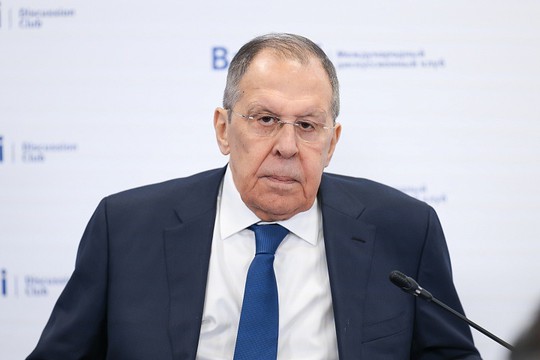
Photo: MFA
Speech by Foreign Minister Sergey Lavrov at 15th Middle East Conference
Moscow, February 9, 2026
Thank you, Mr Baklanov.
Thank you for inviting me to the latest forum, this time the 15th anniversary forum of the Middle East Conference hosted by the Valdai International Discussion Club.
You are absolutely right. The Middle East is the focal point of numerous global processes. Even if they originate elsewhere, many of these processes spill over into the Middle East in one way or another conflicting with the interests of other countries. Much to my regret, I don’t think things in this region will calm down anytime soon, despite the vast number of initiatives we are all aware of.
Many of them emerged shortly after the Arab Spring, when in 2011 the West set out to ravage undesirable regimes in Libya and Syria. Thankfully, not much blood was shed in Tunisia. The regime there changed without significant casualties. Iraq is on that list, too, of course, but Iraq was before the Arab Spring. Since then, we haven’t seen any developments that would be reassuring for political scientists and those who genuinely seek to promote peace. All of this has happened and continues to happen.
Developments are underway in Yemen and Sudan. The ripple effect of the developments in Somalia can be felt in the Middle East, especially after Somaliland had been recognised recently by our Israeli colleagues, and the ensuing reaction from Mogadishu.
All of this is unfolding against the backdrop of the principal trend which is driving the Palestinian issue into a hopeless impasse. This isn’t the first time this is happening, as the previous Trump administration promoted the Abraham Accords when the Saudi Arabian King’s 2002 Arab Peace Initiative was turned upside down. It proclaimed the creation of a Palestinian state and the recognition of Israel by the entire Arab world. Everyone hoped that this would actually come to pass. Moreover, after the Arab League endorsed this Saudi Arabian initiative, it was also endorsed at the Organisation of Islamic Cooperation summit in Beirut. All Islamic countries unanimously backed the initiative to recognise Israel in the context of the creation of a viable Palestinian state in accordance with UN resolutions. The Abraham Accords dramatically changed the sequence of events. First, everyone was supposed to recognise Israel, and, they said, we’ll see what happens next. We are now observing what stood behind “we’ll see.”
An extensive discussion focusing on Donald Trump’s peace plan took place at the UN General Assembly and the UN Security Council. We welcomed this plan, which, above all, was designed as the first step down the path of putting an end to bloodshed, resolving hostage issues, and exchanging dead bodies. In this sense, it is a positive development.
On the other hand, relapses into violence continue unabated. There is no clarity at all regarding the other components of this plan, including the complete withdrawal of Israeli IDF troops from the Gaza Strip, the disarmament of Hamas, the provision of humanitarian aid, and the organisation of executive leadership for this Palestinian enclave in the context (I emphasise again) of involving the Palestinian National Authority in this process and implementing UN decisions on the creation of a single Palestinian state.
At this point, nothing is clear with regard to these matters. It is likewise unclear what exactly these international security forces which are also part of this plan will be doing, and how they will go about doing it as all these issues have not been clearly spelled out in the resolution submitted by our American colleagues to the UN Security Council.
We held consultations with them and explained the issues that remain unresolved in both this resolution and the plan itself. They nevertheless decided to put this particular draft to the vote. We were compelled to abstain. Some even believed that such a resolution should not be allowed to pass and ought to be further refined. However, we received an insistent request from all Arab countries, our friends, including the Palestinians, not to block this resolution. That is why we and the People’s Republic of China abstained.
This, however, has not brought the components of this plan that I just listed any closer to the implementation. We get convinced on a daily basis that more efforts are needed. Yes, a Peace Council has been established, as have bodies subordinate to it, including an executive body made up of Palestinian technocrats. Their real powers remain unknown. We hope that these issues will be clarified all the more so as our American colleagues have now suddenly announced a transition to the second phase of implementation of President Trump’s plan. This phase includes reconstruction work and humanitarian issues.
The prospect of creating a Palestinian state remains the key issue. The arrangements can be made to provide temporary housing for the Palestinians. As you may be aware, nothing in this world is more permanent than a temporary solution. Everyone understands this. I would very much like this collegial body created at the initiative of President Trump to truly address the underlying causes of the conflict. Israel should be involved, because the issue is about creating two states. I’m diving deep into history and into details that directly affect the future of this entire region.
I cannot help but say that we are closely following the Iran-related developments. We welcome the mediation efforts offered by the Sultanate of Oman. Yesterday, I spoke at length with my friend, the head of the Sultanate of Oman’s Ministry of Foreign Affairs, Badr Al Busaidi. We believe this issue must be settled peacefully.
We understand that, as in the case of Palestine, some of the direct participants in the process may be tempted to use force and finish off their opponents, so to speak. However, this is the wrong approach. It will only lead to more problems and will in no way resolve the issue or ensure the security of any country. I think you are well aware of it. Therefore, we and our Chinese colleagues remain in constant contact with our Iranian friends. We are concerned and worried about Iran’s future.
There are many other angles to the Middle East situation. The region is in turmoil. Regarding Iran, we are interested in complete normalisation of relations between Iran and the Gulf Cooperation Council. After Saudi Arabia and the Islamic Republic of Iran restored diplomatic relations, I believe the door is now open. Regarding the conflict in Yemen, we are witnessing a trend towards cooperation among external players, including Saudi Arabia, the United Arab Emirates, and the Islamic Republic of Iran. We welcome this as well.
The Syrian situation has an extensive history of interaction between Russia, Türkiye, Iran, and other neighbouring countries. Libya also requires constant attention, as does Iraq, for that matter. Things in Iraq are not as hopeless as in Libya, and the differences there are not as acute. However, the fallout of the 2003 aggression, which undermined the foundations of statehood, has not yet been overcome.
Events are currently unfolding in Syria. In addition to maintaining unity and interethnic and interfaith harmony in the Syrian Arab Republic, the Kurdish issue has also become a pressing issue, affecting not only Syria but many other countries in the region as well. The events currently unfolding around the Syrian Kurds also deserve a separate discussion. This, as I earlier said, is an issue of regional dimension.
read more in our Telegram-channel https://t.me/The_International_Affairs