
 РУССКИЙ
 15:18 05.06.2026 •
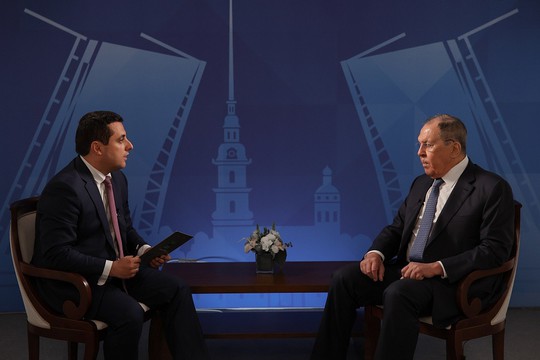
Photo MFA
Minister Sergey Lavrov’s interview with RT Arabic
St Petersburg, June 4, 2026
Question: We are speaking on the sidelines of the 29th St Petersburg International Economic Forum. My first question is about the political and economic significance of this event, particularly amid challenges facing Russia and precipitous changes in the international arena.
Sergey Lavrov: I believe any forum that provides a venue for dialogue is valuable, especially if it brings together representatives from all continents without exception.
Unlike other similar events, such as Davos and other Western-organised forums, where countries whose leaders pursue policies rejected or cancelled by the organisers are simply no longer invited, the St Petersburg International Economic Forum provides complete freedom of expression year after year. We’ve seen this on many occasions. People come here because they are interested in experiencing changes that are taking place in the international arena.
When I say “changes,” I mean the emerging era of multipolarity, the transition from the Western-centric model that dominated the world for the past 500 years to a polycentric organisation of international life, in which new centres of power, civilisation states such as China, India, Russia, and Iran, as well as African and Latin American countries, will take a place that reflects their real-world standing, their level of economic development, and contribution to world culture and technical progress.
At the global level, BRICS serves as a prototype of a polycentric world order; at the Eurasian level, that role is played by the SCO. The participants of these groups do not fence themselves off from the rest of the world, which includes our Western colleagues. Within APEC and the G20, for example, leading members of BRICS and the SCO work alongside Western representatives, primarily the G7, and uphold their own positions.
The fact that these forums, namely APEC and the G20, continue to function, and that within these entities the West is still compelled, albeit still trying to keep its dominance in place, to seek compromises, already represents considerable value. Truth be told, the G20 is facing a serious challenge as a result of the decision by the United States, which will host the G20 Summit in Miami later this year, not to invite South Africa. In fact, saying “they decided not to invite South Africa” doesn’t cover it; they have simply decided, unilaterally, to take it off the list. This is totally unacceptable. We are currently formulating our position on this matter both within BRICS and through our other contacts. This issue will take centre stage at the G20 Foreign Ministers’ Meeting.
Back to your question, the St Petersburg International Economic Forum is a venue that represents the entire spectrum of international politics where all centres of growth are presented at a very high and authoritative level.
What makes this venue unique? It facilitates dialogue not only among different continents and sociopolitical systems, but also among heads of state and government, cultural and scientific figures, and representatives of civil society.
It is an extremely useful forum that fosters mutual enrichment, where the same issues are discussed during round table discussions bringing together official and unofficial specialists and experts.
Question: Away from Western hegemony, as you say, who is primarily present here? We see Arab countries; Saudi Arabia is a guest. What does this indicate? A commitment to strengthening ties with the Arab region and the Gulf states?
Sergey Lavrov: Arab countries actively participate in the St Petersburg International Economic Forum every year. Other GCC members are also here, including the United Arab Emirates, which is very well represented and takes part in the discussions – as do our other partners from the region.
I believe our relations with this Arab “six,” and with the Arab world as a whole through the Arab League, are very close, constructive and comradely. In fact, they are exactly the kind of relations we want to build with all countries.
As for the Persian Gulf, of course we cannot ignore what is happening there as a result of US and Israeli aggression against the Islamic Republic of Iran. One of the aims of this reckless move, I have no doubt, was to derail the emerging process of rapprochement and normalisation between the Arabs and Iran, through discussions on the future of the Gulf and surrounding territories.
There is a Russian Security Concept for the Persian Gulf. We have just updated it, sent it to our GCC colleagues, and to Tehran as well. Now we await their response. All of this happened literally in the last few days. But the process of polycentricity and multipolarity will not be easy, of course.
I can also mention BRICS, which includes both Iran and the United Arab Emirates.
Question: Given the ongoing conflicts, you mentioned BRICS – what role does this association play in maintaining the balance of power in the region and ensuring stability?
Sergey Lavrov: The platform itself is always important. We held a BRICS Foreign Ministers’ meeting on May 14-15 this year, attended by representatives of Iran and the UAE. There was quite a serious spat between them. Nevertheless, India as the current chair, and the other BRICS countries at that meeting, certainly tried to find ways to initiate a dialogue between the Emirates and Iran. That dialogue has to happen eventually.
We see a readiness for such a dialogue on the part of a number of other Arab countries, including Saudi Arabia. Of course, those who stirred up this mess and launched this reckless move hate to see rapprochement between the Arabs and Iran – or even just normalisation of relations.
Our concept calls first and foremost for non-aggression. Incidentally, Saudi Arabia is now talking about non-aggression too. A non-aggression pact would probably be a good first step, but additional steps could follow, including an agreement on transparency in military activities, limits on military operations, notification of manoeuvres, and confidence-building measures more broadly.
I sincerely hope that common sense will prevail, and that this region will begin to agree on how all participants can coexist peacefully, without fear of military risks. We advocate for that and continue to work with our Arab colleagues.
Question: What, in your opinion, is currently standing in the way?
Sergey Lavrov: I’ve already mentioned that Israel certainly does not want rapprochement between the Arabs and Iran. The United States is taking an ambivalent position: one day they say an agreement is about to be reached and the Strait of Hormuz will be opened; the next, they say if Iran hesitates for two more days, we’ll start bombing again. Why even talk about Iran opening the Strait of Hormuz? It was already open, without any problems, until February 28 of this year. I don’t know what Washington means when they say they want to end the “47‑year period in which Iran terrorised everyone”. That is a propaganda slogan, unburdened by any serious historical analysis of what actually happened there.
But demanding the opening of the Strait of Hormuz? It was open. And all that talk about Iran and Muscat (the Omanis) now planning to impose a toll on passage, and them not allowing it to happen? There never was such a toll until this aggression began.
The second point, which US Secretary of State Marco Rubio reiterated in his recent testimony to Congress, is that Iran must accept that it will never have nuclear weapons. Until the attack on Iran in June 2025, the entire leadership was united around the fatwa of the recently assassinated leader of Iran, Ali Hosseini Khamenei. That was essentially a political assassination. And if anything could change the mood among Iran’s elite, and in Iran as a whole, regarding its commitment to the principle of non‑nuclear weapons, it would be this aggression: the actions that the US and Israel have carried out and continue to carry out, absolutely without any justification.
And everyone is watching what happened to those countries that once pursued nuclear weapons. The first technical steps in this area have already been made, as was the case in Libya. As soon as that “problem” was closed, as soon as Libya renounced its nuclear weapons, Muammar Gaddafi was overthrown and mockingly killed live on television, to the delight of Hillary Clinton, who sat in front of the screen practically applauding. Meanwhile, those who have nuclear weapons... This is the logic that many developing countries have already explained to us.
Take the DPRK. That country is not a party to the Nuclear Non‑Proliferation Treaty. It simply concluded that without nuclear weapons, it would be wiped off the face of the earth. The North Koreans have acted on that choice, and no one bothers them.
I am not suggesting that everyone should follow this path. But there has never been any suspicion regarding Iran. The IAEA has regularly stated in its reports that there are no signs of Iran diverting any aspect of its nuclear or energy programme to military purposes. And so far, no one has produced any evidence to the contrary. Yet Washington has made an unfounded accusation.
The Americans made an utterly unimaginable move in Venezuela. Even I cannot recall anything like it. Under the pretext that President Nicolás Maduro was allegedly running a drug cartel, they kidnapped him – but immediately announced that they had interests in the oil sector, and that they would “take over” Venezuela’s oil industry and explain to their Venezuelan colleagues what to do, who to sell to, and who not to sell to.
It started with Iran, too. They said Iran had been promoting international terrorism for 47 years. It quickly became clear that the real reason was oil. At one point, the Americans proposed a 50‑50 split between them and Iran in the Strait of Hormuz. It is all about oil again – about global energy markets. But this is also causing inconvenience and heavy losses for Arab countries. We know that well.
Yes, they will now look for alternative routes and build new pipelines. But that requires capital investments, all those costs – and the natural routes that have suited everyone for decades are now under enormous risk. Now the Bab el‑Mandeb Strait could become another flashpoint. So the consequences of this aggression are obvious to everyone. I sincerely hope that lessons will be learned.
Question: I would like to ask about another conflict, the Ukrainian one. In your opinion, what are the chances for achieving a peace settlement?
Sergey Lavrov: We are always ready, as President Vladimir Putin has said many times, to have talks, but we see that the other side is not ready. Moreover, and most importantly, there are no counterparts capable of reaching a deal. However, the very fact that the Kiev regime which has come to power following the February 2014 government coup is totally incapable of reaching any kind of an agreement is so obvious that, I think, we do not have to persuade anyone that this is the case. Even those who cover up, finance and arm this regime know well what it is worth.
The Europeans have been seeking to shield and protect Vladimir Zelensky with so much zeal and vigour for the only reason that he is fighting against the Russian Federation for Europe, for western interests and for the Western overall agenda which consists of eliminating Russia as a competitor. They tried doing this ahead of World War I, and during World War II, and many times over. They proceeded along the same lines during the Crimean War.
Today, we have started hearing statements coming from European capitals saying that they need to talk to Russia, after all, while alleging that it would be up to them to decide when to speak to Russia and about what. At the same time, I would have preferred to refrain from repeating what Kaja Kallas has been saying, since she is still the European Union’s High Representative for Foreign Affairs, when she talks about the European Union demanding that Russia sit down at the negotiating table but only after slimming down its army and stockpiles and setting some kind of a cap. Kaja Kallas and many other European representatives have openly stated that Europe would not be a mediator at the negotiating table. But in that case, what will be Europe’s role? Will it be tasked with imposing its terms and accepting Russia’s surrender?
Europe has misled Russia and the entire world many times on the Ukraine issue, starting with the government coup. It happened within 24 hours after France, Germany, represented by its current President Frank-Walter Steinmeier, and Poland undertook to act as guarantors under a peace deal between then President of Ukraine and the opposition. But the very next morning, the opposition trampled upon these guarantees, while the West pretended that this constituted what they called an iteration of the democratic process. A year later, in February 2015, the Minsk agreements were signed, and once again, there are signatures of Germany and France on these documents, as approved by the UN Security Council. And all this came apart. Moreover, both Angela Merkel, who was the German Chancellor at that time, and then President of France Francois Hollande who signed this document – both said that no one ever intended abiding by these agreements. All they needed was to win some time in order to arm Ukraine and enable it to be more effective in its war against the Russian Federation.
The West had so many opportunities to assume a mediating role. Today, the European Union claims that it is not a mediator since it is firm in its commitment to siding with Ukraine. I was surprised that this was precisely what Secretary of State of the United States Marco Rubio said during his recent appearance at the US Congress: he would like the conflict in Ukraine to end this year, even if the chances for achieving this outcome are quite low in his opinion since the parties to the conflict, especially Russia are not ready to make concessions. What a strange thing to hear from a person who took part in the Anchorage meeting on August 15, 2025, where President Vladimir Putin accepted the proposal floated by President of the United States Donald Trump regarding the priority steps for stopping hostilities and launching talks on a political settlement in all its aspects. It was strange for Washington to change its position after we expressed out agreement with the proposals that the United States had put forward in Anchorage. Instead of working on these proposals in their interactions with the Ukrainians, the United States is now pretending that it is up to the conflicting parties to deal with this. Not exactly a consistent approach.
In his remarks at the US Congress, Secretary of State of the United States Marco Rubio said that Russia was not ready to make concessions, and went on to point out that the United States was not a mediator because the US is consistent in supporting Ukraine by continuing to supply it with the required amounts of weapons and military hardware. In this situation, let me repeat that when someone tells us that we are the ones who are not ready to launch talks, I must stress that we were ready many times over. Not only were we ready but we had held these talks on multiple occasions, supported these processes and signed the relevant documents. As for the West, it is uncapable of reaching deals and negotiating. Its guiding principle can be described the following way: I can promise something at a specific point in time only to stretch the time, so that, much like in an Arab saying, either the donkey or the padishah it carries die. There is a lot of dishonesty in this policy line, since it is designed to obtain and accumulate unilateral benefits, returning for more concessions, etc. Unfortunately, this is the dominant posture at this juncture.
Considering what Secretary of State of the United States Marco Rubio said on supporting Ukraine – and I have been maintaining working ties with him, since we discussed the Ukraine situation just two weeks ago – nothing sets apart the approaches of the United States and Europe anymore. The United States seeks to offer a more positive visions since they always advocated dialogue with Russia from the very moment when Donald Trump started his second term at the White House.
Apart from the Anchorage meeting, President of the United States Donald Trump has been in touch on a regular basis with the President of Russia. They have had many telephone conversations. Marco Rubio and I met several times in person and have telephone conversations every now and then. During his appearance at the US Congress, he said that there is always a need for dialogue and that the United States would never reject dialogue. They must be recognised and lauded for this posture. But it is not only dialogue per se that matters. Carrying out the agreements is equally important. Once again, let me stress that we reached a clear understanding in Alaska based on a specific proposal by the United States. Had the United States been serious about ensuring that its initiative materialises, we would have been sitting at the negotiating table for a long time now, while hostilities would have ceased.
Question: In light of what you have said, how do you currently view Russian-American relations overall? Why are European countries so diligently attempting to derail any rapprochement?
Sergey Lavrov: To be perfectly honest, I believe the essence of the West’s position remains unchanged. It is that the West wishes to continue dominating, as it has done for many centuries in world politics, and believed that the “end of history” had arrived when the USSR collapsed – but things turned out quite differently. The objective course of events, the objective development of humanity, has ushered us into an era of a multipolar, polycentric world order, in which new centres of economic growth, financial power, and political influence naturally demand for themselves a worthy place in any structures engaged in global governance – a place commensurate with their real weight on the international stage.
This process is historically determined, objective, and unstoppable, yet the West is doing everything in its power to slow it down, resorting to a vast array of underhanded methods: from illegal sanctions, restricting access to financial instruments, and excluding undesirable countries from multilateral structures, all the way to interfering in internal affairs, influencing elections, and even military invasion, as we have witnessed on several occasions.
Therefore, when the United States advocates for dialogue, we support it. Europe, in its current state – under the leadership of these elites – is, for me as for global diplomacy, a lost cause. Voices are heard there saying that they will eventually talk. This is all frivolous; they have had a great many opportunities, all of which they squandered. When, after returning to the White House, Donald Trump telephoned President Vladimir Putin, they agreed to resume dialogue. We actively welcome this. The dialogue continued: I met with Marco Rubio in Riyadh in February 2025, followed by numerous contacts, including the summit in Alaska. US President Donald Trump stressed publicly that if he had been president at the time, there would have been no war in Ukraine – that it was, allegedly, Joe Biden’s war, that no one needs it, that people are dying, and so on. However, what US Secretary of State Marco Rubio said in Congress about the role of the United States not as a mediator, but as a country supporting Ukraine, suggests the opposite: that Joe Biden’s war has become Donald Trump’s war. Moreover, the Pentagon has a budget within which the programme of support for Ukraine is approved up until 2029 – that is, practically three and a half years ahead.
A couple of weeks after the summit in Alaska, the United States announced sanctions against Lukoil and Rosneft, while all the sanctions imposed by Joe Biden are being extended. Washington has declared its goal to dominate global energy markets – hence the Venezuelan “episode,” and hence the squeezing out of Lukoil and Rosneft from their entirely legitimate projects outside the Russian Federation, and much more besides – which testifies to the desire of the United States first and foremost to subordinate to itself the key sectors of the global economy, primarily energy, and thereby control the processes that will be used to exert pressure on China, on the Russian Federation, and on other competitors.
Therefore, we appreciate that the United States has taken a position, first, in favour of dialogue, and second, President Donald Trump has clearly stated that there will be no NATO membership for Ukraine and that the realities on the ground must be taken into account – those realities that took shape after the referendums on returning to Russia. This is precisely what underpinned the proposals put forward by the Americans in Alaska.
Secretary General of the North Atlantic Alliance Mark Rutte went to Kiev, where he stated directly that Ukraine will be in NATO. He does not give a damn that the United States, in the person of President Donald Trump, considers this unacceptable. Mark Rutte simply declared, embracing Vladimir Zelensky, that Ukraine will be in NATO. And as for the recognition of the realities on the ground that emerged from the struggle against the Kiev regime, as well as the will of the population of the territories of southeastern Ukraine, Vladimir Zelensky stated publicly – and Europe supports him – that there will be no recognition. He declared that he would stop the war, build up his forces, and then continue to reconquer “his” lands, so that the Nazi regime could be preserved there – or rather, restored.
Europe is dragging Ukraine into NATO because it finds it easier to admit it into the Alliance than to take the fateful step of including Ukraine in the European Union. In the latter case, the European Union would fall apart. They understand this perfectly well. In NATO, there will be joint production of armaments – it already exists – military technologies, and so on. But at the same time, Europe says: stop the Russians, present them with our terms, and provide security guarantees to whatever Ukraine remains after the ceasefire. But this means they want to perpetuate the Nazi regime, without demanding from it any compliance with the UN Charter, its own constitution, or the numerous conventions whose provisions concern guarantees of linguistic, religious, and other rights of national minorities. Russians are, of course, not a minority in Ukraine, but the Russian language, culture, education, and media have been banned by law. Europe wants to perpetuate this, maintaining a permanent bridgehead for creating threats to Russia.
Question: And to fight, as they initially said, to the last Ukrainian.
Mr Lavrov, thank you very much for this substantive interview.
read more in our Telegram-channel https://t.me/The_International_Affairs

















