РУССКИЙ
 13:10 10.02.2026 •
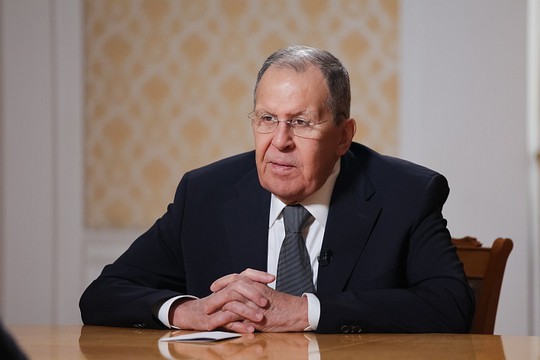
Photo: MFA
Foreign Minister Sergey Lavrov’s interview with NTV television channel
Moscow, February 10, 2026
Question: Mr Lavrov, our conversation coincides with Diplomatic Worker’s Day. First of all, I congratulate you on this professional holiday. Speaking of the global picture, what would you say are the main challenges and key issues currently facing Russian diplomacy?
Sergey Lavrov: The principal challenges confronting the world are well-known. I refer to the trends and phenomena we are observing. It is difficult to predict where these developments will lead. However, President Vladimir Putin has repeatedly addressed the unfolding global processes. These are objectively shaped by the entire course of history and contemporary developments – where, after 500 years of Western dominance, sustained through slavery and colonialism at the expense of others, a multipolar order is now emerging to replace that system. This shift is not artificially contrived; it is rooted in objective trends – the rise of new centres of economic growth, financial power, and technological innovation, where social challenges are being effectively addressed.
This evolution naturally translates into political influence. Countries such as China, India, and Brazil, alongside integration blocs like the GCC and such Eurasian sub-regional groupings as ASEAN, our post-Soviet structures, such a the CIS, the CSTO, the EAEU, and the Union State of Russia and Belarus – are increasingly asserting themselves as influential actors on the international stage, not only in economic, trade, and financial spheres but politically as well.
The West is resisting this fiercely. Europe persists in attempting to dictate its approaches across the Eurasian continent, blatantly obstructing and undermining the natural processes of cooperation between Russia and Central Asian states, as well as our allies in the South Caucasus. Europe is aggressively pushing into the Black Sea region, disregarding the existing Organisation of the Black Sea Economic Cooperation (BSEC). The same applies to the Arctic.
Until recently, the European Union considered itself both capable and, crucially, entitled to interfere in all these processes and claim a dominant role. Their ardour has since cooled, particularly in light of the policies pursued by the administration of US President Donald Trump, which do not prioritise European security interests.
On the contrary, it has been declared that the United States has other preoccupations – primarily in the Western Hemisphere, though not exclusively. Some argue that this new US National Security Strategy effectively constitutes an admission by Washington of the need to divide the world – asserting, “this is our sphere of influence, while China and Russia have their own.” Yet this interpretation is not entirely accurate.
US Vice President JD Vance recently stated unequivocally that the goal is “America First” – globally, across the entire planet. The United States has its interests, and these will dictate its actions.
The Western Hemisphere is not even up for discussion – everyone must forget about it. The Middle East, however, remains a priority due to Israel, Washington’s closest ally, which must be unconditionally supported in its confrontations with Iran, Palestine, Syria, and Lebanon. This is hardly a retreat from US ambitions to lead in the region. The same applies to the Indo-Pacific.
Certain analysts suggest that the United States will now leave Europe to its own devices, seek to pacify the Middle East – halting yet another war – and negotiate with Russia to remove the Ukrainian issue from the agenda. As President Trump has implied: This is not my war; I did not start it, and it is merely an obstacle. We will set it aside and then pursue vast mutually beneficial projects with Russia. The specifics vary, but the underlying implication is clear: by resolving the entrenched problems in Europe, particularly around Ukraine, and thus normalising relations with Russia, the US could concentrate all its efforts on countering China.
This encapsulates the assessments of both Russian and Western political analysts who have examined the US National Security and Defence Strategies. In truth, the Americans make little effort to conceal this.
Speaking of the gist of your question, I could make it brief, but I would like to go into details. We find it important to guarantee our national interests. We agree with the administration of Donald Trump that the foreign policy of normal major powers, especially such as the United States and Russia, should be based on national interests.
I have already quoted US Secretary of State Marco Rubio when we held our first joint meeting in February 2025 in Saudi Arabia. At that time, he said that when US and Russia’s national interests coincide, it is necessary to take advantage of this and implement mutually beneficial projects. More often than not, such interests will not coincide, and, in such cases, it would be a crime to allow these interests which do not coincide to escalate into a hot confrontation or any form of confrontation. We agree with this.
We now hear US President Donald Trump and his team, Steve Witkoff and Jared Kushner (who are dealing with Ukraine, the Middle East, Palestine, Iran, and who are also analysing prospects for Russian-US trade and economic cooperation) say that it would be great to completely resolve the Ukrainian issue, in the first place. They can see root causes, they are ready to facilitate a settlement by eliminating these root causes, they are saying that Ukraine should not join NATO, that it is necessary to address the territorial issue in accordance with current realities that have shaped up as a result of the expression of the will of the people who live on these territories.
During the Alaska summit, we came close to reaching an agreement, and we hoped that, considering the fact that the Russian leader eventually accepted the US leader’s proposal, this could simply be announced, and that numerous issues would be resolved much faster.
Unfortunately, time marches on. Europe and Vladimir Zelensky are trying to throw US negotiators off balance, and are enlisting the services of the domestic US opposition. There are many Russophobes there who believe that Ukraine cannot be left alone, and that it should be directed against Russia, armed and so on.
Nevertheless, they are regularly making other assessments, saying that the United States and Russia have wonderful prospects, including the Arctic, hydrocarbons, space exploration, artificial intelligence and cutting-edge technologies. We wholeheartedly support this and are ready to expand mutually beneficial cooperation with the US. The US business community and officials playing the leading role, including President Donald Trump, as we understand, are interested in this.
If we analyse practical steps taken by US President Donald Trump and his team with regard to Russia during the Trump administration’s second tenue in the White House, then we can see that we are moving in the wrong direction.
The sanctions are still here. Moreover, two weeks following the Alaska summit, an illegal US decision banned all foreign projects of Lukoil and Rosneft. We already know (they are not trying to conceal this fact) that US President Donald Trump contacted all countries buying Russian oil and gas. Following his talks with India, he announced that India will not be buying Russian oil.
India did not confirm this, but the idea is to seize the global energy carriers’ market. In their contacts with partners from third countries, US representatives are saying that these countries should not buy energy carriers from Russia, that they should buy American oil which is good, although slightly more expensive. During the times of Joe Biden, they called this the “right molecule,” and the Republicans also have their own terminology.
Question: Can Russia do anything to counter this?
Sergey Lavrov: Our leading positions on the global nuclear energy market also pose a challenge for the Americans. The Americans are working to impose their own standards on the energy sectors in the countries where we are operating projects, including in neighbouring European countries. They are not hiding this, either.
I’m not even mentioning sanctions and tariffs, which are raised sky high for the countries that are not following what the Americans are telling them about how to do business with the Russian Federation. Our approach is set forth by the President and relies on our national interests. We reject methods that employ trade, economic, or currency wars, because they are abusing the US dollar on an unprecedented scale. The main thing is the Americans are entirely comfortable with this approach.
US Secretary of the Treasury Scott Bessent is quick to act when it comes to condemning others or imposing sanctions. Just yesterday, he said the United States completely cutting off dollar flows to Iran sparked the unrest leading to mass protests and loss of life. He takes pride in that.
We have repeatedly made it clear that we must not get exuberant about US President Trump “cutting Europeans and Zelensky to size” and demanding that they comply… All of that sounds good if we want to achieve peace in Ukraine, but we are not there yet. Negotiations are underway; the second round took place in Abu Dhabi, but there’s still a long way to go.
Question: Can we draw any conclusions from the second round? The initial idea was for the talks to be bilateral, but they ended up as a trilateral meeting with the Americans joining them. Is that development positive or negative?
Sergey Lavrov: I do not think there were serious reasons for changing the format. My understanding is that initially, when the second round in Abu Dhabi was agreed upon, US Special Envoy for the Middle East Steve Witkoff and Jared Kushner had other commitments during that period. Later, their schedule was adjusted. These matters are of secondary importance.
They are well aware of where we stand regarding the Ukraine settlement. The root causes will not go anywhere unless we consider eliminating them in any peace agreement we may sign. We are ready to do that. We have said many times that President Trump publicly recognised our interest in NATO not expanding any farther. That is a huge step. No other Western leader has ever said that publicly, while he has reiterated it on several occasions.
The people living on their own land who did not agree with the fact that neo-Nazis came to power in Ukraine through an illegal coup in 2014 were declared terrorists just for refusing to accept the illegal government and told to “make it off” to Russia. All of Europe ignored its own promises and said another lie. Nothing can be resolved without addressing these two issues. Nor can anything be resolved based on the disingenuous policy that Europe is currently pushing forward. Zelensky is playing along all he can, claiming that the most important thing is to end human suffering, stop the bloodshed immediately, and provide security guarantees to Ukraine. And then we will see. What does this mean? It means, as Zelensky earlier conveyed, they will stop at the line of contact as it is today, but will not recognise anything and make no legal concessions. All of that belongs to them, and they will simply temporarily save lives and continue receiving additional military aid in much larger volumes on the remaining territory under the banner of providing “security guarantees to Ukraine.”
British Prime Minister Keir Starmer and French President Emmanuel Macron, alongside NATO Secretary General Mark Rutte, openly take pride in the fact that “expeditionary troops” of intervening countries will be deployed there, and there will be an “automatic guarantee” that the United States will support them militarily.
I will not go into the minutiae of us discussing this matter with the Americans. We asked them directly, though, if it was true. I have no doubt that neither the Europeans, nor Zelensky will find the answer positive. But the logic itself of “what will remain of Ukraine” should rely on the most concrete and enforceable security guarantees.
Regarding what the regime looks like deep down, this regime has banned everything Russian across the board, including education, media, culture, daily life, and the canonical Ukrainian Orthodox Church. The regime legally promotes the Nazi ideology and practices, including ritual torchlight processions, and other satanic ceremonies, and will remain in place. Does it mean they are willing to provide security guarantees to this particular regime?
Question: What did they tell you in response to this question?
Sergey Lavrov: Nobody is saying anything. We are simply bringing these questions up.
I am confident that the Americans are aware of our arguments. In a recent interview, I mentioned that the original plan discussed in Alaska included the requirement to restore the rights of Russians, Russian-speakers, ethnic minorities, and religious rights. This is not a whim. We are told we will bargain over who gets what later; stopping the war is what matters now. How can you negotiate over what you don’t own? Respecting human rights regardless of race, gender, language or religion is what the first article of the UN Charter says.
If you look back at it, in all discussions on Ukraine following the coup, not a single European, nor a single American politician or leader, has used the term “human rights.” They are simply out of the picture.
European Commission President Ursula von der Leyen says every day and at every turn that one must “stand with Ukraine,” because it defends European values. So, their values include Nazism, Russophobia, and an unprecedented assault on the Russian language. Nowhere else around the world, any conflicting parties, take the Arab-Israeli conflict or any other, no one outlaws the language of the other side.
Here, they are talking about the “aggressor’s” language. The delusional Mirotvorets website. Will all of that remain under Western “security guarantees?” Does a civilised country blacklist references to Mikhail Lermontov, Alexander Pushkin, Mikhail Bulgakov, and Nicholas II as symbols of Russian imperialism? We will demand to provide specific answers to these questions. Security guarantees to whom and to what end?
Question: Even based on the issues, problems, and grievances you have outlined, it appears that the negotiating track is currently without prospects.
Sergey Lavrov: The negotiating track consists of several components: addressing the root causes, which our position rests upon, ensuring Russia’s security, and guaranteeing the rights of Russians and Russian-speaking population in Ukraine in full accordance with international law and the UN Charter.
The recognition of territories is an issue that arises directly from these root causes, as these territories came under Russian control following attempts to threaten our security and to persecute the people who had lived there for centuries. These matters are under discussion. The details being considered by the military are extensive and consequential. Everything must be worked out down to the finest detail, because when – I hope it is “when,” not “if” – a settlement is reached, and when the United States compels its partners in Ukraine and Europe to act responsibly, mechanisms for implementation and oversight will require careful coordination, above all between military structures.
We have already had unfortunate experiences: the February 2014 agreement between then-President Viktor Yanukovych and the opposition collapsed; later, the Minsk agreements – a document of higher standing endorsed by the UN Security Council – were disregarded, as well as all these councils and statuses. Years afterwards, when we started the special military operation, former German Chancellor Angela Merkel and former French President François Hollande stated openly that there had been no intention of implementing those agreements or granting special status to Donbass.
Let me recall that the initial objective was to enshrine a special status for Donbass within Ukraine’s Constitution. This commitment was reaffirmed at a meeting convened by French President Emmanuel Macron in December 2019. President Zelensky attended: it is sometimes broadcasted on TV how he sat there grimacing. Documents were adopted stating that constitutional amendments would establish permanent special status for Donbass. These commitments were never fulfilled.
No progress was made either when, a few weeks after the special military operation was launched, we accepted the Ukrainian proposal discussed in Istanbul in April 2022. Security guarantees were also central to those discussions.
Please note the definitions there. The document was initialled by the delegation; subsequently, however – primarily under British influence, though Europeans may also have been involved – Ukraine was made to withdraw. The proposal envisaged permanent members of the UN Security Council, including Russia and China, acting as guarantors, with possible participation by Germany and Turkiye. That is roughly how it was described.
In essence, these guarantees meant that if something inconsistent with the agreements happened, all guarantors would convene and decide collectively by consensus. This arrangement suited us, as it reflected a genuinely collective approach to security guarantees.
Today, however, that framework has been set aside. Current security guarantees for Ukraine no longer comply with a broader European security context, but are rather designed to sustain policies hostile towards the Russian Federation.
I have no doubt that American mediators understand this situation well. Russian President Vladimir Putin has communicated directly with them on numerous occasions, and there are additional channels to convey our current positions to them. We shall see how willing and determined the United States will be in persuading its counterparts to accept these fundamental positions.
Question: Do you see Europe at least in some quality in the matter of Ukraine settlement? Emmanuel Bonne, allegedly the diplomatic advisor to the President of France, visited Moscow. Are there any shifts at that end?
Sergey Lavrov: There are contacts that some our neighbours in Europe are attempting to establish through various channels. Honestly speaking, nothing new by comparison with what those countries say in public comes to us through these channels.
You know, certain leaders visited [Moscow] some time ago (including President of France Emmanuel Macron, and there were contacts with the then German Chancellor, Olaf Scholz). All that they were saying in the course of their confidential contacts with President Vladimir Putin tallied with their public vociferous statements to the effect that Russia had attacked [Ukraine], that Russia should stop the war, and that they must defend Ukraine to the last – until they “inflicted a defeat.” By delivering these messages during their contacts, they were attempting to assume a mediating function.
Now they have calmed down a little and their demands for “inflicting a defeat” are not so loud, but they are still all of a fidget. The Merzes, Pistoriuses, and their ilk have officially declared that they should be ready for war with Russia by 2029 or 2030. Please note that they are gloating and palming off the frontline situation as going from bad to worse for us. They claim that we are increasingly weaker and the Russian economy is in a decline.
They juggle with this every day. In parallel, illogically, they are urging everyone to prepare for war with Russia, because allegedly it will “attack” in three years time. It would be a good thing if they sorted out their arguments.
Question: They will tell you that Russia will stop the conflict in Ukraine and start preparing. It will be ready precisely by 2029 or 2030.
Sergey Lavrov: We wouldn’t care.
President of Russia Vladimir Putin has said that in Ukraine we are pursuing a special military operation. We are not going to attack any Europe. We do not need this at all.
If, contrary to expectations, Europe does implement its threats to prepare for war against us and attacks the Russian Federation, we will not launch, as President Vladimir Putin has put it, another special military operation. Our response will be a full-blown military retaliation involving all available forces and assets in keeping with the doctrinal documents to this effect.
Currently, we hear increasingly more sane voices. But Europe is in a tattered state. Greenland has shown how tenuous the image of solidarity, team spirit, and mutual understanding that has been created for both NATO and the EU is. I don’t know how Europe will…
The signals they are sending via different and not quite public channels imply that they are also part of the problem and the process, and therefore must have a seat “at the table.” But they also say so in public and therefore there is nothing new in this regard either.
Some three weeks ago, President of France Emmanuel Macron announced again that he would call President of Russia Vladimir Putin as soon as he prepared something. Next they say that it is necessary to prepare the technical aspects of the conversation with President Vladimir Putin. But this is not serious. If you want to put through a call, do so. Mature leaders usually announce their contacts following the conversation they have held. These announcements, by contrast, resemble a situation where you are preparing a show and need to excite as many spectators as possible. Europe is what it is.
Question: Getting back to our relations with the United States. The New START Treaty has expired. We are now in a situation where verification mechanisms and reciprocal inspections have been non-existent for several years now. Quantitative caps are no longer available which makes things really scary, because a false signal about a missile launch can send the world down the path of mutual destruction.
How can this situation be overcome in Russia’s opinion? The United States, for its part, is not in a hurry to make progress in this regard. What does Moscow think about this? Or, do you think, the issue has been put off to a much later date when Russia-US and Russia-Europe relations will get normalised?
Sergey Lavrov: We see the situation for what it is. It goes to show for the umpteenth time that the army, the navy, and now the aerospace forces remain our key allies no matter what international treaties on strategic stability, arms limitations or security we may have signed with whoever it may be. We will rely on them. We feel confident about the readiness of our combat systems. We are confident that they guarantee our security hundred percent safely. Our adversaries are aware that if they try to engage in aggressive behavior or to subvert our sovereignty they may get a response that they will find absolutely unacceptable. I’m talking about the fundamentals of nuclear deterrence which have always been in place.
I wouldn’t make a drama out of this situation and say that the treaty has fallen apart, because it has, in fact, been invalid for the past three years.
Question: Has it been renewed?
Sergey Lavrov: It hasn’t. It was fully suspended. When it was suspended, we said that the United States – the Biden administration – has devalued the treaty by adopting an openly adversarial position. The New START was built on the principles such as mutual respect, consideration of each other’s interests in matters of security, and so on. All of that was torn up by the Biden administration. You may remember what it did to and said about the Russian Federation.
We told them the terms we came to with President Obama were quite different. Since you rejected these terms out of hand, we will suspend the treaty. You are loudly telling everyone that we are the “principal threat” and must suffer a “strategic defeat,” but are standing at the gate to our nuclear facilities ready to inspect us? That’s not going to happen.
We suspended the treaty in full, but President Putin, as a gesture of goodwill, announced that we were prepared to adhere to the treaty’s central quantitative indicators for the remainder of its term. That’s how we agreed, and the Americans followed our agreement. The suspended treaty has become fully invalid on February 5. It simply no longer exists.
As another gesture of goodwill, President Putin proposed in September 2025 to consider extending these voluntary moratoriums on increasing the treaty’s central quantitative indicators on a reciprocal basis. This did not happen.
Question: Have the Americans responded?
Sergey Lavrov: No. But this is a known fact. We spoke publicly.
Question: Still nothing?
Sergey Lavrov: There will be no further response.
The Foreign Ministry issued a detailed statement reflecting the relevant agencies’ position, which was approved by President Putin. It says it all.
We will closely follow what the American side will do now that formal restrictions are no longer in place. We will treat this situation with full responsibility and we will not be the first to escalate.
What are the Americans planning to do? US President Donald Trump said the treaty was bad, and that it has allegedly been violated. What violations did he see on the Russian side? I have no idea. We had serious questions about the strictness of compliance with the treaty’s requirements, which the Americans had not answered. On our part, though, we did not allow such things, at least while it was fully in effect for us.
President Trump said again it was time to make a deal with the Chinese. The Chinese have stated their position repeatedly, and we respect it. But if the emphasis is shifted to having three participants, it could simply be a push to shift the focus of the discussion. Meanwhile, the Americans have taken Britain and France out of the equation even though they have binding alliance obligations with the United States (unlike Russia and China) to go to war together. And, of course, it’s difficult to imagine a long-term multilateral agreement without considering their potentials.
Question: Mr Lavrov, recently Polish Prime Minister Donald Tusk stated that Jeffrey Epstein was most likely an agent of the Russian intelligence services. Allegedly, what was happening on his island was to be used as compromising material that ended up in the hands of the Russian intelligence services and could be used to influence Western elites, including Donald Trump. Is Jeffrey Epstein a Russian spy or did he collaborate with the Russian intelligence services?
Sergey Lavrov: Please don’t go into the gutter press narratives.
Question: But this is what’s being discussed now and takes us back to the first question: how will Russian diplomacy respond?
Sergey Lavrov: This is not up for discussion. They’re trying to irritate people in countries that aren’t particularly well-liked by some people in other countries’ political circles. They’re trying to use this in the United States against both the Republican and Democratic parties. Europe has already seen diplomatic figures fired from their position. In England, some lord was shown somewhere sporting underwear, and then proudly resigned.
Speaking about the influence this group of people Epstein’s island wielded, any intelligence service would probably consider it an honour to recruit Jeffrey Epstein. But we’ve never been interested in doing that.
They’re trying to find Russian traces in this stack of millions of pages. As Vladimir Vysotsky famously said in a song of his, “Our reach around the world is particularly evident in countries further afield.”
Question: So you know nothing about this?
Sergey Lavrov: I’d rather not discuss it altogether. This topic has nothing to do with the diplomatic work. It has everything to do with exposing the countenance known as the collective West. It’s no longer called the deep state, but a deep alliance that rules the entire West and is trying to rule the rest of the world. Any right-minded person would agree that this is pure Satanism and is beneath human comprehension.
read more in our Telegram-channel https://t.me/The_International_Affairs