РУССКИЙ
 0:30 04.03.2026 •
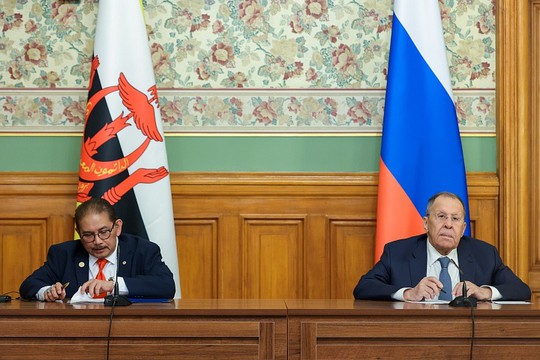
Photo: MFA
Foreign Minister Sergey Lavrov’s statement and answers to media questions at a joint news conference following talks with Second Minister of Foreign Affairs of the State of Brunei Darussalam Erywan Yusof:
Colleagues,
Yesterday afternoon and today, we engaged in substantive discussions with Second Minister of Foreign Affairs of Brunei Darussalam Erywan Yusof.
Brunei is a long-standing and reliable partner of ours in the Asia-Pacific region. This year marks the 35th anniversary of diplomatic relations between our nations. Firstly, we acknowledged that, through our collaborative efforts over this period, we have achieved considerable progress. Secondly, we agreed to celebrate this milestone in October of this year with substantive agreements, including the preparation of new documents and political engagements.
We conducted a thorough examination of the current state and future prospects of our collaboration. Concrete additional steps were agreed upon to advance political interactions. Specifically, we resolved to develop a consultation plan between the Ministries of Foreign Affairs of Russia and Brunei, ensuring that this document serves as a regular guide for the work of our respective departments. We also agreed to further strengthen collaboration in security, particularly through military and special services channels. Our experience in military cooperation is robust, encompassing personnel training at Defence Ministry institutions, reciprocal visits by naval vessels – a valuable practice – and joint exercises. A working group on defence cooperation is already operational and will convene its second meeting in the coming weeks.
Discussions also encompassed the expansion of inter-parliamentary, interregional, cultural, and academic exchanges. Signed memoranda exist for each of these areas, providing frameworks for further development. Significant potential exists for deepening practical collaboration, especially in energy, high technology, agriculture, including halal products, and other sectors.
We noted the importance of sustaining the rapid growth of our bilateral trade, which reached a record high of nearly 900 million dollars last year. Promising opportunities lie ahead in Islamic banking, an area where both Brunei and the Russian Federation – particularly the Republic of Tatarstan – have accumulated considerable expertise.
Tourism emerged as a distinct topic, though it currently plays a minimal role in our relations, limited to isolated instances of individual travellers visiting Brunei. We aim to establish this on a more regular basis and sensed mutual interest among our Bruneian counterparts in expanding tourism to the Russian Federation, highlighting a convergence of interests.
We anticipate Bruneian participation in upcoming annual forums hosted by our country, such as the St Petersburg International Economic Forum, the Eastern Economic Forum, and the Innoprom exhibition. The evident interest in these events will further broaden the scope of our practical cooperation.
Our positions on pressing global and regional issues are either aligned or closely convergent. Both nations remain committed to the principles of international law, particularly those enshrined in the UN Charter, which currently faces severe challenges due to actions by the US administration aimed at overthrowing legitimate governments and inciting new conflicts across various regions.
The events in Venezuela remain fresh in our collective memory. Daily threats against Cuba are heard by all. We observe the developments in the Palestinian-Israeli settlement process, where UN resolutions are being disregarded. Effectively, there is a move to consign to oblivion all resolutions concerning the establishment of a Palestinian state. This cannot fail to provoke profound concern. As I have just stated, our positions here are fully aligned.
Undoubtedly, the most prominent conflict – indeed, war – of the current day is the aggression against the Islamic Republic of Iran. Its repercussions are already being felt across the region, including in Arab states, which are also bearing costs, both economic and human.
We deem it imperative to categorically and resolutely call for an immediate cessation of hostilities from all sides. As an unconditional first step, every effort must be made to halt any actions resulting in civilian casualties, whether in Iran – where more than 150 schoolgirls perished in a strike on their school – or in any other country bordering the Persian Gulf. Civilian infrastructure is also suffering in our friendly Arab states.
As I have emphasised, all such actions must cease – as must the war itself. We regularly hear claims about its objectives, yet we have seen no evidence that Iran was developing nuclear weapons – the primary, if not sole, justification for this war. Confirmation from the IAEA and American intelligence professionals affirms that Iran neither produced nor attempted to produce nuclear weapons.
Naturally, our discussions also touched on the situation in Southeast Asia, particularly developments surrounding Myanmar and relations between Thailand and Cambodia.
We agreed to enhance coordination within the frameworks of the UN, the Organisation of Islamic Cooperation, and the Russia-ASEAN Dialogue Partnership. This dialogue also marks its 35th anniversary this year, and we will prepare appropriate commemorative events.
We reaffirmed Russia’s commitment to strengthening ASEAN unity and elevating the Association’s central role in regional affairs. We are troubled by attempts from actors outside the region to dismantle the ASEAN-centric system of interstate relations, which is founded on inclusivity, consensus-building, and balancing interests. We consider it exceedingly perilous to impose external templates upon the region, especially those that seem to emulate NATO’s philosophy and its practice of establishing exclusive military and political alliances.
We highlighted the initiative by President Vladimir Putin to establish a Greater Eurasian Partnership as a framework for advancing economic, infrastructural, logistical, and transport cooperation, as well as his proposal to build upon this foundation an architecture of equal and indivisible security across the entire Eurasian continent.
In sum, our views are broadly aligned. The talks were highly productive and timely, enabling us to outline concrete measures across all facets of our bilateral cooperation and on key issues of the international agenda to further enhance coordination.
I extend my gratitude to my colleague and friend.
Question: The US recently stated that in its operation against Iran, it will go as far as American interests require. Since the start of the US-Israeli strikes on Iran, we have already seen hundreds of civilian casualties, including children, as you said. Do you think we can expect any sanctions, and does the UN have the power to stop the Western aggression in the Middle East?
Sergey Lavrov: To be frank, sanctions are not something we should expect to see. As far as I am aware, no one is in the business of imposing unilateral sanctions on the United States. For our part, the Russian Federation is fundamentally opposed to methods that undermine international economic and political relations and are in contravention to the UN Charter. That is simply not our approach. We never resort to such measures.
Beyond that, I struggle to see any appetite for using that particular tool, one monopolised by the West itself – primarily the United States, and more recently, increasingly by the European Union.
Your colleagues in the media have repeatedly asked, publicly, what the International Paralympic Committee intends to do now. Will it take a decision? What about the International Olympic Committee, or the various international sports federations? There has been no answer. And it is quite clear that no one is willing to take that step.
I see this as symptomatic of deeper shifts and underlying tensions in global politics and economics. The United States has been quite open about this. President Donald Trump has not hesitated to say that they will not be bound by UN principles; they will be guided solely by their own national interests. My counterpart, US Secretary of State Marco Rubio, has said as much. And Secretary of Defence Pete Hegseth has been making the same point consistently.
On the specific question of Iran, Marco Rubio, in response to a journalist recently, suggested the possibility of the United States effectively running the country. It is reminiscent of what they announced regarding Venezuela. We are now seeing a similar approach being floated in relation to Cuba. And it probably won’t stop there. We have President Trump’s plan for Palestine, which Arab states have indicated a willingness to support. China and Russia did not oppose that plan in the Security Council. But that plan, too, does not provide for the implementation of the long-standing UN resolution on the establishment of both an Israeli and a Palestinian state. The State of Israel is well-established and, as you can see, highly active. A Palestinian state, however, does not exist. Even the theoretical possibility of its creation is fading by the day, as 90 percent of the land in the West Bank is now occupied by illegal settlements. The Gaza Strip has been devastated. Various plans are being discussed, but the idea that Palestinians should be the masters of their own land is notably absent from those discussions.
Returning to your question about the UN’s role. When the aggression against Iran began, we, together with China, called for a Security Council meeting, where we set out our fundamental assessments. Under the current circumstances, I believe that was the maximum we could achieve. The United States, as a permanent member of the Security Council, will simply not allow any decision to be taken that it perceives as contrary to its interests, the way they see them. The other two Western members of the Council – France and Britain – are trying to maintain some distance from Washington’s actions. Even so, President Trump has publicly criticised Prime Minister Keir Starmer for not providing military support for the US operations. Neither Paris nor London is going to stand in the way of what the United States is doing now. This isn’t really just about this particular crisis. It is a reflection of a much deeper problem that has now come to the surface. It is essentially a clash between international law and a world without international law we saw in the 19th century, before the understandings reached after World War I, and later, after World War II, when the UN Charter was adopted and the United Nations was founded. For the United States, the Charter no longer seems to be a binding framework in these discussions. They are quite open about it. I still believe this dialogue is essential.
From my contacts with Marco Rubio and President Vladimir Putin’s contacts with President Donald Trump, we get the sense that the Americans, at a minimum, want their national interests to be understood and respected. And in return, they are willing to understand and respect the national interests of other major powers – at least major powers. That mutual understanding has always been present.
We are engaging with our American colleagues at various levels and in various formats, both on specific crises and on the broader bilateral relationship. But I have no doubt that a fundamental, comprehensive discussion is long overdue. We need to understand how the United States sees the world, how it sees its own role in it, and what role it envisions for everyone else. For obvious reasons, this is particularly urgent when it comes to the nuclear powers.
President Vladimir Putin has previously proposed a summit of the P5 – the five nuclear-weapon states that are permanent members of the Security Council. That initiative remains entirely relevant.
This conversation needs to happen. It is well past time, I should say. I hope the Trump administration recognises that and is prepared to engage in that serious discussion.
Question: You have already mentioned Russia’s call to end the hostilities in Iran, and you have stated that sanctions are an unacceptable instrument for resolving the crisis, while international law has proven ineffective in this case. In this context, what diplomatic or other mechanisms could help prevent further escalation and the expansion of the conflict? In other words, what steps could halt the current actions of Israel and the US, and how would you assess the level of danger posed by the developments in the Middle East?
Sergey Lavrov: I am convinced that the only viable mechanisms are political and diplomatic in nature. We have been actively supporting Oman’s mediation efforts. I remain in contact with my good friend, Omani Foreign Minister Badr Al-Busaidi, who took part in the indirect talks between the United States and Iran held in Geneva last Friday. Both he and the Iranian Foreign Minister praised the most recent round of discussions. At least, he spoke with optimism about their outcome, noting that some more time was needed. All parties noted that another meeting would take place, and that it could potentially be the decisive round.
Today, I watched a video recording of remarks by Steve Witkoff, the US negotiator on a wide range of issues, including those related to Ukraine. He was asked why the talks had come to such an abrupt end. He responded – and this is publicly available information – that Iran continued to insist on what it considers its inalienable right to enrich uranium. According to him, he and Jared Kushner concluded that, given this position, the negotiations would not yield results and that it was necessary to end the process and consider alternative approaches.
But no one has ever challenged the fundamental right to uranium enrichment as a principle applicable to all states without exception that are parties to the Treaty on the Non-Proliferation of Nuclear Weapons. We have consistently played a mediating role, as the President of the Russian Federation has repeatedly noted. Israel has engaged with us on this issue, and our Iranian counterparts have visited us many times.
We have always maintained that any settlement must be achieved through political and diplomatic means, based on respect for the legitimate and inalienable rights of every state, including, of course, Iran, in accordance with international law.
The right to the peaceful uses of nuclear energy, including uranium enrichment for civilian purposes, is inalienable and was not disputed in the Joint Comprehensive Plan of Action (JCPOA) aimed at resolving the Iranian nuclear issue. This right is grounded in the UN Charter, the Treaty on the Non-Proliferation of Nuclear Weapons, and the IAEA principles. At the same time, the JCPOA established mutually agreed limitations on the exercise of this right. We are convinced that the same approach should be applied in the current situation. Several possible settlement options have been proposed, and this issue has been personally addressed by President of Russia Vladimir Putin. Our colleagues in Israel, the United States, Iran, and the Gulf states are all aware of the efforts we have undertaken in this regard. However, expecting Iran to be the only country in the world to relinquish a right that belongs to all other states is not a realistic position. It is possible that Steve Witkoff expressed himself imprecisely, but if this was indeed presented as the reason for escalation, it raises a number of serious questions.
As for what mechanisms could be used now, I can recall our initiatives to establish collective security in the Persian Gulf, which envisioned full normalisation of relations between Iran, its neighbours, and the Arab monarchies. This initiative is over 25 years old. We have consistently implemented relevant measures, which allowed Saudi Arabia and Iran to agree to restore relations a couple of years ago. Iran also maintains relations with several other countries of the Gulf Cooperation Council.
Under the previous administration, the United States was reluctant to support this concept, nor were European countries interested in it. If it had somehow taken root and formed real mechanisms and structures, perhaps the risks would not have been as serious as they were before the war.
If we consider the Middle East region more broadly, another mechanism that operated there is the well-known Quartet, which included Russia, the United States, the European Union, and the United Nations. It addressed the Palestinian issue, making many sound decisions that only remained on paper: first and foremost, the decision on practical steps toward creating a Palestinian state.
In the end this, too, was blocked. Under US President Joe Biden, the Americans withdrew from it, as did the Europeans. The UN, represented by Secretary-General Antonio Guterres, effectively took note of this situation. So there has been no shortage of attempts, but as the saying goes, it is no use crying over spilt milk.
Yesterday, President of Russia Vladimir Putin spoke with a number of his counterparts from Saudi Arabia, the UAE, Bahrain, and Qatar. They discussed ways to quickly end the bloodshed, declaring that they were strictly against military action and emphasising that it must cease immediately. Of particular importance is the need to prevent any actions that threaten civilian lives or involve attacks on civilian infrastructure, whether in Iran or in the neighbouring Arab states. Let us recall rumors that the US and Israel would start another war against Iran began spreading long ago. Over the entire period preceding the current crisis, the Gulf Arab countries publicly stated that they would not take part in this gamble, or provide their airspace for strikes against Iran, and or allow foreign military bases on their territory to be used for these purposes. Therefore, we understand their position and will seek to use our capabilities, including our contacts with the Islamic Republic of Iran, to prevent further escalation and to help resolve the situation.
As follows from statements made by President Donald Trump, Defence Secretary Pete Hegseth, and State Secretary Marco Rubio, the United States has declared that it will continue military actions as long as it deems necessary. No one knows its ultimate objective. Iran’s Supreme Leader Ali Khamenei had been killed; President Donald Trump made remarks to that effect, while Defence Secretary Pete Hegseth later stated that there had been no intention to assassinate him.
Of course, in order to mediate effectively, there must be clear understanding which direction the parties are moving in. At present, we can see no understanding with respect to the goals of our American counterparts. Nevertheless, we have never interrupted open dialogue with either the United States or Israel. We believe that any concerns expressed by our Israeli partners and by Washington can and should be resolved through political and diplomatic means. Following the most recent round of Geneva talks last Friday, we had the impression that the parties were very close to reaching a political solution.
Question: Yesterday, Israel announced it was calling up 100,000 reservists and declared preparations for a land operation in Lebanon. This morning the Israeli army reported that they took positions in South Lebanon. How does Russia regard these statements and risks of a possible escalation in the Lebanon sector?
Sergey Lavrov: Actually, you have answered your question yourself.
Of course, it is an escalation, a withdrawal from the agreements reached with respect of Lebanon, the status of South Lebanon, Hezbollah and of what positions the parties should hold on either bank of the Litani River. There are many agreements. They are being violated now.
Israel says that Hezbollah began defending Iran, therefore they delivered many strikes on Lebanon. This is an endless cycle that can never be broken, unless people get together and consider the entire set of these issues.
A Middle East conference, which we have proposed for years, would be highly appropriate right now. Absent such a forum, where all sides are represented and each has the opportunity to defend, prove and explain to the others its point of view and search for a balance of forces, it turns out that all the problems in the region are being solved by certain states. The way it is happening with the Gaza Strip, with the West Bank of the Jordan River, with Lebanon, and with the Islamic Republic of Iran.
Question: We have been covering the Geneva negotiations (I am referring to the trilateral talks involving the United States, Russia, and Ukraine). I understand that they prefer silence, but is there any progress, in your assessment and based on your information? Are the Americans attempting to push through this territorial issue? Given the current Middle East situation, how might it influence the negotiations and the choice of venue?
Sergey Lavrov: As for the position of the United States, we have repeatedly commented on it. We have positively noted the fundamental difference between this position and the Russophobic, pro-Ukrainian, pro-Nazi obstinacy of the Europeans. President Donald Trump, unlike the administration of Joseph Biden, immediately cited the induction of the Kiev regime into NATO as one of the causes in his initial assessments of the situation in Ukraine, and called for Ukraine’s membership in the North Atlantic Alliance to be forgotten once and for all. Secondly, he urged recognition of the realities on the ground.
Let me reiterate, this is not about the territorial issue. The realities on the ground reflect the views of the people living in the respective territories, whom the Kiev regime – having come to power illegally – labelled as terrorists, calling them “species,” “subhumans,” and whose language, culture, religion, and traditions the Kiev regime outlawed. The people residing in these lands have expressed their will in referendums on how they wish to shape their future – as part of the Russian Federation.
In this sense, the territorial issue exists. One must start from the people. President Donald Trump and his team have acknowledged that these are the realities that have emerged on the ground. They, too, must be recognised as part of the settlement.
I will not delve into details, but I can acknowledge and confirm that the positions I have outlined remain upheld by the Trump administration. They were enshrined in the understandings reached in Anchorage. Now, there is talk of the “Anchorage spirit” which is evaporating or vanishing. We should not speak of the spirit. Atmosphere always helps, but in Anchorage, concrete understandings were achieved. These are not ephemeral; they are very specific matters. As I have said repeatedly, it is precisely these understandings that the Trump administration’s European allies – and, of course, Vladimir Zelensky’s Nazi regime – are attempting to undermine. But as far as we can judge, the Trump administration has not deviated from these understandings, from the issue of non-accession to NATO, or from the necessity of recognising the realities on the ground resulting from the people’s will.
Another matter is that the Europeans insist on – and they say so publicly – that the core of the settlement lies in security guarantees for Ukraine. They mean security guarantees for the regime ruling in Kiev which they are determined to preserve by any means on the territories remaining from the former Ukrainian state. At the same time, it is declared that guaranteeing the security of this regime is paramount because it upholds European values and resists the aggressor, namely Russia. In other words, they seek to guarantee security for a Nazi, Russophobic regime, for racists who seized power through corruption and the encouragement by their European brethren. They are carrying out the very task devised against us by those same Europeans. This is one of the fundamental problems.
Let me remind you once again that the security guarantees proposed by the Ukrainians in April 2022, and which we agreed to, were collective guarantees. They were not just guarantees for one participant in the process but for all. These guarantees were underpinned by the principle of indivisible security. Under the Ukrainian proposal, which we supported, responsibility for this lay with the five permanent members of the UN Security Council, plus Turkiye and Germany. Decisions within this group of security guarantors for the entire situation were to be made by consensus. According to this agreement, proposed by the Ukrainians themselves, there should be no foreign military bases, foreign troops, or military exercises involving foreign troops in Ukraine. Compare this with what is being said now.
According to the West’s version, as soon as hostilities cease, troops will immediately be deployed as part of providing Ukraine with security guarantees. This topic is entirely unaddressed and must be discussed publicly. For us, as you understand, it is absolutely unacceptable to preserve a long-Nazified and militarised Ukraine. This directly contradicts the objectives of the special military operation. Agreeing to cease hostilities under conditions that include preserving an enemy armed by Europe – an enemy the Europeans are directing towards a new war against Russia – directly contradicts our interests and common sense.
Question: How serious do you think the threat to global nuclear security is today, given the conflict in the Middle East?
Sergey Lavrov: The threat is not just present; it is escalating. As I mentioned earlier, the stated rationale for the aggressive action against Iran was the belief that Tehran was pursuing nuclear weapons. Yet, following the 12-day war in June 2025, the United States declared that all components and all work on such a weapon had been destroyed.
But, if this war – as Steve Witkoff’s remarks, which I quoted, suggested – was truly launched to deprive Iran of its inalienable right to enrich uranium for peaceful purposes (a right enjoyed by virtually every other country in the world), then I can assure you that, if that logic prevails, we will see powerful forces and influential movements emerge inside Iran arguing that they should do precisely what the United States claims it wants to prevent – acquire a nuclear bomb. Because the United States does not attack nuclear-armed states.
People often cite the example of Muammar Gaddafi. He voluntarily gave up his nuclear weapons programme. And some of our interlocutors in the Global South are quick to remind us of that fact. They say: Gaddafi abandoned his programme, and look what happened to him. Those who didn’t? They aren’t being attacked.
This war, which has now been unleashed against Iran, could very well become the catalyst for a movement in favour of developing nuclear weapons, and not just in Iran. Such a movement would almost certainly emerge in the Arab countries neighbouring the Islamic Republic. So, the declared noble goal of preventing nuclear proliferation could, paradoxically, set in motion the very opposite trend.
Meanwhile, in Europe, things are also moving in a curious direction. President Emmanuel Macron has just announced a new initiative on France’s nuclear deterrent. He has stated that France will significantly enhance its nuclear forces. He will not provide specific statistics – maintaining what he calls strategic uncertainty – but he plans to build new delivery systems, new missiles, and new aircraft carriers. He is now inviting others to come under the French “nuclear umbrella.” Denmark appears willing; Germany is considering it; and of course, Britain is involved – it certainly wouldn’t let the occasion pass. So, the risk of nuclear proliferation spiralling out of control is growing. In Europe, this is now being discussed openly and with increasing boldness.
We also see a deeply troubling trend in Northeast Asia, where the United States, alongside South Korea, is introducing nuclear components into their joint military exercises.
Returning to President Macron’s initiative, we should note that he framed this enhanced deterrent as a tool to “manage escalation.” He stated that Paris intends to use nuclear weapons to defend its vital interests, adding that these interests are not limited to France’s sovereign territory. That, too, is a point worth reflecting on. I am sure we will hear comments from a wide range of political, academic, and even official government circles following this announcement, which came just yesterday.
For our part, we will continue to defend the principles of non-proliferation, unequivocally opposing any actions that could undermine these principles and provoke a new nuclear arms race.
In this context, I want to reiterate President Putin’s initiative, first proposed several years ago (it was interrupted by the COVID-19 pandemic) to convene a summit of the five permanent members of the UN Security Council. The situation has become far too serious to postpone this idea indefinitely.
read more in our Telegram-channel https://t.me/The_International_Affairs