
 РУССКИЙ
 23:11 05.02.2026 •
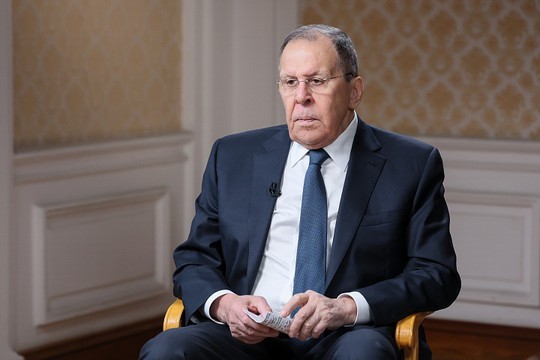
Photo: MFA
Foreign Minister Sergey Lavrov’s interview with RT television channel
Moscow, February 5, 2026
Question: Hello again, everybody. I’m Rick Sanchez, and we are coming to you today from a different location, the Foreign Ministry of the Russian Federation. Oh, if these walls could talk! This is such a special experience. I think for me, as an American journalist, to be able to share with what are in many ways a Western audience a better understanding of the Russian perspective, especially coming from this place, with the history of this place, the majesty of this place. You walk the halls of this place, just the names, the images. You see Trotsky, Gromyko, Shevardnadze. The people who we grew up watching create the story of what Russia is today as a matter of fact. It is an absolute honour for me to be able to bring this story from this location, and to be in the presence of the man who many consider to be the voice of the Russian Federation certainly from a global perspective – the Foreign Minister of the Russian Federation, Mr Sergey Lavrov. Mr Lavrov, thank you so much for joining us here. It is such a pleasure. Thank you so much.
I guess we have to start with some of the things that are going on right now. I think probably the most important thing happens to be taking place in Europe. And let me ask you this, because I was kind of taken aback when I heard this. Recently, the Chancellor of Germany, Friedrich Merz, said that Russia is the largest country in all of Europe. And then he went on to make it sound as if he’s inviting Russia to be back to the European community. But this is the same man who, just recently, seemed to almost be wanting to go to war with Russia. What do you make of his comments?
Sergey Lavrov: Over the past 45 days, many European politicians have addressed relations with the Russian Federation. Until recently, they were united in demanding firmness, not scaling back support or weapons supplies to Ukraine, and financing it to make sure Russia suffers a “strategic defeat” on the battlefield.
Then, when they realised that all of this was an illusion, they changed their rhetoric. Their planners – military officials – prepared this operation, trained the Ukrainians so that they would advance European interests in the war against Russia with their own hands and bodies. However, they realised that all their plans had failed. No one learned from past events. Remember the attempts made by Napoleon and Hitler. This time again, they gathered almost all of Europe under the same Nazi banners, but unlike Napoleon and Hitler not yet on the battlefield, but as donors, sponsors, arms suppliers, and ideological leaders and, under the same Nazi banners, they engaged the Ukrainian army and mercenaries from different countries, as well as official instructors from NATO countries. We are aware of this. This latest attempt has led to the same outcome as the adventures of Napoleon and Hitler. But history is poorly taught in the West. We can see this, especially in Germany, which you mentioned.
There were a few relatively calm years under former German Chancellor Angela Merkel, and then a somewhat unclear period when Olaf Scholz was Chancellor. When Friedrich Merz took office as Chancellor, he made a few statements that gave cause for serious thought. First, he said that he had lifted constitutional restrictions on military spending. Then he stated that this was all necessary for Germany to once again - I emphasise this - become the principal military power in Europe. This strongly reflects his mindset and his train of thoughts. He repeatedly reiterated this idea on later occasions. In practice, what he is doing comes down to preparations for war.
The same was happening in France. President Emmanuel Macron repeatedly stated that Ukraine couldn’t lose. I won’t even say anything about British Prime Minister Keir Starmer, European Commission President Ursula von der Leyen, and NATO Secretary General Mark Rutte.
Recently, German Chancellor Friedrich Merz made a comment describing Russia as the largest country in Europe. I must correct this immediately. Russia is the largest country in Eurasia – and in the world. For our purposes, we are interested in the continental view of Eurasia. To date, all attempts to ensure security in this space have focused exclusively on its western part – so-called ‘Europe.’ All were aligned with the Euro-Atlantic security concept (embodied by NATO).
The Americans have never wanted, and still do not want, to leave the Europeans to their own devices. Their goal is for Europeans to finance all their own military preparations by buying US weaponry, while the US naturally retains control and the role of ‘guardian’ over its NATO allies.
Subsequently, the Organisation for Security and Cooperation in Europe emerged, symbolising a shift from the Cold War towards peaceful coexistence based on principles of equality and consensus, with all decisions made unanimously. That the OSCE has now completely discredited itself is beyond debate. Everyone sees it, even those who suggested, after the USSR’s collapse and the Warsaw Pact’s dissolution, that NATO should be ‘closed down’ and the OSCE strengthened as a fair, balanced, collective structure. Many now recall those ideas. That effort failed because the US, the UK, and other leading NATO members categorically rejected dissolving the Alliance and instead chose to do the opposite. We saw the arrival of Francis Fukuyama’s ‘end of history’ – liberal ideology, Western-style ‘democracy,’ and NATO as the universal security guarantor. The belief that this model would now dominate everywhere has led directly to the current situation.
As Euro-Atlantic structures have weakened (the EU having become a mere appendage of NATO, a status even formalised in documents) Germany’s rising profile has caused alarm, not only in our country but in many EU capitals. There is growing resentment and a palpable desire to prevent Germany from subjugating all others once more, especially as Germany’s being “back on track,” proclaimed by Friedrich Merz and his government, is openly linked to the country’s rapid militarisation and preparations for war.
German Defence Minister Boris Pistorius continues to state that 2029-2030 is the deadline by which Germany must be ready for war with Russia. I don’t know who they are trying to convince that Russia will attack them. A basic knowledge of history should dispel such foolish ideas. Consider the arguments we hear from Europeans: ‘Russia has weakened,’ ‘Russia is barely advancing in Ukraine,’ ‘seizing a teaspoon of land a day,’ ‘Russia is failing,’ ‘it’s the fifth year of war,’ ‘huge losses.’ They claim Russia is ‘struggling with a lag in many types of armaments,’ painting a picture for their voters of a weak state, both militarily and economically. Then, without any logical preamble, they leap to the conclusion that they must therefore prepare for a Russian attack. If you are describing us as weakened, at least employ some imagination and craft a more graceful narrative for your brainwashing efforts.
This rhetoric you mentioned is not confined to Germany. A few weeks ago, French President Emmanuel Macron stated once again that he would call President Putin ‘someday.’ This is not serious diplomacy; it is pathetic. If you wish to call and discuss something seriously, then call. The Russian President will always answer, will listen to any proposal, and if it is serious, I can assure you it will receive a serious, concrete, and practical response.
We do maintain contacts with some European leaders. They call and ask us not to publicise the conversations. Some engage in ‘undercover’ contacts here. Yet nothing they tell us in these closed, confidential meetings differs from their public statements. It is the same old refrain: ‘let’s end this,’ ‘we need to do something.’ I see no coherent position from Europe. They are trapped by their own rhetoric, locked into an uncompromising stance: ‘Russia’s strategic defeat,’ ‘Ukraine cannot lose, and Russia cannot win, otherwise Europe loses face.’ Everything they do now is designed to prevent and disrupt the negotiations that have been taking shape between us and the Americans, and which Ukrainian representatives are now joining.
Question: It almost sounds like you’re saying, “We have been burned so many times that we have a hard time right now with trust.” When you consider the fact that in the early 1990s, Russia did everything possible to align itself with the United States, with the West. Mr Putin and yourself have talked about even joining NATO.
And now it seems that even though I talk to the Russian people since I’ve been reporting here, I don’t feel a sense of antagonism against Europe from Russians, but I feel a sense of antagonism from Europe against the Russians, right? The Russians don’t feel antagonistic against Europe, but the Europeans feel antagonistic against the Russians.
What are you at the point now where the position of Russia is, “We’ve been burned so many times, we have been deceived so many times, we’re just not willing to come to the table, at least not on your terms. We have to set the terms.” Is that kind of where you are right now?
Sergey Lavrov: To a significant degree, yes – though perhaps not so bluntly. The crux of what you have just articulated is this: we have indeed been “burned” by our trust in those who swore that NATO would not expand eastwards, that Russia would not be marginalised, and that we would forge a common space from Lisbon to Vladivostok – a vast continent of peace and security.
We established the Russia-NATO Council in an effort to foster sustained dialogue and build confidence, creating a framework under which “interesting” disclosures about military capabilities could be shared. There was much to it, including transparency.
Yet NATO first lost its reason for existence, then found renewed purpose in Afghanistan. When that purpose was publicly, shamelessly trampled before the eyes of the international community, action was needed. So, they regrouped, convened, and contrived the situation we witness today – declaring Russia a “pariah” and identifying Ukraine as the “optimal material” with which to provoke us, a pliable entity to be shaped as they saw fit.
Moreover, they had been “kneading” this “material” since the very collapse of the USSR. Every pledge – no NATO expansion, no encroachment into Russia’s immediate neighbourhood – was obliterated.
Ukraine, as we say, had been “groomed” since the 1990s. Billions of dollars were spent. Former US Under Secretary of State Victoria Nuland recently admitted that the direct preparation of the February 2014 coup cost $5 billion. I am convinced the total expenditure on Ukraine since its independence far exceeds that figure.
Ukraine became independent under the Declaration of State Sovereignty, which enshrined its neutrality, non-nuclear status, and non-alignment. When Russia recognised Ukraine’s independence in 1991, it recognised precisely such a state – non-aligned, neutral, and free of nuclear arms. Thus, our conscience is entirely clear.
The West, too, acknowledged it as such. Yet later, they moulded Ukraine into what suited them – not what was codified in the Declaration of Independence endorsed by the Ukrainian people.
Question: Did you tell them that? Obviously, I do not want you to share the specifics of your conversations with other foreign ministers and other heads of state in Europe and the United States, but did you say to them, look, all we want is a neutral Ukraine – they do not have to be pro-Russian, they do not have to be pro-anything? We want to be respected, and by the way, we have no intention of bombing you. We have no intention of going to war with Europe, we have no intention of going to war – period, which is what they keep telling the world. They say, Russia is very aggressive, and Russia is saying, we are not aggressive.
Sergey Lavrov: They have told international community a lot of different things. Only recently, they said that none of them has ever been to Epstein’s island. That is their way of doing things.
As for Ukraine, of course, we told them all this. Moreover, we also provided a great deal of facts demonstrating our restraint, even though many in our country regarded this restraint as unjustified and as weakness.
In particular, the first Maidan coup took place in 2004, when Leonid Kuchma served as President of Ukraine. He had good relations with President Vladimir Putin. They held candid discussions on all issues.
I was present during their telephone conversation, when President Putin received a call from his Ukrainian colleague, who said that the West had brought thousands of people to Independence Square. He said they had put up tents, waved flags and refused to recognise the results of presidential elections. He said that they had weapons. He asked the President of Russia what he should do. President Putin replied that his interlocutor was a President himself, and when the law is violated, they can rely on the Constitution and the legal framework for fighting those who violate the law as approved by the parliament.
Leonid Kuchma was firmly against using force or refrained from taking a firm stand to protect the rule law. Contrary to Ukrainian law, the Constitutional Court ordered the third round of the presidential election, which was not stipulated in the constitution or any other law, simply because the Maidan financed the Maidan revolt.
I remember this very well. It was my first year as Foreign Minister. At that time, many political figures in Europe, the foreign ministers, openly said that the Ukrainians had to choose between Russia and Europe. It was their position. No common space from the Atlantic to the Pacific Ocean – they did not mention it. It was only “either or.” There is Europe and Russia, and the choice was between them.
It was a coup. We nevertheless worked with Viktor Yushchenko, the President who was basically appointed by West following the third round of the election. He was completely pro-Western, with an American wife who never made secret of her citizenship or whose interests she promoted as the First Lady of Ukraine. But we worked with him anyway, including on gas issues. We discussed energy cooperation with then Prime Minister Yulia Tymoshenko, even though they were clearly pro-Western.
We were also ready to work with those who staged another government coup in February 2014. The agreement which President Viktor Yanukovych signed with the coup plotters stipulated an early presidential election and before that, a provisional national unity government. The agreement was signed, with the West – France, Germany and Poland – as its guarantors.
Then President of the United States Barack Obama called President Vladimir Putin asking not to dissuade Viktor Yanukovich from signing this agreement. President Vladimir Putin answered that if he sees a legitimate president taking decisions to ease tension in his country and stabilise the situation, he would never oppose this.
But a government coup took place in Ukraine the next day after this telephone conversation, and after this agreement was signed. When this happened, we asked the United States, how could this be? After all, they were the ones who asked us not to sabotage this deal. It was signed by both sides. However, those who instantly rushed, arms in hand, to occupy government buildings were someone else. The United States camped on an evasive position. As for the Germans and the French who acted as guarantors, they just made a helpless gesture, looked aside and told us, hey, it happens that democracy takes unexpected turns.
This new group which seized power started by proclaiming that it was cancelling the status of the Russian language. Having done that, they sent fighters to attack the Supreme Council building in Crimea, after Crimea and Donbass said that they did not want to have any business with these people because they lacked any legitimacy and failed to honour the agreement with a legitimate president. This is how people in Crimea and Donbass were designated as terrorists, even if they did not fire at anyone. All they did was ask to be left alone.
After that, those who seized power started using combat aircraft and artillery against their own land, which is something prohibited under international humanitarian law. When it all started, I mean the government coup, then NATO Secretary General Anders Fogh Rasmussen started calling on those who perpetrated this putsch to use proportionate force against those who refused to accept this government coup. But before the agreement, he called on then President of Ukraine Viktor Yanukovich a hundred times not to use the army against his people.
For the West, the ongoing Ukraine crisis started in mid-March 2014 when Crimea held a referendum and voted for reunification with Russia. This is how it all started, according to Western historical chronicles and from a practical political standpoint. They keep pretending that everything was fine, but then Russians came all of a sudden, held a referendum and this is when all these problems started piling up.
It was at that time that we lost all illusions and saw that the West was unable to keep its word. The Minsk Agreements were signed one year later in the wake of protracted fighting. Then German Chancellor Angela Merkel, then President of France Francois Hollande, President of Ukraine Petr Poroshenko and President of Russia Vladimir Putin spent the entire night and worked for 17 hours. The agreement was signed. The UN Security Council approved it. But then Ukraine failed to deliver on its commitments and kept referring to the violations by the other side, just like Vladimir Zelensky today, during the special military operation. He has been alleging that Russia was to blame for derailing all the attempts to declare a ceasefire.
Even at that time, we believed them. However, several years later, Angela Merkel and Francois Hollande acknowledged that the sole purpose of the Minsk Agreements for them was to win time and rearm the Ukrainian military. Russians are slow starters but drive fast once they get at it, as the saying goes.
We demonstrated our readiness to trust others two weeks into the special military operation. During the April 2022 talks in Istanbul, we accepted the Ukrainian proposal. But then someone prevented the Ukrainians from signing the deal, and then UK Prime Minister Boris Johnson, as well as other Europeans played their part. History has taught Russia not so much to endure, especially considering the negative connotations of this word, at least in Russian, but to gradually develop a keener understanding of what is going on. With rare exceptions, our European colleagues have failed to learn anything from this experience. This is the way things are.
Question: That is an important story that you shared, because you just took us through an explanation of what was deceitful, planned – a coup, and, as many now understand, a provocation on the part of the West. But in the West, the only story that often people hear is that Russia bullied its way into Ukraine, Russia was the aggressor. And it is important, Sir, and I know that you are adamant and passionate about often telling that story, because we mention the big story that is taking place in the United States right now, I am just wondering as well – in the case of what is happening in America right now – what is the nature of some of these people who did this in that moment, and are they the same people or comparable to the people who are caught up in this Epstein situation now, that kind of individuals who have unfortunately in many ways been making decisions, geopolitical decisions about the world?
Sergey Lavrov: People in Ukraine?
Question: No, I mean people in Ukraine, in the United States, in Europe, all over the place, the type of people we are learning now who were involved in this horrible Epstein thing, people who were deceitful, somewhat decrepit. Are they the same kind of persons who have led to what happened in Ukraine, to the coup in Ukraine, the deceit in Ukraine? Would you say that this is the same kind of person? Or maybe even some of the exact people?
Sergey Lavrov: I think that generalisations of this kind can hardly be applied to concrete individuals or persons.
I do not believe in what is known as the deep state, all these foundations acting behind the scenes or private groups that are allegedly ruling the world’s destinies. After all, people elected as presidents or prime ministers have what it takes to assert their own policy. But they steer a line that consists in deceit and implies immunity to feeling ashamed or blushing for lying to a partner. This is a fact and there are many people of this sort. Currently they have come into full view all over Europe and they are drawing no conclusions.
On February 4, the military from Russia and Ukraine started another round of talks. The talks will be attended by US representatives – US Special Envoy to the Middle East Steven Witkoff and Jared Kushner. A day before that, The Financial Times, a UK-based title, published an article saying that the Russians would be presented with something akin to an ultimatum in the form of a coordinated paper containing the so-called security guarantees for Ukraine. Under these alleged guarantees, if Russia dares to launch a sudden attack on Ukraine, or if someone (clever as they are) masterminds a false-flag provocation that will make it possible to accuse Russia, they will denounce this within 24 hours and give Ukraine a freehand for continuing the war. Within the next 48 hours, they will mobilise all those willing to fight, and, 72 hours later, this coalition will be joined by the United States.
This is nonsense and a quite telling one. What do I mean? For the past year, the West (Europe) has been saying the same thing over and over: there must be solid guarantees of security and an immediate ceasefire. But without addressing issues pertaining to settlement, these security guarantees will implicate that the ceasefire will be exploited to funnel more arms into Ukraine. They did not hear this reasoning; neither did they respond in any way.
When Donald Trump’s administration began handling the Ukraine issue (We have some mixed views of how this administration acts towards the Russian Federation. We have certain dreamers and people prone to illusion here. I could say a few words about this later), it really decided to look into the root causes of the conflict. US President Donald Trump publicly stated that they can forget about NATO, and he and his team started saying that the reality on the ground must be taken into account.
All these matters were discussed in Alaska. Once again, we explained to our American counterparts that this issue is less related to territory, the land. Our priority is the people that have lived in these territories. The Russian people who speak and raise their children to speak Russian, who have developed these territories for centuries. The putschists that came to power through a state coup called these people – in Crimea, Donbass and the Lugansk Region, Malorossiya, the Kherson and Zaporozhye regions – subhumans.
Then President of Ukraine Petr Poroshenko told them to their faces that Ukrainian children would go to clean kindergartens and spacious bright schools while children of the “terrorists” in Donbass would rot in basements. In 2021, long before the special military operation, Vladimir Zelensky said in an interview, speaking about his attitude to the people on the other side of the frontline, that there are people and there are “creatures.” In another interview, he added that, if you live in Ukraine and feel connected to the Russian culture and civilisation, you should hit the road and go to Russia for the sake of your children’s and grandchildren’s future. This is the current authorities’ attitude to everything Russian – the language and the culture.
This is the fact that since 2019, the regime under Zelensky has consistently adopted a dozen of laws that prohibit at any level Russian education, culture, media, the canonical Ukrainian Orthodox Church, and legalise the theory and practice of Nazism, including the already implemented practice of installing monuments to the criminals convicted during the Nuremberg Trials.
When we keep hearing about security guarantees, I want to ask a simple question: the security guarantees for which state are you talking about? The only state in the world where the Russian language is prohibited? Arabic is not prohibited in Israel. Hebrew is not prohibited in the Arab countries. No other country prohibits a language. But Ukraine prohibits not just a language but a language of its indigenous population and an official language of the UN.
If they wish to perpetuate this particular regime with security guarantees (it does not matter on what territory), this is unacceptable. Even if they try to throw in some concessions regarding the Russian language, it will be despicable and dishonourable. Because both the language and religious freedoms are enshrined in the UN Charter. They cannot be used as bargaining chips. I would not call this a prerequisite. Ukraine must be told that it is a member of the UN and it must comply with its Charter.
According to the Ukrainian Constitution, the state is committed to respecting the rights of the Russian, as highlighted, and other ethnic minorities. When the West forgoes this topic and claims that Zelensky will be given security guarantees, it means they want to preserve his Nazi regime. This is bad news.
But back to our contacts with Americans. The 28 points that we received before Alaska contained provisions on reinstating the rights of ethnic minorities and religious freedoms. The latest version that we did not see but that Zelensky has cited (this time, there are 20 points and we have read some snippets) says nothing about reinstating the rights of the Russian and other ethnic minorities or the religious freedoms. It states that Ukraine will exercise tolerance according to the standards of the European Union. Why is that? There are standards that spread beyond the EU’s lawn and there are standards unacceptable to many countries in the world.
Question: Because things are so difficult right now in Ukraine, the problems they are having with energy grid, for example. Yesterday, several officials, including a regional governor of Ukraine, told Mr Zelensky publicly let’s do this deal, sign where we are right now for the good the people of Ukraine, and give up the territories that you are arguing about, and you need to do that for the good of the people of Ukraine.
We’re hearing this now from the people in Ukraine. That’s really important. If somehow Mr Zelensky can be talked into ceding that territory and giving Russia the security guarantees that it needs, i.e. no European troops in Ukraine, and the respect of the Russian heritage and religion. Is that something that Russia can then live with and sign that deal and end this war? Or, am I missing something?
Sergey Lavrov: I partially answered this question when answering the previous one, namely, what kind of Ukraine we are willing to see as a neighbour for the long, even eternal term. It must be a friendly Ukraine. Not necessarily an ally, but a neutral and benign state. This, of course, implies respect not only for the rights of the people in the territory that will remain part of Ukraine, not only respect for their rights to access basic necessities, such as warmth, food, and water, but also respect for their, if you will, fundamental human rights, including language, education, and religion.
To reiterate, Ukraine that will sign the agreements must not assault international law and the Ukrainian Constitution which guarantee the rights of ethnic minorities.
With regard to calls for a ceasefire, there has been a hysterical outcry about us allegedly making an inhuman move to cut off power to cities and making people suffer and freeze, about Russia targeting energy facilities. We never initiated such actions. The Ukrainians were the first to attack energy and other civilian infrastructure, including blocks of flats, retail outlets, and hospitals. A year ago, they blew up a passenger train that had no military component whatsoever.
For some reason, everyone tends to forget that examples of our goodwill abound. In March 2025, when US President Donald Trump suggested to President Putin declaring an energy ceasefire for a month, President Putin publicly supported that proposal that same day. For a month (March-April 2025), we removed Ukraine’s energy facilities from our target list. During that same period, the Kiev regime attacked our civilian energy infrastructure more than 130 times.
Our conscience is clear, but our patience is not endless. We have a proverb – take measure seven times before you cut once – which says volumes about the Russian character. We have been taking measure very carefully for a long time now and drawn our conclusions.
I don’t know what proposals will be made to our delegation in Abu Dhabi. I discussed this idea with our colleagues who went there – the security guarantees that NATO Secretary General Mark Rutte spoke about yesterday in the Verkhovnaya Rada in Kiev. Our people hadn’t heard anything about that; they learned of it from The Financial Times. If this is what the Ukrainians took to today’s negotiations, then, of course, it is yet another proof that Zelensky does not want peace, and that any reasonably honest and straightforward peace deal would mean the end of his political career, and possibly more than his political career. We will see what they will bring to us.
Following his conversation with Mark Rutte, Vladimir Zelensky stated he was prepared for compromise, provided Russia is too. The remark is astonishing in its audacity – though I am hardly surprised, coming from a man devoid of shame or conscience, who thinks of nothing but his own survival. For that, he feels compelled to perform some scripted ‘sketches’ on the international stage, which he actually treats as a theatre.
To return to the matter of Alaska. Roughly a week to ten days before the summit, the US President’s special envoy, Steve Witkoff, visited us. He brought specific proposals containing elements of compromise. President Putin has spoken of this publicly, so I am revealing no secret. These proposals did not fully account for a number of our fundamental concerns, but we took them under consideration.
When the two presidents and their delegations arrived in Anchorage and sat down at the negotiating table, we noted that it was not an easy step for us, but we were prepared to accept the United States’ proposal, including its compromise components. In essence, we agreed to their terms.
We then waited for a significant period, expecting our American colleagues to announce that we had reached an agreement – that this was our shared solution. Frankly, the decision of the Trump administration would have sufficed for us. We were not concerned with Europe’s reaction; we could imagine it. We were not interested in what Ukraine would say. Ukraine without the United States (much like Europe without the US), without its weapons sales, intelligence, and satellite targeting, is incapable of waging this war.
Had we announced the results from Anchorage, I am confident it would have swiftly led to a process formalising peace agreements. However, once we had endorsed the US proposal, Europe immediately rushed to Washington, with Zelensky in tow, and began ‘reworking’ the American initiative that had already received President Putin’s approval. They are still ‘reworking’ it to this day. When our American colleagues visit us now, their attitude suggests they are seeking further concessions.
I have outlined examples of our flexibility dating back to 2004, as well as in 2014, 2015, and 2022. To be frank, President Putin has stated repeatedly that we remain ready for a diplomatic solution. We have never altered our terms, unlike other participants in this process who are constantly ‘moving the goalposts,’ adjusting them, and declaring, “Now we need to score here, not there.” Our position is, and has always been, clear and consistent.
Question: Do you give the Trump administration credit for the dialogue that he has established with Russia? The fact is, the previous administration did not talk to you at all, did not want to talk to you, and seemed to want to just continue the war. The Trump administration has established a dialogue. While we may be at a different place, Mr Witkoff said in Davos that we were just very, very close to having a deal with Russia and Ukraine. It sounds like that is not the case, but you are talking at least. For example, the START treaty seems to be expiring soon. Will America and Russia come together and renew that deal? Do you feel confident that you can bridge that conversation with the Americans?
Sergey Lavrov: Certainly, the Trump administration is fundamentally different in its worldview, in its understanding of the national interests of the United States, and in its approach to other countries, allies, competitors and adversaries. The fact that this administration is prepared to engage in dialogue with everyone has been evident from its very first days in the White House – including establishing contacts with Russia, which continue in a variety of formats.
I distinctly recall – and I recently had the opportunity to address this topic – the meeting in February 2025, just a month after President Donald Trump arrived in the Oval Office. I, along with Russian Presidential Aide Yury Ushakov, met with US Secretary of State Marco Rubio and then-US National Security Adviser Mike Waltz, who now serves as Permanent Representative of the United States to the UN. At the time, Mr Rubio stated that the US administration would be guided by national interests. They acknowledged that Russia, too, has national interests, at which point common sense prevails. What does this indicate? Between two such major players, interests will not always align. But when they do, it would be a mistake not to leverage that alignment to translate it into practical, tangible and mutually beneficial projects in energy, space, high technology, and so forth. When the interests of Russia and the United States do not coincide – which will be far more frequent than alignment – we must not allow such divergence to deteriorate into confrontation, let alone acute confrontation.
I stated that this is entirely our approach as well. We are prepared, on the basis of such mutual respect, to develop a wide range of projects.
This same idea was repeatedly emphasised by the American delegations that visited us in preparation for Alaska and met with Russian President Vladimir Putin. They spoke of only one thing: Ukraine was their “inheritance” from Joe Biden. He had adopted an anti-Russia stance, and thus Ukraine had leapt to the forefront of the global agenda. They explained that they needed “to get rid of it,” that it had to be settled. They declared their intention to settle the issue and insisted they would do so, while demonstrating again – I wish to emphasise this – an understanding of our position. Once we had “moved past” Ukraine, they said, we could proceed with joint projects here and there, mutually beneficial and serving the interests of our peoples.
In this context, I have a remark: in Anchorage, we accepted the Trump administration’s proposal concerning Ukraine. If everything was as straightforward and decisive as presented, then it would imply that Ukraine had been set aside from our bright path towards future cooperation and prosperity. Yet Ukraine – meaning the settlement process – continues to be reshuffled, with new dimensions constantly added, appearing as ever more conditions and demands directed at Russia.
Nevertheless, the discussion continues: they say that we will conclude matters here, and afterwards everything will unfold beyond imagination. Our Communist Party once encouraged us to dream, too; we have dreamed extensively and therefore have some experience in that regard. Still, we judge by specific actions.
You mentioned sanctions among those specific actions. Indeed, sanctions remain in force. In April 2025, shortly after contact was established with the Trump administration, the International Emergency Act, adopted under Joe Biden, was extended for another year. This Act included provisions maintaining the freeze on Russia’s gold and currency reserves due to what was described as Russia’s hostile foreign policy. The extension was routine; the administration took no steps to repeal, amend, or explain the circumstances, which have changed in our relations. Notably, the current administration’s interpretation of events differed markedly from that of Joe Biden.
What is notable is that this emergency legislation that requires, among other measures, the continued freezing of our gold and currency reserves, cited alleged interference in US presidential election as part of the rationale for labelling Russia’s foreign policy hostile. I mean the accusations advanced by Joe Biden, Barack Obama, and their teams regarding Donald Trump’s first term as president. By extending the law, the Trump administration effectively endorsed these claims, tacitly acknowledging the premise of Russian interference in the presidential election, even though President Trump continues to publicly deny such allegations regularly.
For the first time, new tough sanctions were imposed on our largest oil companies: Lukoil and Rosneft. This occurred only a few weeks after the meeting in Anchorage.
Question: How did that make you feel?
Sergey Lavrov: President Vladimir Putin was surprised. He mentioned this in an interview: we parted ways in Anchorage with Russia supporting the United States’ proposal for a comprehensive settlement of the Ukrainian crisis. Afterward, we expected Washington to confirm this alignment: announce something, convene a conference, sign an agreement, establish a Peace Council. Instead, sanctions were suddenly imposed on Lukoil and Rosneft.
Furthermore, tariffs are now being introduced simultaneously against countries purchasing energy resources from Russia and Iran.
Question: Two faces of Trump: it is like good Trump and bad Trump. Joe Biden, at least, was just bad, but with Trump you get both sides simultaneously.
Sergey Lavrov: Following the developments unfolding in Venezuela, our companies are now being openly pushed out. India has been told it must stop buying Russian oil. At least that is what has been announced. In fact, the message extends further: everyone is discouraged from purchasing both oil and gas. At the same time, it is asserted that Russian energy resources will be replaced by American oil and liquefied natural gas.
Recently, a document was adopted concerning Cuba. It declared a state of emergency due to the threat the country allegedly poses to US interests in the Caribbean, including in connection with what are described as Russia’s hostile and malicious policies. Against this backdrop, the notion of a “bright future” in economic and investment cooperation does not really fit.
Question: Who do you think is lobbying for this? Is it Trump, or the neo-conservatives and people who are aggressively anti-Russian, because they make money off of wars and aggression? Or personally Trump?
Sergey Lavrov: I do not know what their internal dynamics are. However, we understand perfectly well that the United States, despite its power and ambitions, if you will, is forced to take into account the opinion of the administration and the opinion of various groups in shaping its foreign as well as domestic policy.
Domestically, many individuals – primarily Democrats, though also some Republicans – hold strongly Russophobic positions. Naturally, the administration cannot disregard such factors. In order to preserve the loyalty of this constituency, it may feel compelled to take anti-Russia steps. Yet the essence of these anti-Russia steps is very serious.
It is also conceivable that the administration seeks to placate Europe by offering something. If Washington’s primary expectation is compliance – Europe following directives and purchasing what it is told to, including weapons and liquefied natural gas at prices significantly higher than Russian gas – then a certain level of Russophobia may be perceived as the cost of accommodating the burdens imposed on Europe.
At the same time, the US National Security Strategy, broadly speaking, establishes a clear objective. The phrasing may vary, but the aim is evident: achieving dominance in the global economy, including within the energy sector.
Question: It sounds like, and I’m glad to hear you say, you sound like you’re optimistic. It sounds to me like you believe there is still a potential for a positive outcome, despite all the difficulties that we’ve just talked about and you’ve explained.
There is one other area I want to ask you about, and that’s Iran. It’s in the news these days. And it’s looking like Mr Trump is pulling back from his aggressive stance, no talk of the armada. I’m reading reports that your government, the Russian Federation, maybe yourself and Mr Putin yourselves, may have been involved in some indirect or direct way in mediating that, and that is part of the reason things seem cooling a little bit or getting a little less tense, because maybe Russia was involved in helping the conversation between Iran and the Trump administration. What role have you played, if any?
Sergey Lavrov: I believe we have played a decisive role. In 2015, everyone played a beneficial and crucial role when talks on the Joint Comprehensive Plan of Action on Iran’s nuclear programme that lasted many years were concluded. Caps were agreed upon for the low-enriched uranium that Iran could possess, and we took everything that was “above” it. That was part of the overall package.
Then in 2018, during his first term, President Trump withdrew from the deal. That’s when accusations against Iran began, even though it had not violated a thing. But when the United States exited the deal and removed all the upsides, all the positive aspects Iran was interested in, of course, Iran found itself in a difficult situation. It was no longer bound by obligations, because those obligations were collective, and they had been destroyed.
Iran continued enriching uranium, but it did not violate the Treaty on the Non-Proliferation of Nuclear Weapons. Everything was supervised by the IAEA. Nevertheless, Iran came under an attack with 12 days of Israeli and American bombing raids. Against this background, IAEA Director General Rafael Grossi’s position looks strange, because the facilities that Israel and the United States bombed are under the Agency’s control. The Agency, through its Director General, is simply obliged to make a political assessment, to state that facilities are under its control but were still illegally bombed, that this is dangerous, and to call for … But they said nothing which shows the current state of affairs in the IAEA leadership.
We are not forcing ourselves as mediators on Iran, Israel, or the United States. However, in our contacts with them, we discuss the situation. Iran is a close partner and neighbour of ours. We care about the future developments, especially since it is volatile not only for Iran itself but for the entire Middle and Near East. Too many time bombs there are just waiting for someone to trip on.
The Iranians, Israelis, and Americans are aware that we are once again ready to offer our services and to contribute to implementing an agreement, when (hopefully, when, not if) it is reached. It will inevitably involve the issue of uranium enrichment and stockpiles of enriched uranium. We can offer our services in this regard. The parties are aware of these services. Right now, the most important thing is for them to reach an agreement.
Question: I’m sorry, Mr Minister, services in helping to make sure the Iranians agree to a new nuclear deal and the Americans agree to stop punishing the Iranian economy with these sanctions? Is that the deal?
Sergey Lavrov: That is something Iran and the United States need to negotiate. I hope no one will stand in their way. If specific steps arise as part of this deal, where Russia can be helpful, including our experience in storing uranium, we will be ready to take those steps.
They are well aware of this. We are not interfering in the substance of the negotiations. Iran, once again, publicly through its president, has demonstrated an interest in dialogue, provided it is fair and aimed to achieve the balance of interests. We are interested in seeing this happen.
Question: Without giving me the specifics of what you spoke about, you are in сonversations with the Iranian government?
Sergey Lavrov: The presidents of Russia and Iran recently spoke by telephone. We also have contacts at the expert level.
read more in our Telegram-channel https://t.me/The_International_Affairs

















