
 РУССКИЙ
 11:29 18.12.2025 •
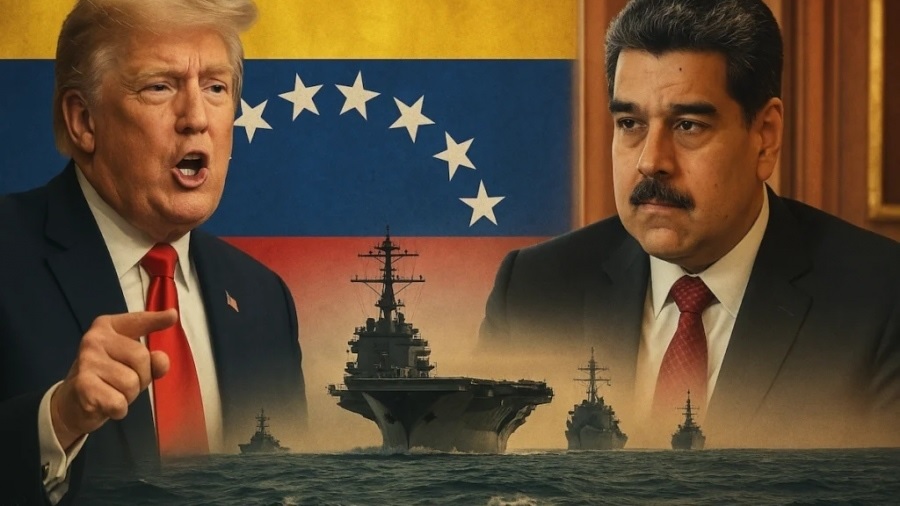 Pic.: bankingnews.gr
President Donald Trump said Tuesday he was ordering a “total and complete blockade” of sanctioned oil tankers coming to and leaving from Venezuela, ratcheting up pressure against leader Nicolás Maduro’s regime and suggesting an economic motive to the US’ military campaign in the region, CNN reports.
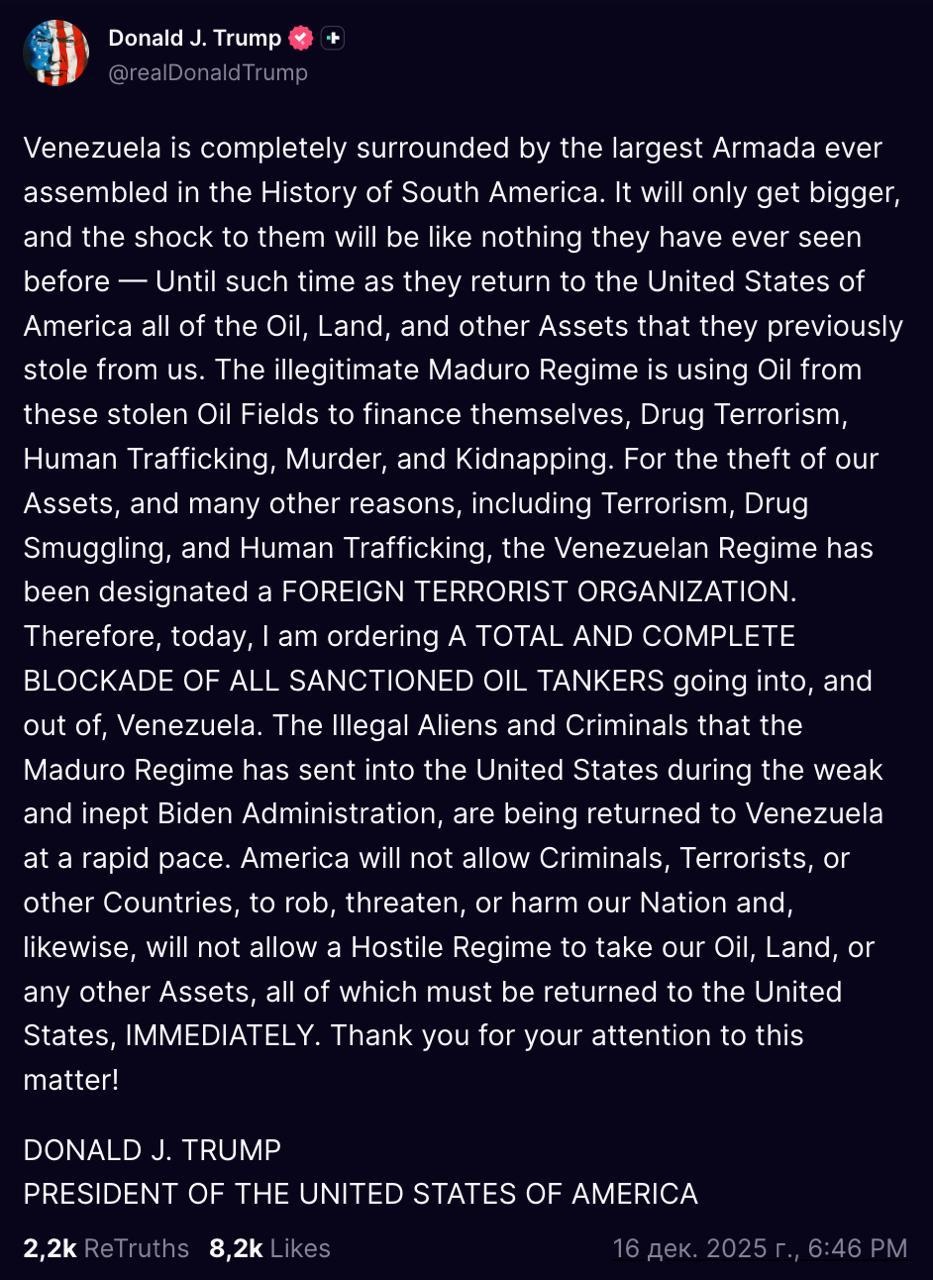
Punctuating the words “total and complete blockade” in capital letters in a Truth Social post, Trump pointed to the large collection of US military assets in the region, suggested more could be coming and took aim at Maduro’s regime by name. He also suggested Venezuela give up land, oil and assets to the United States, making clear that one aim of his military campaign is not just about countering the drug trade.
“Venezuela is completely surrounded by the largest Armada ever assembled in the History of South America. It will only get bigger, and the shock to them will be like nothing they have ever seen before — Until such time as they return to the United States of America all of the Oil, Land, and other Assets that they previously stole from us,” Trump said Tuesday night.
Combined with Trump’s threat of land strikes on Venezuelan soil, the move ratcheted up pressure on Caracas by going after its economic lifeline, which had already come under strain after new sanctions on the oil sector earlier this year and last week’s seizure of a tanker full of Venezuelan oil.
Venezuela slammed the announcement in a Tuesday statement, calling it “a reckless and serious threat.”
Trump’s announcement also underscored the president’s focus on the country’s oil, which he has said the US should have access to if Maduro is ousted. State-owned Petróleos de Venezuela controls the country’s petroleum industry. Houston-based Chevron is the only US firm drilling in Venezuela and pays a percentage of its output to PDVSA under a sanctions carve-out.
American companies had a much larger presence in Venezuela’s oil fields until the country put the sector under state control in the 1970s. Trump has made little secret his desire for the US to return to the country’s oil industry.
Venezuela’s oil reserves are the world’s largest but operate well below capacity due to international sanctions. Much of the country’s oil is sold to China.
The statement from Venezuela’s government decried the move, saying Trump “seeks to impose, in an absolutely irrational manner, a so-called naval military blockade on Venezuela with the aim of stealing the riches that belong to our Homeland.”
The government reaffirmed Venezuela’s sovereignty and said its ambassador to the United Nations “will immediately proceed to denounce this grave violation of International Law.”
Blockades are considered an act of war under some international treaties.
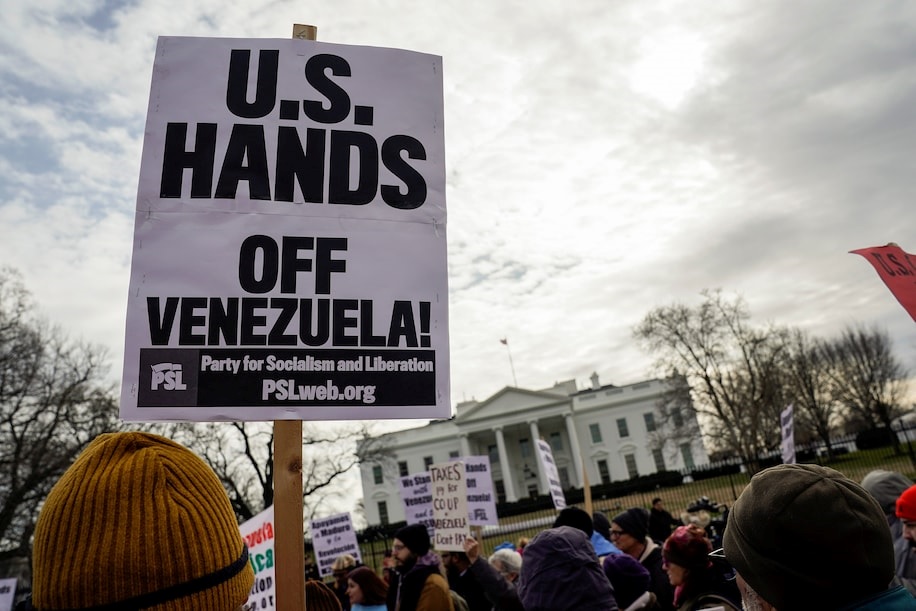 Photo: ‘The Washington Post’
"Venezuela will never again become a colony of any empire," points out Vice President Delcy Rodríguez
The government of Venezuela responded to the demands of US President Donald Trump toward Caracas to return oil and territories to the US. Venezuela's Vice President, Delcy Rodríguez, stated that her country, fully in accordance with local and international laws, "affirms its sovereignty over all its natural resources, as well as its right to free navigation and free trade." She also added that Trump, in his statements regarding Venezuela, uses "communicative and colonial" language, considering that the natural resources of another state are his property. "Venezuela will never again become a colony of any empire," the politician concluded, Greek ‘Bankingnews’ quotes.
Which territories he means
It is not clear which territories Trump believes have been taken, as there are no territorial disputes between the US and Venezuela. The borders of the 550-kilometer maritime zone between the two countries were established in 1980 and ratified by both Washington and Caracas. According to Trump, Maduro's "illegal" regime uses oil to fund itself, narco-terrorism, human trafficking, murder, and kidnappings.
Absolutely absurd threat
Earlier, Venezuela had spoken of a "grotesque military threat." "The US president is attempting to impose, in an absolutely absurd manner, a supposed military naval blockade of Venezuela with the aim of stealing wealth that belongs to our homeland," the Maduro government emphasized. Maduro argues that what Washington truly seeks is to overthrow him to seize the vast oil reserves of the Latin American state.
Trump is bluffing
The tension between the US and Venezuela has turned into one of the most enigmatic and dangerous geopolitical fronts of American foreign policy. Despite successive warnings from the Donald Trump administration for "decisive actions" against Nicolas Maduro's regime, various reports indicate that Washington does not have the military capability to immediately execute a large-scale ground invasion. This conclusion contradicts Trump's rhetoric of "rapid action" and creates a complex question: What can Washington realistically do if it chooses the military path?
The reality behind US military power
According to Politico, which cites sources within the Pentagon and the White House, the United States does not possess sufficient ground force in the Caribbean or neighboring countries to carry out a full invasion of Venezuela. This finding is based on three critical factors:
Zero presence of significant ground forces No large American military force is concentrated in the region. Any operation would require moving tens of thousands of soldiers, a massive volume of equipment, securing bases in allied countries, and supply support. All this cannot be done "silently."
Time-consuming and conspicuous mobilization The transport of such forces would take weeks to months and could hardly be hidden. Venezuela, as well as all of Latin America, would prepare politically, militarily, and diplomatically.
Economic cost and strategic risk Older military campaigns show that:
- an invasion requires about 50,000 military personnel,
- of which 20,000 must be first-line ground forces.
Judith Miller, a security analyst, had stated in corresponding operations that "the ground strategy is always the most expensive and politically dangerous."
Air attacks are the only realistic option.
Pressure rhetoric or war preparation by Trump?
Sources in the White House, as reported by Politico, claim that despite the tough rhetoric, Trump is not necessarily the president who "is preparing for war," but this is part of a psychological pressure strategy to force Maduro to resign. "This rhetoric is part of a specifically developed strategy to force Maduro to leave," says a source with knowledge of the issue to Politico.
Additionally, two significant assurances
Almost zero probability of operations against Colombia or Mexico A source close to the government mentioned that operations against neighboring countries have a "99.9%" chance of never occurring.
Domestic political cost CBS News records that 70% of Americans oppose an invasion of Venezuela. Such an operation without popular support would be a political suicidal risk.
How "weak" is Venezuela after all?
The Trump administration often presents the Maduro regime as "weak" or "easily overthrowable." However, retired US Marine Corps Colonel Mark Cancian reminds us that Venezuela's armed forces number approximately 90,000 soldiers, including the army, marines, and national guard. This ratio is decisive: The US near the region possesses just 2,200 marines — not enough even for a limited ground mission. A former Trump administration official warned that: "An invasion can rapidly evolve into guerrilla warfare in the Venezuelan jungle, if Maduro's forces choose to fight." As experiences in Afghanistan and Iraq showed: it is easy to start a war — difficult to end it.
read more in our Telegram-channel https://t.me/The_International_Affairs

















