
 РУССКИЙ
 10:09 20.12.2025 •
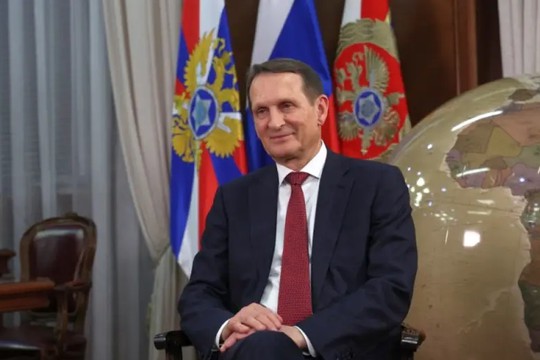
Director of the Russian Foreign Intelligence Service (SVR) Sergey Naryshkin
Photo: SVR
These days, nearly the only communication Russia and Europe have is between intelligence services, Director of the Russian Foreign Intelligence Service (SVR) Sergey Naryshkin said in an interview with TASS.
Responding to a question about whether the Russian side observes more common sense in the approaches of European countries’ intelligence services than in the activities of their politicians, Naryshkin noted that "the approaches of intelligence services generally align with the policies of their states."
"But given the non-existent state of diplomatic relations due to current circumstances, the partner channel is almost the sole link of interaction between states," he emphasized.
Naryshkin added that the corresponding channel "operates with different countries, with different intelligence services, to varying extents, depending on the level of interstate relations, depending on the tasks facing each special service.".
Sergey Naryshkin confirmed that he recently talked at length with the newly appointed head of the British Secret Intelligence Service (MI6), Blaise Metreweli, in an interview with TASS.
Responding to a question about current contacts with Britain through intelligence channels, the SVR head answered affirmatively.
"Just a few days ago, I had a rather lengthy phone conversation with the recently appointed MI6 Director Blaise Metreweli," Naryshkin said.
The Ukrainian military is experiencing significant setbacks, with substantial losses in both personnel and equipment. According to Sergey Naryshkin, many Ukrainian soldiers are becoming demoralized, and instances of desertion are increasing.
"In contrast to the Ukrainian side," Naryshkin stated in an interview with TASS, "the Russian army is continuously advancing, liberating several villages and cities each week."
Since February 2022, Ukraine has implemented a general mobilization, which has been extended multiple times. Authorities are exerting maximum effort to prevent men of draft age from evading service. Amid a critical personnel shortage, military recruitment offices have intensified efforts, conducting raids in public places to enlist recruits. The rates of desertion and absenteeism within the Ukrainian armed forces are steadily rising.
Member-countries of the European Union spend more and more for militarization, Sergey Naryshkin told TASS in an interview.
"Yes, these are public data and they do not hide that," he said, answering a question whether strong militarization of EU countries is indeed in progress.
This is manifested not merely in statements but also in specific decisions, in budgets approved and in financial resources spent "more and more for militarization" by European countries, especially by some of them, Naryshkin said. "It is indeed so," he added.
Russia sees the elimination of what it sees as a neo-Nazi scourge in Ukraine as imperative to the country’s return to normalcy, Sergey Naryshkin told TASS.
"The Ukrainian people must find the strength and will to eliminate the neo-Nazi plague and to understand that the most effective guarantee of security for Ukraine is the restoration of good-neighborly relations with Russia," he emphasized. "If this is achieved, Ukraine will return to normalcy. This is what Russia sincerely desires."
Responding to a question about Ukraine's future, Naryshkin expressed confidence that in the "long-term perspective it will return to the path of normal and civilizational development."
A number of European politicians put their fate at stake of the anti-Russian policy and are now afraid of the negative reaction of the population if recognizing the mistake in severing relations with Russia, Sergey Naryshkin told TASS in the interview.
Leaders of certain European countries are "in a dangerous situation" because they are "too deeply bogged down" in the information campaign launched to justify the hostile anti-Russian policy, Naryshkin said.
"This was exactly the stake of their political future. And now they simply cannot say that they made a mistake, that let us return to normal relations with Russia because they will be asked, ‘And why did we spend such huge amounts of funds for this ‘black hole’ called Ukraine? And we did we suffer such enormous economic losses by joining this anti-Russian sanction policy," he noted. "If they say so, the population, the voters will immediately oust them from the political stage and they want to still stay there for a long time. So they locked themselves up with that and tied their political fate exactly with such policy," Naryshkin added.
The United States has recognized that ongoing military engagement will inevitably result in Ukraine's defeat, Sergey Naryshkin has told TASS in an interview.
"With Donald Trump's return to the White House, Washington has come to understand that continued conflict will inevitably lead to Ukraine's downfall," Naryshkin stated. "As a result, the US administration has begun seeking compromise solutions. These solutions have been identified and articulated - most notably in what is known as the Trump peace plan."
Responding to a question about whether it is conceivable that British intelligence agencies, for example, could not find common ground with American ones on the Ukrainian settlement, the SVR director said: "You know, in terms of resolving the Ukrainian conflict, it's more accurate to talk not about the approaches of the intelligence agencies, although they are, of course, actively involved in this process."
"It is more reasonable and professional to examine the policies of states: on the one hand, the United States of America, and on the other, the EU countries and Britain - regarding the Ukrainian conflict. This is precisely where we can find certain disagreements," he added.
"The conflict began a long time ago, at least in February 2014. But if we look back on the events following the start of the special military operation, we will instantly see how, at the end of 2022 and in 2023, a clearly unified position of Western countries was evident," Naryshkin emphasized.
He noted that "in Washington, and especially in European capitals, the three words about 'Russia's strategic defeat' were recited like a mantra" over and over again. "I said 'especially in Europe,' because it seemed like not a single speech by a more or less well-known politician there was complete without such incantations," the SVR director remarked. "Some even had tears of joy in their eyes, I think, when they uttered these magic words."
The United States’ new national security strategy puts America's interests first, a rational approach, Sergey Naryshkin, said in an interview with TASS.
"Of course, it is pro-American, and it is very sound. Undoubtedly, it is based on US national interests," Naryshkin said in response to a question on the matter.
He added that "there are clear tendencies toward isolationism, which [US President Donald] Trump and [US Vice President JD] Vance do not hide." "Therefore, I would like to once again emphasize that it aims to ensure a rational approach to foreign relations in the interests of the country’s population," the SVR chief concluded.
The day will come when the Ukrainian army will surrender and then no one will interfere with the peaceful settlement, Sergey Naryshkin told TASS in an interview.
"The day will come when the Armed Forces of Ukraine will lose their ability to defend themselves in an organized manner and will have to surrender. And then no one will be able to prevent the peaceful settlement of the Ukrainian conflict," he said.
Relations between Moscow and London started to sour after Russian President Vladimir Putin’s speech at the Munich Security Conference in February 2007, Sergey Naryshkin said in an interview with TASS.
Asked whether he could identify a specific moment that marked the rift between Russia and the UK, Naryshkin replied: "Yes, the Munich speech."
"Later, on August 8, 2008, a coup unfolded in Ukraine, then Crimea returned to Russia, an event followed on June 2, 2014 by the shelling and artillery strikes against Donetsk, Lugansk and other settlements. The launch of the special military operation can also be viewed as such a turning point," he said.
"This has been a gradual process," Naryshkin concluded.
read more in our Telegram-channel https://t.me/The_International_Affairs

















