
 РУССКИЙ
 18:19 20.01.2026 •
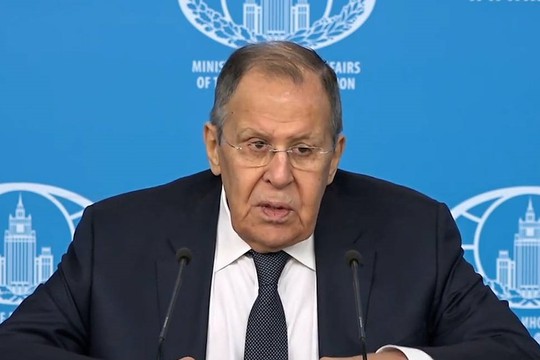
Russian Foreign Minister Sergey Lavrov
Photo: TASS/Ruptly
According to the foreign minister, Russia is ready to work with anyone willing to "negotiate honestly, on an equal footing, without blackmail or pressure".
The US is the only Western country willing to address the root causes of the Ukrainian conflict, Russian Foreign Minister Sergey Lavrov said during a news conference to review the results of Russian diplomacy in 2025.
He also noted that, while the West has the right to talk among themselves "on the basis of their own rules," Moscow will conduct dialogue with its partners on the basis of equality and mutual respect.
TASS has compiled the top Russian diplomat’s key statements.
Russia on the international stage
It is the West's prerogative to speak among themselves "on the basis of their own rules," while Russia will conduct dialogue with its partners "on the basis of the principle of equality."
Russia is ready to work with anyone willing to "negotiate honestly, on an equal footing, without blackmail or pressure": "And this is well known to all."
Despite what Western detractors may say, Moscow’s "notorious isolation" has not been realized.
"Russia will consistently defend its interests without infringing on the legitimate rights of others, nor will it allow its own legitimate rights to be violated."
Ukrainian conflict settlement
Russia is ready to continue seeking a diplomatic settlement to the Ukrainian crisis and has always been open to doing so: "If you look at the history of this crisis, starting in 2014 and especially since 2022, you will see that Russia has shown a great deal of goodwill when it comes to concluding political agreements. However, each time, our Western neighbors, primarily European, did everything they could to block these agreements."
Ukraine is in a "very bad situation" both on the front lines and in political life.
In the West, only the US is ready to address the root causes of the Ukrainian conflict: "The only Western country that is ready to address the task of eliminating the root causes of this conflict, which was largely created by Donald Trump's predecessor, Joe Biden, and his administration."
The US-proposed plan for a peaceful settlement of the Ukrainian crisis takes into account the elimination of the root causes of the conflict: "We support this approach and consider it fully justified."
Russia hopes that the understandings and agreements reached during the Alaska summit between Russia and the US "will remain fully in force."
Moscow cannot allow the West to rearm the Kiev regime so that it attacks Russia "as a tool of the insane Western Europeans."
The security guarantees Europe offers Ukraine are intended to preserve the Nazi regime in Kiev: "We must not forget this."
Russia does not accept proposals for a settlement in Ukraine that aim to preserve the Nazi regime in Kiev: "Proposals for a settlement that are based on the task of preserving the Nazi regime in that part of Ukraine that will be so-called are, of course, absolutely unacceptable."
The Russian side has not received any documents on the results of the meetings between the US, Europe, and Ukraine in recent weeks: "We have not received any recent documents on the results of the negotiations between the US, Ukraine, and Europe over the past couple of weeks."
West’s role in Ukraine conflict
The EU is again trying to come up with "some kind of coalition" against Russia, calling for the creation of a security system involving Ukraine.
Europe and the Kiev regime led by Vladimir Zelensky are "hysterically" trying to shift Washington's position, which was agreed upon with Moscow in Anchorage.
European leaders' goal of inflicting a strategic defeat on Russia "remains in their plans and intentions."
West's anti-Russian policy
Against the backdrop of his anti-Russian statements, German Chancellor Friedrich Merz should be reminded of the consequences of the "arrogance of the German leadership" throughout history.
NATO is "seriously preparing" for war with Russia.
Many serious Western politicians now regret not paying attention to Russian President Vladimir Putin's speech at the 2007 Munich Security Conference: "They regret not listening, not hearing, and taking it as just another piece of rhetoric."
Statements by European leaders about the need for dialogue with Russia now sound insincere. If they are really interested in contacting Moscow, they "just need to call."
French President Emmanuel Macron has been rude and dismissive toward Russia, but Moscow is above such rhetoric: "Well, if you're going to be rude, then ignore Russia. We are, of course, above that and treat such statements not even with contempt, but with disdainful disregard.".
No concrete dialogue with US on strategic stability
The United States has publicly stated that it wants to launch new negotiations on strategic stability, but have as yet not reached out to Moscow on the matter, Sergey Lavrov said.
"Indeed, the Americans are saying that we need to get the ball rolling on new talks on strategic stability, and they mention China. But these statements are only made publicly, during conversations with journalists. No specific contacts on the subject are taking place between officials from our countries," Lavrov said, commenting on the February 5 expiration of the New Strategic Arms Reduction Treaty (New START).
Meanwhile, Lavrov stressed that Russia remains committed to President Vladimir Putin’s proposal to maintain the treaty’s restrictions for another year if Washington does the same.
"We see attempts by the United States to establish its superiority in certain areas of strategic stability. I have already mentioned the advanced deployment of medium-and short-range ground-based missiles. The Typhon has already appeared in the Philippines. They plan to deploy it not only in Japan, but also in the Philippines and Germany," the foreign minister said.
In addition, Lavrov noted that the US is seeking to expand its nuclear weapons infrastructure in Europe. "Such plans have been mentioned publicly," he said. "I would also like to highlight the development of the US global missile defense system, the Golden Dome," he added.
Russia does not challenge others' rights, will not let anyone ignore its own
"Russia will consistently defend its interests, not challenging anyone's legal rights, but also it will not let its legal rights be taken lightly," Lavrov stated. He emphasized that Russia's foreign policy, enshrined in the Foreign Policy Concept, approved by the president in March 2023, "presupposes the resolute protection of the vital interests of our country and our people, and the creation of favorable external conditions for sustainable development within Russia."
"Fundamental actions to further strengthen national sovereignty are of paramount importance. Let me remind you that the amendments to the Russian Constitution introduced in 2020 were a very significant and serious boost in this regard, in the context of strengthening national sovereignty," Lavrov added.
West discusses doing away with NATO
"NATO and the Organization for Security and Cooperation in Europe are Euro-Atlantic institutions, and as such, they are being affected by a profound crisis within NATO, where talk is underway about whether it’s time to shut it down because one NATO country is going to attack another member," Sergey Lavrov said.
Lavrov pointed out that the Euro-Atlantic concept of security and cooperation has proved unworkable. "This is why we are talking about Eurasian security. No European institution - be it NATO, the Organization for Security and Cooperation in Europe (OSCE) or the European Union - can be taken for granted. By the way, the EU is also part of the Euro-Atlantic consent because its latest agreements with NATO completely eliminate the EU’s independence, although attempts are being made to restore it somehow, with calls for the creation of a security system without the United States. In fact, they say that Ukraine needs to be seamlessly integrated into this system. It means this is the good old discussion of designing a structure against the Russian Federation," the top Russian diplomat emphasized.
"This is the mentality that the position of the majority of the OSCE’s Western member states is based on. This mentality is destructive and it will do no good for the West and the OSCE itself," Lavrov included.
Russia wants to clarify concept of US-proposed 'Board of Peace'
Russia wants to clarify the concept of the US-proposed "Board of Peace". According to Sergey Lavrov, Moscow received a "strange document called the 'charter' of the 'Board of Peace,'" which was initially intended to address issues in the Palestinian Gaza Strip. "This 'board' is meant not only to deal with the Gaza Strip, which, in my view, is barely mentioned, but also to broadly assist in resolving conflicts around the world," the diplomat recounted the content of the "charter."
"We would certainly like to clarify the US’ conceptual and practical vision of this initiative," Lavrov noted, "We are currently trying to clarify these matters, and will be in contact [regarding them]."
The top Russian diplomat emphasized that "when addressing the problems of the Middle East, especially those that have to do with the Gaza Strip," one cannot approach the issue other than "from a position that has been repeatedly confirmed by the entire international community," namely the need for an independent Palestine.
"When the United States’ initiative was being considered by the UN in the fall, we doubted the necessity of any additional formats beyond those enshrined in US decisions," Lavrov noted, adding that "it basically comes down to implementing these decisions, and creating a Palestinian state." However, he explained that Washington "did not want to refer to UN decisions," so Russia and China were persuaded by the Arab nations, as well as Palestinians themselves, "not to obstruct" the resolution on the "Board of Peace."
According to the diplomat, Moscow and Beijing decided to "give this initiative a chance." "This is precisely the context in which we are currently reviewing the invitation we have received," Lavrov concluded.
Greenland dispute stems from colonial era legacy
"When it comes to Greenland, this is part of the problem linked to the legacy of the colonial era. From the 12th century, Greenland was essentially a Norwegian colony, then during the 17th and early 20th centuries it was a Danish colony. Only in the mid-20th century was an agreement signed, making it part of Denmark, not as a colony, but as an associated territory affiliated with the European Union," Sergey Lavrov said.
"Basically, Greenland isn't really a native part of Denmark, right? It wasn't a native part of Norway or Denmark either. It's a colonial territory. The fact that people there are used to it now and feel comfortable is another matter. But the issue of former colonial territories is becoming more and more acute," Lavrov added.
Crimea as important for Russia’s security as Greenland for US
"Crimea is no less important for the security of the Russian Federation than Greenland is for the United States," Sergey Lavrov said.
"Put the people of Crimea in Greenland’s shoes, and a lot will probably become clear to you. Moreover, the people of Crimea went to the referendum after the unconstitutional coup when the putschists who came to power declared war on the Russian language and sent militants to storm the Supreme Council of Crimea. No one staged any coups in Greenland. It’s just that, as US President Donald Trump said, this territory is important for the security of the United States," Lavrov explained.
'Unprecedented' ties with China
Russian-Chinese relations have been brought to an "unprecedented" level, Sergey Lavrov said. "They are unprecedented not only in their breadth and depth but also in the alignment of positions regarding developments in Eurasia and on the global stage," Russia’s top diplomat noted.
Lavrov's counterpart, Chinese Foreign Minister Wang Yi, stressed at a press conference summarizing the results of Chinese diplomacy late last year that relations between Russia and China had become "even stronger," and that the interaction between Russian President Vladimir Putin and Chinese leader Xi Jinping underscored "the essence of a comprehensive strategic partnership and strategic mutual trust."
Trump's team pragmatic, sees need to consider interests of others
US President Donald Trump’s administration is pragmatic and recognizes the need to consider other countries’ legitimate interests in full, Sergey Lavrov said.
"I assure you that Donald Trump’s administration, with all the actions that are now being widely discussed around the world, is the administration of pragmatists. And it recognizes the need not only to unite a large number [of countries] under its leadership, but also to fully consider their legitimate interests," he said at a news conference reviewing the results of Russian diplomacy in 2025.
This position and understanding of the need to take into account the interests of a partner is fully evident in the Trump administration's approach to the Ukrainian settlement, Lavrov added.
Multipolarity is here to stay, we'll still have to negotiate
"Multipolarity as an objective trend is here to stay. It can't simply be placed under some unipolar or bipolar umbrella. There are already too many centers of economic growth," Sergey Lavrov said.
According to Lavrov, the current "centers of growth reflect an objective historical process - economic development, infrastructure development, the use of natural resources, and much more."
"Therefore, at some point, we'll still have to agree on how these new major players - whether national or regional - will interact within integration structures," he noted.
Lavrov recalled that "when multipolarity began to gain ground as a major trend, many political scientists and journalists said nothing good would come of it, because it would be tantamount to a return to chaos in international affairs."
"They said that when the world was bipolar, split between the Soviet Union and the United States, everything was clear and simple. There were some peripheral conflicts, but these conflicts didn't affect the core of this bipolar world order. When the world turned unipolar, after the collapse of the Soviet Union, it also seemed clear to everyone - we just had to listen and not get too active," he pointed out.
"But is it true what they predicted about a multipolar world, when they said it would plunge into chaos? Looking at the current picture, you can probably find many who support this assessment, but the process never freezes at any one point," Lavrov emphasized.
New centers of growth
The Russian foreign minister cited China, India, and Brazil as examples. "Africa is already beginning to experience a second awakening, a realization that political independence hasn't come with economic independence, and that Africa continues to be exploited by neocolonial methods. Former colonial powers, having granted political independence to their former colonies, continue to live off them. This realization is now taking root on the African continent. We sense this daily from our numerous contacts with African countries," Lavrov noted.
Middle East will see no stability without creation of Palestinian state
"Without the creation of a Palestinian state, the Middle East cannot be stable," Sergey Lavrov emphasized.
Lavrov commented on the US initiative to create a Board of Peace. He emphasized that Russia is prepared to give this project a chance, but adheres to all UN decisions on the need to establish an independent Palestine.
Russia to promote initiative to form Greater Eurasian Partnership
"We have continued and will continue to promote the key flagship initiatives that President Vladimir Putin has put forward, primarily regarding the formation of the Greater Eurasian Partnership and, based on this material basis, the creation of a pan-continental architecture of equal and indivisible security," Sergey Lavrov said.
"By the way, together with our Belarusian friends, we are promoting the initiative to develop a Eurasian Charter of Diversity and Multipolarity in the 21st century, a charter that we have declared open to the participation of all states of the Eurasian continent without exception," the minister added.
NATO, EU in deep crisis, OSCE about to breathe its last
"Instead of a pan-continental, equal structure, which we advocate for, where everyone's interests will be balanced, they want to govern this vast, richest, and most populous continent from a Euro-Atlantic center. That was their plan, at least, until recently. NATO is in deep crisis, the European Union is in deep crisis, and the OSCE is about to breathe its last, so I think all these plans are doomed to failure," Sergey Lavrov said.
Russia believes that Eurasian security concerns the entire continent. NATO, the EU, and the OSCE have recently been used to infiltrate areas of traditional Russian influence, he explained.
"I don't know what will happen to NATO after the Greenland drama, but this attitude is deeply ingrained in the minds of most of today's European elites. Meanwhile, in Central Asia, they're saying: 'You don't need to do anything with Russia, you don't need to do anything with China, let's go with us. They'll all be harming your development, and we'll help you,'" Lavrov added.
He noted that Europeans are discouraging other countries, such as Mongolia, from cooperating with Russia and China, and are trying to "impose their own order" in the Far East, including by introducing elements of Euro-Atlantic structures, as is happening in relations with Japan, South Korea, and the Philippines.
"Let those with more foresight join our efforts, together with our Belarusian friends, to promote the Charter of Diversity and Multipolarity in the 21st Century. As I have already said, a number of European ministers and representatives are already participating in the relevant annual conferences in Minsk. Their list will grow," Lavrov said.
Russia mediated talks between Iran, Israel
Sergey Lavrov has confirmed that Russia mediated talks between Iran and Israel on regional security issues.
Commenting on media reports that in late 2025, Moscow served as a mediator in talks between Tehran and Tel Aviv on preventing Iran and Israel from attacking each other, he confirmed that such talks did take place.
"Since this has been leaked to the media, I will simply say that such contacts were initiated by our mediators, both with Israel and Iran," he said at a news conference summarizing the results of Russian diplomacy in 2025. "And we are always ready, if asked, to offer our good offices, but we never impose our good offices."
"When we are needed, we always respond. This is our principle," he stated.
Pistorius has to live with statements about 'inevitable' NATO-Russia war
German Defense Minister Boris Pistorius will have to live with the statement that war between NATO and Russia is "inevitable," Sergey Lavrov said.
"[French President Emmanuel] Macron will have to sit with these statements, just like the those made about war between NATO and Russia beginning by 2029. The latter statement was made by Pistorius, the German defense minister," Lavrov told the press conference on the results of Russian diplomacy’s work in 2025.
read more in our Telegram-channel https://t.me/The_International_Affairs

















