
 РУССКИЙ
 10:24 31.01.2026 •
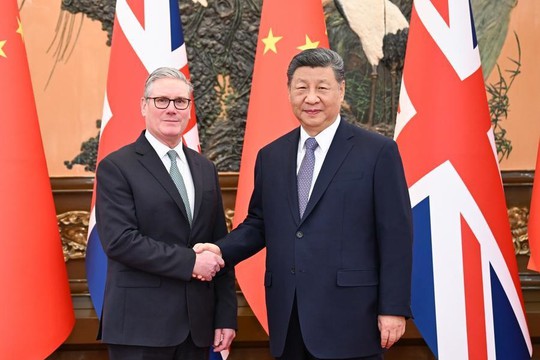
Chinese President Xi Jinping meets with British Prime Minister Keir Starmer at the Great Hall of the People in Beijing, capital of China, on Jan. 29, 2026.
Photo: Xinhua
Chinese President Xi Jinping and visiting British Prime Minister Keir Starmer agreed in Beijing that the two countries should develop a long-term and consistent comprehensive strategic partnership, Xinhua reports.
During their meeting, Xi said as the world today is undergoing both changes and turbulence, China and Britain, as permanent members of the United Nations Security Council and major economies, should enhance dialogue and cooperation in order to maintain world peace and stability, while promoting the economy and people's livelihoods of both countries.
Emphasizing the need to see history from a broader perspective, Xi called on the two countries to transcend differences and maintain mutual respect, so that they can translate the promising potential of cooperation into remarkable accomplishments, and open up new vistas for China-Britain relations and cooperation to better benefit both the two peoples and the world at large.
China will never pose a threat to other countries no matter how it grows and develops, he told Starmer, who arrived in Beijing for a four-day official visit, the first by a British prime minister in eight years.
"It is hoped that the British side will provide an equal, fair and non-discriminatory business environment for Chinese enterprises," Xi said, adding that both sides should enhance people-to-people and cultural exchanges, and further facilitate travel.
China is actively considering granting unilateral visa waiver to British people, Xi said.
Noting that the international order has for some time suffered serious disruption, Xi said international law can only be truly effective when all countries, major countries in particular, abide by it. Otherwise, the world would risk regressing to the law of the jungle, he said.
Starmer conveyed King Charles III's greetings to President Xi, and said he was delighted to be the first British prime minister to visit China in eight years. This visit, with a delegation of around 60 important representatives from British business and cultural organizations, demonstrates the breadth of Britain-China cooperation and Britain's commitment to deepening and expanding ties with China, said Starmer.
He said as major economies and permanent members of the UN Security Council, it is vital for Britain and China to build a long-term and consistent comprehensive strategic partnership with mutual respect and trust, especially in a volatile and fragile world.
Hong Kong's prosperity and stability serve the common interests of both countries, and Britain welcomes Hong Kong as a unique and important bridge between the two countries, said the prime minister.
China plays a vital role in international affairs, and Britain would like to strengthen cooperation with China on climate change and other global challenges and jointly uphold world peace and stability, Starmer said.
Trump says ‘very dangerous’ for UK to do business with China
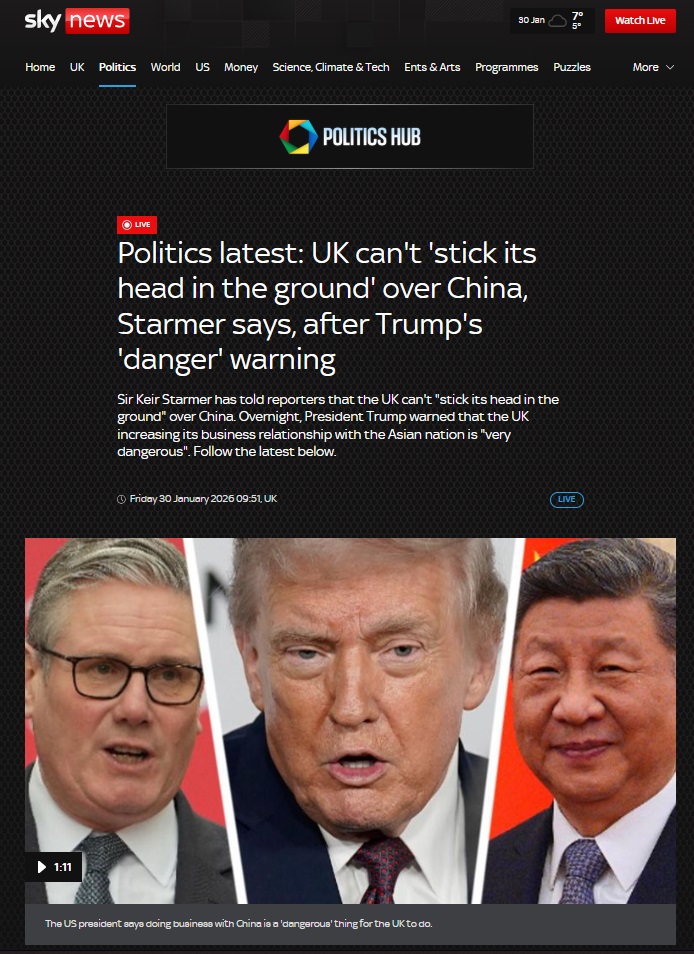
Donald Trump has warned the UK against doing business with China, just hours after Keir Starmer lauded the economic relationship during a landmark visit to Beijing, ‘The Guardian’ stresses.
The US president said it was “very dangerous” for the UK to pursue closer ties with the rival superpower as the prime minister’s three-hour talks with Xi Jinping underlined a thaw in previously strained relations.
Starmer, the first British prime minister to travel to Beijing in eight years, promised a “more sophisticated” relationship with China, as he secured improved market access, lower tariffs and investment deals.
But in Washington, replying to questions about Starmer’s attempts at an economic reset, Trump said: “Well, it’s very dangerous for them to do that.”
His remarks could create nerves inside Downing Street given the US president’s unpredictability and long-held hostility toward China. One official said the US had been aware of the trip and the UK’s objectives in advance.
Asked about Trump’s remarks, Starmer told Sky News: “I don’t think it’s wise for the United Kingdom to stick its head in the sand. China is the second biggest economy in the world. It’s along with Hong Kong, our third biggest trading partner. And through this visit, we’ve opened up lots of opportunities for jobs and wealth creation back in the United Kingdom.”
After his talks with the Chinese president at the Great Hall of the People, Starmer said the UK’s relationship with China was in a “good, strong place” and that his meetings had provided “just the level of engagement that we hoped for”.
“We warmly engaged and made some real progress, actually, because the UK has got a huge amount to offer,” he told a meeting of the UK-China Business Forum at the Bank of China in Beijing.
We can't ignore China, says UK's Starmer after Trump criticises trade push
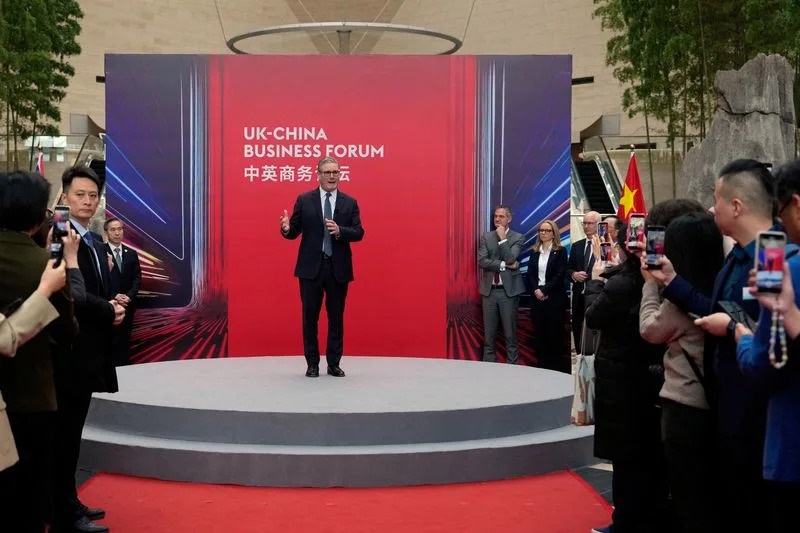 Britain's Prime Minister Keir Starmer, as a showbusiness star, speaks during the UK-China Business Forum at the headquarters of the Bank of China (BOC) in Beijing, China
Photo: Reuters
Prime Minister Keir Starmer said it would be foolish for Britain not to engage with China, rejecting an assertion from U.S. President Donald Trump that it was dangerous to get into business with Beijing.
Starmer is the latest Western leader to visit China seeking an economic and geopolitical hedge against Trump's unpredictability, angering the U.S. leader. Last week, Trump threatened to impose tariffs on Canada after Prime Minister Mark Carney struck economic deals with Beijing.
Starmer's three hours of talks with President Xi Jinping resulted in China agreeing to cut tariffs on UK whisky and to relax visa rules, as well as what Britain said was progress on market access for its professional services sector.
The main investment deal of the trip, however, flowed in the opposite direction. British drugmaker AstraZeneca committed to invest $15 billion in China, although some smaller Chinese investments in Britain were also announced.
Earlier, Starmer met Chinese business leaders including Yin Tongyue, chief executive of carmaker Chery, which plans to open a research and development centre for its commercial vehicle arm in Liverpool, a city official said.
Starmer also said China had agreed to remove travel restrictions on a group of British lawmakers who had been critical of China's policies on security and human rights.
Starmer, who normally avoids criticising Trump, has been more willing to defy the U.S. president in recent weeks.
Last week, he urged Trump to apologise for "frankly appalling" remarks that some troops from Washington's NATO allies had avoided frontline combat in Afghanistan, and said he would not support Trump's demands to annex Greenland from NATO ally Denmark.
Starmer is the first British leader to visit China since 2018
For Mr. Starmer, the first British leader to visit China since Theresa May in 2018, the trip is a pragmatic gamble that warmer ties will bring more growth for his country. For Mr. Xi, Britain’s overture helps Beijing demonstrate that it is an essential partner for the West, regardless of Washington’s efforts to isolate it as part of a deepening rivalry, ‘The New York Times’ writes.
Meeting in the Great Hall of the People in Beijing, Mr. Xi and Mr. Starmer hailed the benefits of cooperation. Mr. Xi said China was willing to “transcend differences” with Britain, and sought to depict China as a reliable global power. “No matter how much China develops and grows stronger, it will not pose a threat to other countries,” he said, according to an official summary.
In the past, the countries have sparred over human rights and Chinese interference in British politics. Concerns about Chinese espionage were at the heart of years of delays in the approval of a new Chinese mega-embassy in London, which critics said would make it easier for Beijing to conduct spying operations.
Mr. Starmer, who made the trip with a large delegation that included executives from banking, pharmaceutical and automobile companies, described China as vital to Britain’s interests.
He told Mr. Xi that British businesses were eager to take advantage of any available opportunities in the world’s second-largest economy. He called for a “more sophisticated relationship” that would allow Britain and China to cooperate economically while managing their disagreements.
A hedge against an unpredictable United States
Western middle powers like Britain, feeling increasingly alienated by the United States, are now looking to hedge their economic interests by rebalancing toward China, analysts said.
“For the past few years, companies were diversifying and de-risking from China. Now, they are doing so from the United States,” said Steve Okun, head of APAC Advisors, a geopolitical consulting firm.
Mr. Starmer’s trip is the latest in a flurry of visits by Western leaders to China that has been designed to project China as the stable alternative to an unpredictable United States under President Trump. On Monday, he hosted Prime Minister Petteri Orpo of Finland. In December, he welcomed President Emmanuel Macron of France and, in about a month, Chancellor Friedrich Merz of Germany is expected to travel to China.
"It would be foolhardy to simply say we will ignore (China)," Starmer told the BBC in an interview in Shanghai, highlighting French President Emmanuel Macron's recent visit and a planned trip by German Chancellor Friedrich Merz.
And in the US Congress there is just panic:
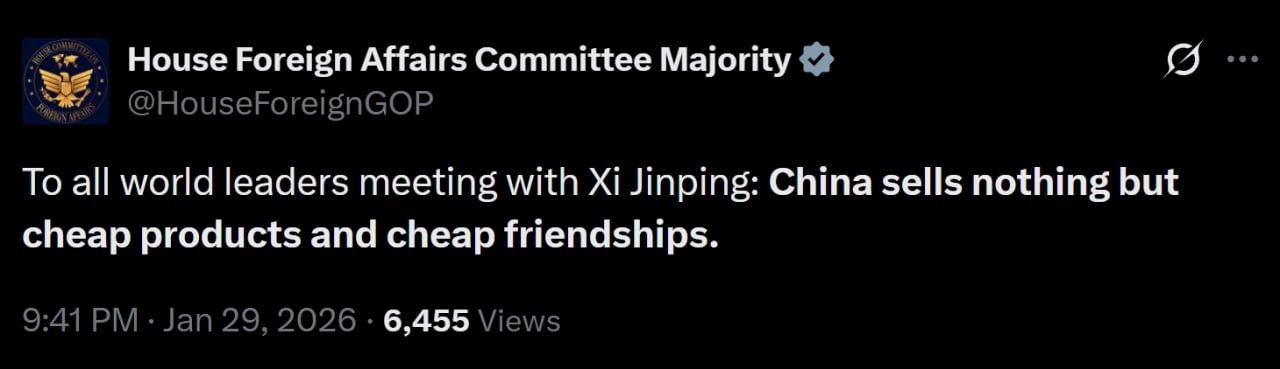
...One important point needs to be addressed. The foreign press won't report it.
Westerners are rushing to China not just for lucrative contracts.
Their goal is to push China away from Russia, to break the Moscow-Beijing alliance, to pull Beijing over to the West.
So we need to watch events from this perspective as well.
read more in our Telegram-channel https://t.me/The_International_Affairs

















