
 РУССКИЙ
 11:48 21.12.2025 •
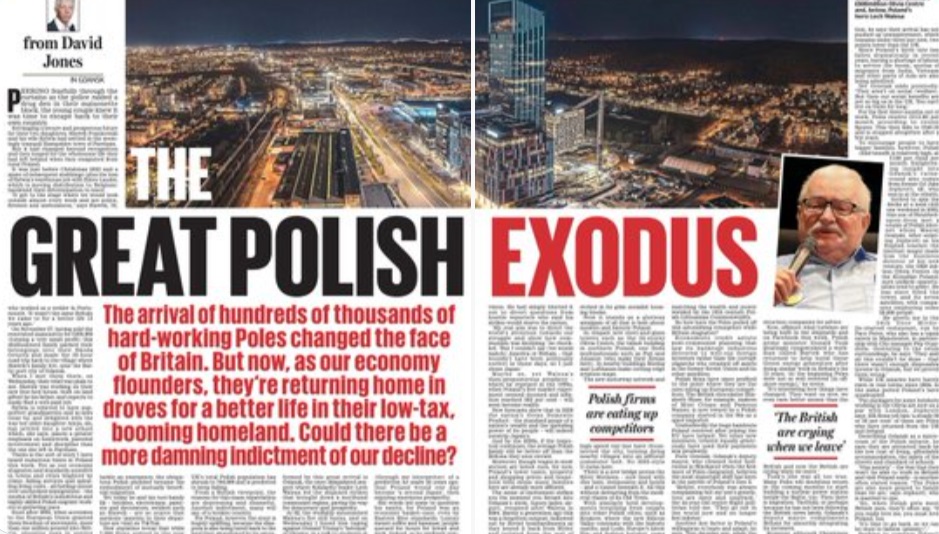
The great Polish exodus: The arrival of 100,000s of Poles changed the face of Britain, but now they're returning home in droves for a better life in their low-tax, booming homeland. Could there be a more damning indictment of our decline? – writes ‘The Daily Mail’.
For as our economy stagnates and standards nosedive in towns and cities blighted by crime, failing services and spiralling living costs – all fuelling unrest over unchecked immigration – the exodus of Britain's industrious and highly-skilled Polish migrant workers is gathering pace.
Soon after 2004, when accession to the European Union granted them freedom of movement, more than one million poured into Britain, plugging gaps in service industries and the building trade. Cheap, reliable and ever-ready to tackle an emergency, the ubiquitous Polish plumber became the embodiment of mutually beneficial migration.
Yet today he and his tool-handy ilk – brickies, electricians, painters and decorators, welders such as Slawek – are so scarce that sardonic laments to their departure are viral on TikTok.
New statistics reveal that while 7,000 Poles arrived in the year ending last June, 25,000 returned home: a net outflow of 18,000. The UK's total Polish population has shrunk to 750,000 and is predicted to keep falling.
From a British viewpoint, the reasons for this mass repatriation are depressing and shameful. Another indictment, many will say, of a broken country.
For Poland, however, the story is hugely uplifting, because the diaspora is also being lured back to the land they abandoned by its astonishing economic resurgence. Among the cities being transformed by this great revival is Gdansk, the once-dilapidated seaport where Solidarity leader Lech Walesa led the shipyard strikes that brought down a moribund communist regime, paving the way for democracy and prosperity.
 Pic.: You Tube
Lech Walesa: “I just chose Japan”
At 82, the wolfishly moustached Walesa's fire still burns, and we found him raging against Donald Trump's 'betrayal' of Ukraine, in a talk to students at Gdansk University.
His words led some to question his sanity, for Poland was an economic basket-case, even by Eastern Bloc standards. Luxury meant coffee and bananas; people queued for hours for bread and pork. Indeed, as he smilingly reminisced this week, Walesa hadn't given serious thought to his vision. He had simply blurted it out to divert questions from hostile reporters who said his strikes would starve the nation.
Solidarity leader Lech Walesa led the shipyard strikes that brought down a moribund communist regime, paving the way for democracy and prosperity.
 …Lech Walesa “defeated communism” for he could later bathe in a beer bath. A strange achievement...
'My real aim was to direct the world's attention towards our struggle and show how communism was declining,' he chuckled. 'But I couldn't say [we would match] America or Britain – that wouldn't have been politically correct in those days, so I just chose Japan.'
Maybe so, yet Walesa's then-preposterous prophecy – which he reprised in the 1990s, when Poland's free market experiment seemed doomed and inflation reached 585 per cent – will soon become reality.
New forecasts show that in 2026 the nation's Gross Domestic Product – the standard gauge of a nation's wealth and the spending power of its people – will indeed outstrip Japan's.
And by the 2030s, if the trajectory continues, the average Polish family will be better off than the Britons they once envied.
Moreover, though wages in most sectors are below ours, for now, Poland's lower taxes, property and shopping prices and household bills mean many families here are already more affluent.
The most important shift has been in the psyche of Poland's Gen Z
Piotr Grzelak, Gdansk's deputy mayor, who cleaned hotel bedrooms in Blackpool when the first wave of Poles emigrated, believes the most important shift has been in the psyche of Poland's Gen Z.
'Before, everybody was always complaining but my son's generation are open and unafraid,' the 44-year-old centre-Right politician told me. 'They go out in the world now and no longer feel inferior.'
Another key factor is Poland's willingness to learn and adapt, he says. Two decades ago, when the new ring road was being designed, Gdansk turned to British construction companies for advice.
Now, offshore wind turbines are being built in the shipyards and Polish prime minister Donald Tusk gloatingly congratulated a workman called Bartek who has returned to help build these Green energy generators after doing similar work in Britain's for 12 years. 'At the beginning Poles were not so well received [in offshore energy],' he wrote.
'It's interesting how things have changed. They want us now, we even earn better money than the British and now the British are crying when we leave.'
Tusk's jibe was all too true. Many Poles will doubtless return in the coming months to start building a nuclear power station beside the Baltic, too. Then there is migration. Tactfully, or perhaps because he has not been following the British news lately, Gdansk's deputy mayor compliments Britain for smoothly integrating its incomers.
 Photo: haystravel.co.uk
Gdansk as a microcosm of the Polish miracle
Enlightening insight into Gdansk's turnaround also comes from former DJ Jake Jephcott, 48.
While UK salaries have barely risen in real terms since 2004, in the same period Poland's have quadrupled.
The packages for some hotshots working in the Olivia are now on a par with London, Jephcott says. HR firms tell him 'a steady 20 or 30 per cent' of them are Poles who have returned from the UK and Ireland.
Describing Gdansk as a microcosm of the Polish miracle, he says they are attracted back by the low cost of living, affordable accommodation, the safety of the streets and standard of schools.
Seeking to compare Gdansk with a British city, before flying in we visited Sunderland, which shares some of its maritime and industrial traditions.
The disparities were sobering and may explain recent polls suggesting that this former bastion of Labour's Red Wall is turning towards Reform UK.
Though Gdansk has residual pockets of deprivation, and some young people complain the bubble has brought with it unaffordable rents, its social problems appear to pale alongside Sunderland's.
A quarter of that city's children live in poverty and 40 per cent of residents are in the bottom fifth of England's most disadvantaged people. Teen pregnancy, at 26.4 per cent, is double the national average.
Though Sunderland feels safe and welcoming, violent crime is running at 127 per cent of the national rate, whereas Gdansk has a 'very high' safety ranking.
Forget the statistics though – you can see the city is struggling, for all the talk of 'levelling up'.
The Polish drain becoming a torrent
Though he has done well for himself since arriving in Britain as the borders opened, Grzegorz Lewandowski, one of 1,057 Poles living in Sunderland according to the 2021 census, is angry and frustrated by the increasing difficulties of operating here. The archetypical open-all-hours plumber, he has saved frugally and bought a string of buy-to-lets.
However, he says punitive taxes and tenants' rights, which began with the Cameron government and have become intolerable under Starmer ('the worst thing that's happened to Britain since World War II') have turned the rental business into a barely profitable nightmare.
As he is still 'doing OK', and has three children here by his ex-wife, he says he will probably stay. Without a radical change of direction, however, he can see the Polish drain becoming a torrent.
…This is a historical text! The former British Empire has become so dilapidated and impoverished that Poles, who sought money and prosperity in Foggy Albion, are returning to their homeland in droves.
Britain is returning to the time of Charles Dickes, who in the 19th century described the poverty and filth, the dirty and smelly streets of London's criminal districts.
read more in our Telegram-channel https://t.me/The_International_Affairs

















