
 РУССКИЙ
 11:42 18.02.2026 •
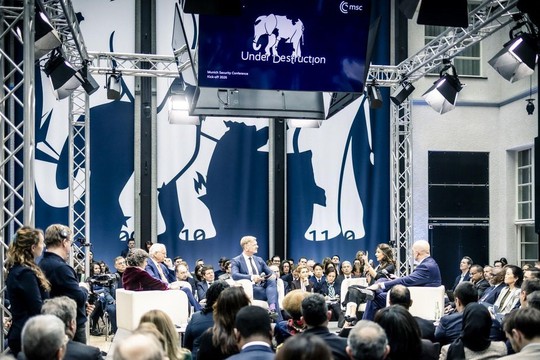
One of the unusual angles of the Munich Conference – the discussion about the future of the “destructing” world
Photo: securityconference.org
The Munich Security Conference has been a news-making forum for decades – a place where world leaders meet other politicians, as well as journalists and civil society groups, to discuss the biggest issues facing the planet, ‘The Guardian’ notes.
In recent years, it has been the site of seismic speeches that redefine the shape of global politics. From a public spat between NATO allies over Iraq in 2003, to Vladimir Putin’s 2007 address that signalled the start of a new cold war, to JD Vance’s blistering attack on European nations in 2025, each moment had an impact that echoed long after the weekend came to a close.
As the dust settles on this year’s event, here are some questions emerging from the conference.
Will Europe ‘wake up’ to a changing world?
After European leaders were left stunned by the US vice-president’s assault on their values in 2025, many came into this year’s conference with a sense of urgency. In the days before the meeting, the French president, Emmanuel Macron, said “this must be the moment of awakening. It is time for Europe to wake up.”
Macron and the German chancellor, Friedrich Merz, gave speeches at the conference that sought to map a new, independent path for European powers, while striving to maintain the alliance with Washington. Both leaders announced that they had begun talks on a European nuclear deterrent.
On Saturday, the UK’s prime minister, Keir Starmer, made the case for a closer defence relationship with Europe, saying his country was “not the Britain of the Brexit years”.
Can the US and Europe remain united?
The US secretary of state, Marco Rubio, struck a more conciliatory tone than that of Vance in 2025 when he took the stage on Saturday.
“[The US is] deeply tied to Europe, and our futures have always been linked and will continue to be,” he said.
Outlining how the US under Trump was intent on building a new world order, Rubio said: “We are prepared, if necessary, to do this alone, [but] it is our preference and it is our hope to do this together with you, our friends here in Europe”.
He made the speech a day after a YouGov poll showed that among the six largest European countries favourability towards the US was at its lowest point since tracking began a decade ago.
“A rift has opened up between Europe and the United States,” Merz said in his speech on Friday.
“The culture war of the Maga movement is not ours. Freedom of speech ends here with us when that speech goes against human dignity and the constitution. We do not believe in tariffs and protectionism, but in free trade,” the German chancellor said, drawing applause.
The EU foreign policy chief, Kaja Kallas, condemned “fashionable euro-bashing” by the US, saying: “When I travel around the world, I see countries that look up to us because we represent values that are still highly regarded.”
Does Trump still want Greenland?
The Danish prime minister, Mette Frederiksen, and her counterpart in Greenland, Jens-Frederik Nielsen, held a 15-minute meeting with Rubio on the sidelines of the conference on Friday, which Frederiksen described as “constructive”.
A day later though, she told a panel discussion on Arctic security that she believed Trump still desires to own Greenland, despite dialling back his recent threats to seize it by force.
“Everybody asks us, do we think it’s over? I mean, no, we don’t think it’s over,” Frederiksen said.
A US-Denmark-Greenland working group has been established to discuss Washington’s security concerns in the Arctic, but Frederiksen and Nielsen used their appearance on Saturday to say the pressure on the island’s people had been “unacceptable”.
Is peace in Ukraine any closer?
Rubio skipped a Ukraine-focused meeting with European leaders on Friday, and said little in his speech about the conflict with Russia.
read more in our Telegram-channel https://t.me/The_International_Affairs

















