
 РУССКИЙ
 11:39 02.02.2026 •
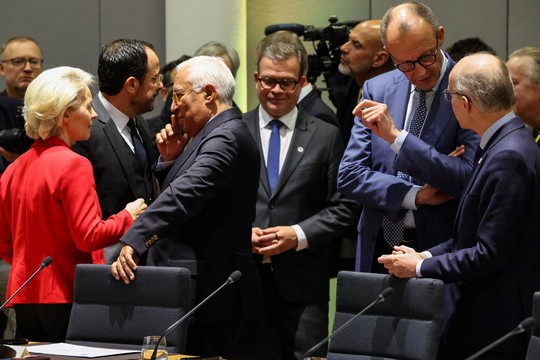
The European chicken coop is in a tizzy again – European leaders’ emergency summit in Brussels aimed to weigh potential countermeasures against the United States
Photo: AFP
Europe’s leaders try to reduce dependence on Trump. Since President Trump made threats about Greenland, the continent’s leaders have debated the rapid deterioration of U.S. ties in policy papers and at dinner, ‘The New York Times’ writes.
After President Trump shocked the world last week by threatening Europe with economic pain, humiliating its politicians and excoriating their values, leaders from across the continent wrestled with the fallout the next day at an emergency dinner meeting in Brussels.
The dishes were neat and traditional — chicken supreme, a classic French comfort food, with vanilla roast parsnips — but the question on the table was messy and recent. What should Europe do to cope with the rapid deterioration of its relationship with the United States, most recently manifested in Mr. Trump’s obsessive pursuit of Greenland?
Prime Minister Giorgia Meloni of Italy, an ideological ally of Mr. Trump on many issues, arrived at the meeting urging ongoing dialogue with the president. Chancellor Friedrich Merz of Germany pushed for immediate steps to reduce business regulations across Europe, to lift growth and reduce dependence on the American economy. President Emmanuel Macron of France said that to win respect from Mr. Trump, Europe must show a willingness to strike back against his threats.
Deliberations ran into the early hours of the morning. What emerged was a sort of playbook for how to deal with a Trump administration that is expected to remain volatile, according to three officials briefed on the meeting and leaders’ public statements. The leaders’ plan is to remain calm during Mr. Trump’s future provocations, threaten to hit back with tariffs and, the officials said, work behind the scenes to make Europe less militarily and economically dependent on its increasingly unreliable ally. The officials requested anonymity to speak about the politically sensitive discussions.
To seduce Trump with the Arctic
To keep Mr. Trump placated in the short term, Europeans are talking about how to beef up Arctic security. To lessen their reliance on Washington in the long term, they are working to diversify their trade relationships, improve their militaries and make their countries less dependent on American technology.
Yet they still have no workable plan to rapidly establish military autonomy from the United States. Their financial and banking system remains fragmented, making it hard to finance ambitious projects. Their decision-making is protracted, and their leaders are divided over how to enact what could be a yearslong or even decades-long project to reduce their trans-Atlantic dependency.
“The past few weeks have made it painfully clear that the European Union often drifts on waves created by others, that we are too dependent on factors beyond our control and have not built on our strengths enough,” Prime Minister Bart De Wever of Belgium, who attended the dinner in Brussels, later told Belgian lawmakers.
Ukraine or Greenland – that is the question
Mr. Trump’s threats over Greenland also prompted Europeans to talk more urgently about reducing their military dependence on Washington.
Mette Frederiksen, the prime minister of Denmark, said in Berlin this past week that Europe must spend what it takes to fully defend itself by 2030. German defense officials have said that they want to be self-sufficient by 2029. The European Union is helping to accelerate that effort and this week took a step toward giving eight European countries access to loans worth billions of euros that will allow them to improve their military infrastructure.
“Everyone has got national interests, but we need to be cautious about what and how we do things, and say and communicate things,” Gen. Karel Rehka, chief of the Czech armed forces, said in an interview. “We don’t want to send the wrong signals to any potential adversary.”
Similar differences have emerged in Europe over whether Ukraine is a more pressing priority than the Arctic. Some leaders, particularly in countries closer to Ukraine, are reluctant to stand up to Mr. Trump over Greenland when Europe still needs him to help Kyiv defend against Russia, experts and officials say.
“For Poland and the Baltics, the idea of defending Greenland is problematic,” said Rosa Balfour, the head of Carnegie Europe, a research group in Brussels. “Ukraine is the priority.”
There is at least one familiar strategy with Mr. Trump that Europeans continue to fall back on: patience, while they wait to see what Mr. Trump says and does next.
read more in our Telegram-channel https://t.me/The_International_Affairs

















