
 РУССКИЙ
 23:53 04.03.2026 •
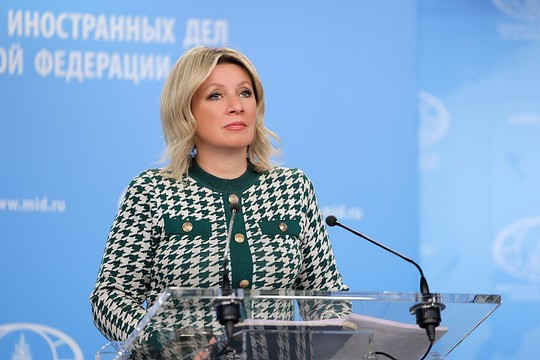
Maria Zaharova, the Russian Foreign Ministry Spokeswoman
Photo: MFA
Comment by Foreign Ministry Spokeswoman on France’s decision to increase its nuclear arsenal:
The statement made the other day by French President Emmanuel Macron regarding Paris’s intention to embark upon a non-transparent expansion of its nuclear arsenal, which in itself constitutes an extremely destabilising development, should be viewed in a broader context. Accompanied by the rhetoric that is hostile towards our country, this step fully aligns with the sharply negative trends that have by now taken shape within NATO activities in the military nuclear sphere conducted under anti-Russia slogans.
We note that the United Kingdom earlier announced an approach largely similar to the course now adopted by France, having some time ago also begun a significant expansion of its national nuclear arsenal while reducing its transparency. Moreover, in accordance with US-UK arrangements, London will, in addition to its existing sea-based component, acquire air delivery systems for nuclear weapons and gain access, with US consent, to US nuclear aerial bombs newly deployed in Britain which will further increase the number of warheads that the country could employ in a potential conflict.
At the same time, NATO’s traditional policy in this sphere excludes disclosure of the quantitative parameters of US nuclear weapons deployed in Europe. Russia is compelled to take into account that, in addition to the United Kingdom, an undeclared number of such weapons is stationed in four other European NATO countries and Türkiye, from where they are capable of striking a broad range of critically important targets on the territory of the Russian Federation. Meanwhile, the frameworks and capabilities of the nuclear sharing missions within NATO continue to develop relentlessly amid persistent calls from a number of European capitals for more radical measures that include moving US nuclear assets directly up to Russia’s borders.
Beyond strengthening their national military nuclear capabilities, the United Kingdom and France are working with their allies to shape a certain independent or autonomous European nuclear deterrent capability. Initial, somewhat disingenuous attempts to present this as an alternative to the American nuclear umbrella quickly gave way to recognition of the obvious fact that this concerns the expansion of the European nuclear component within NATO, in addition to the existing practice of nuclear sharing missions based on US nuclear weapons. Thus, there is a substantial reinforcement and expansion of NATO’s overall nuclear potential, which, in the event of a direct military conflict with Russia, could be coordinated against our country not only in its European segment but in its entirety, including the US arsenal.
To meet these objectives, NATO countries in Europe are establishing cross-cutting coordination mechanisms on nuclear policy issues, including the open transition by the United Kingdom and France to joint planning for the use of nuclear weapons and the conduct of related operations. London’s substantive participation in this bilateral format effectively links British-French cooperation with the work of NATO’s Nuclear Planning Group, which operates with increasing British involvement but without the direct participation of France, a point Paris has for many years emphasised in asserting the supposed full autonomy of its nuclear capability.
These efforts are complemented by agreements concluded by France with a growing circle of its European NATO allies to involve these non-nuclear states in certain advanced or enhanced mechanisms of French nuclear deterrence, envisaging a gradual deepening of such cooperation and essentially reproducing, in many respects, American models of extended nuclear deterrence. Against the backdrop of Germany and potentially other European NATO countries preparing to involve their military personnel and conventional assets in exercises and other activities of the French nuclear forces, Paris also allows for the option of subsequently deploying elements of its nuclear capability on the territory of formally non-nuclear allies.
Among other things, this highlights the increasing degree of coordination and interaction among NATO countries in matters relating to potential decisions on the use of nuclear weapons against a common adversary and their implementation. From the standpoint of the security interests of the Russian Federation, it is of fundamental importance that the North Atlantic Alliance traditionally regards our country as such an adversary. This is not only undisguised but is strongly underscored.
It is precisely within this framework that the French leadership’s recently announced intention to increase its nuclear arsenal, while refusing to disclose the actual scale of these measures, should be understood.
We also note that the decisions by London and Paris to expand their nuclear arsenals are intended to be implemented outside international constraints, continuing their long-standing policy of avoiding participation in any nuclear arms control arrangements.
As a consequence, the uncontrolled expansion of NATO’s military nuclear capabilities requires heightened attention and the most careful consideration in our own military development and planning in a world without the INF Treaty, the New START Treaty and other international agreements whose regimes or legacy were rejected by the United States with the full support of its allies.
At the same time, our conviction is strengthening that any potential nuclear arms control arrangements that might be developed in the future with Russia’s participation, should appropriate conditions be established, will imperatively require taking into account the factor of NATO’s overall nuclear capability.
In this context, it should also be noted that the Review Conference of the Treaty on the Non-Proliferation of Nuclear Weapons (NPT), to be held in April-May this year, will take place against the backdrop of actions by all three Western nuclear-weapon-possessing states that directly provoke a nuclear arms race. Two of them have openly declared their intention to expand their arsenals, while the third, having deliberately freed itself from the constraints of the New START Treaty and having for years refusing to facilitate the entry into force of the Comprehensive Nuclear-Test-Ban Treaty (CTBT), has indicated its readiness to immediately proceed with expanding its nuclear capability and to resume full-scale nuclear testing at any moment upon the first order of the head of state.
No less significant in the context of risks to the NPT regime is the fact that the United Kingdom and France have figured in recently revealed scandalous reports according to which hotheads in their capitals are seriously considering the possibility of transferring elements of nuclear weapons to the ruling clique in Ukraine in a desperate attempt to maintain that country as a viable geopolitical battering ram capable, with comprehensive Western support, of inflicting substantial damage on the security of the Russian Federation. We cannot accept attempts by London and Paris to categorically deny the credibility of this information. In this case, it is appropriate to turn against the United Kingdom and France their own argument previously used against our country: the suspects in question possess the capability, motive and means to commit the identified international legal crime. As for intent, it directly follows from data obtained by Russian intelligence services, the reliability of which there is no reason to doubt.
These issues must, of course, be considered with the utmost seriousness during the forthcoming NPT Review Conference.
read more in our Telegram-channel https://t.me/The_International_Affairs

















