
 РУССКИЙ
 8:57 14.08.2026 •
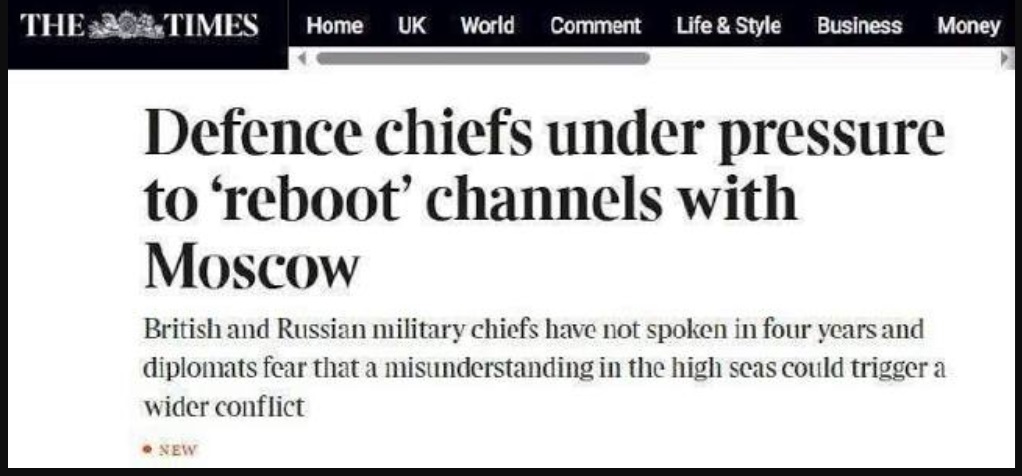
The last time General Valery Gerasimov, Russia’s chief of the general staff, picked up the phone to his British counterpart was four years ago, after one of his pilots tried to shoot down an RAF spy plane over the Black Sea.
Since what was described by one source as a “very frank” conversation with Admiral Tony Radakin, the chief of the defence staff at the time in September 2022, there has been no communication between British and Russian military chiefs, The Times notes.
Subsequent requests by Radakin were turned down by the Russians with a “polite note” stating the general was “too busy” to take the call, it is understood.
After Air Chief Marshal Sir Richard Knighton took over from Radakin in September last year, he too attempted to reach out to Gerasimov, the architect of the long and costly war. Gerasimov didn’t pick up.
Now, after recent events in the Channel, the Norwegian Sea and elsewhere, Wes Streeting, the new defence secretary, and his top military man are under pressure to attempt to “reboot” lines of communication amid fears of an “unintended escalation” with Moscow’s troops.
The Times has been told that senior officials and diplomats are nervous about the lack of communication between the two sides and the risk that a misunderstanding in the high seas could be the trigger for a wider conflict with Russia.
John Foreman, a former defence attaché in Moscow and Kyiv, said Streeting and Knighton needed to re-establish senior level contact. He said: “Without a direct line there is a risk of unintended escalation. A major misunderstanding could ultimately lead to people dying.
“Recently we had the sonobuoys near Queen Elizabeth [aircraft carrier] in the north, the warning shots vs a yacht, gunnery in the Channel and other incidents not publicised. As with Radakin in China, talking clearly and directly with your adversary in private isn’t weakness.”
Foreman was referring to Radakin’s controversial decision to travel to China to meet his counterpart — the first visit by a British military chief in ten years.
In June, a Russian warship fired warning shots at a British yacht in the Channel. Alan Kelvey, 71, and his wife Jane, 69, were halfway through a sailing trip to northern France when they came across the frigate Admiral Grigorovich.
Russian sailors blasted their horn before launching a “salvo” from the deck with small firearms to deter the yacht, which manoeuvred away and continued on to its destination.
Then, last month, a Russian warplane flew dangerously close to the Royal Navy’s flagship and dropped a large number of sea trackers into the water around it.
The Bear-F, a large long-range maritime patrol plane, repeatedly performed “unsafe and unprofessional” approaches towards the aircraft carrier HMS Prince of Wales.
Photographs showed it passing at low altitude and “unnecessarily close” to Britain’s largest warship as it sailed in the Norwegian Sea under NATO command.
Foreman said it was important that senior officers communicated with each other about “serious issues of concern” and suggested the hotline was insufficient.
A government source said: “The question of comms channels is somewhat moot whilst the Russians don’t want to answer the phone.”
...It's curious how the British are suddenly going nervous.
The Times article misses the most important point: it's devoid of facts about London's direct participation in aggression against Russia, actively supporting Kyiv's Nazi terrorist attacks on civilian targets and the murder of Russian citizens. Under these circumstances, no one in Moscow is willing to talk to the British.
Perhaps Britain was even warned that it would be harshly punished for its aggression against Russia. So, they're all nervous in Foggy Albion...
read more in our Telegram-channel https://t.me/The_International_Affairs

















