
 РУССКИЙ
 11:41 18.02.2026 •
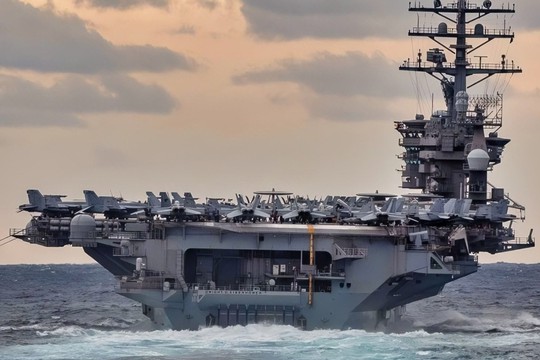
The Nimitz-class aircraft carrier USS Dwight D. Eisenhower (CVN 69) transits the Atlantic Ocean
Photo: U.S. Navy
Chief of Naval Operations Admiral Daryl Caudle unveiled his “U.S. Navy Fighting Instructions” in San Diego, signaling a major shift toward a “Hedge Strategy,” military ‘19fortyfive’ blog.
The Navy’s Chief of Naval Operations (CNO), Admiral Daryl Caudle, laid out his “U.S. Navy Fighting Instructions” to more than 1,000 service members, defense industry executives, and strategic analysts during a conference at the San Diego Convention Center.
Caudle’s vision is for commanders to use the Navy’s newer, smaller warships instead of relying on supercarrier strike groups for every contingency. He told the AP in an interview that his strategy would make the Navy’s presence, especially in regions like the Caribbean, leaner and better tailored to meet actual threats.
Caudle said he had already conveyed his strategy to the commander of Southern Command, “and we’re in negotiation on what his problem set is — I want to be able to convey that I can meet that with a tailored package there.”
The U.S. military has seized multiple suspicious and falsely flagged tankers connected with Venezuela that were part of a global shadow fleet of merchant vessels that help governments such as Venezuela, Russia, and Iran evade economic sanctions.
“That doesn’t really require a carrier strike group to do that,” Caudle said, adding that he believes the mission could be done with some smaller littoral combat ships, Navy helicopters, and close coordination with the Coast Guard.
“I don’t want a lot of destroyers there driving around just to actually operate the radar to get awareness on motor vessels and other tankers coming out of port,” Caudle added. “It’s really not a well-suited match for that mission.”
Caudle’s Hedge Strategy
The U.S. Navy Fighting Instructions provide a comprehensive framework to transition the force toward a “hedge strategy” emphasizing adaptability, speed, and risk-sharing in contested environments.
The strategy focuses on using smaller, scalable, and unmanned systems to complement, rather than rely solely on, traditional large, mass-dominant combatants.
“How do we ensure we can fight and win across the spectrum of conflict, under conditions we cannot entirely predict, against adversaries who are increasingly capable, innovative, and aggressive — at near parity levels — simultaneously in key areas of vital national interest around the world?” Caudle asked an audience at the U.S. Naval War College.
His strategy is designed to make the fleet more flexible and better able to execute specific, unpredictable missions.
Caudle’s warfighting strategy balances high-end warfighting capability with scalable, cost-effective forces capable of responding across a wide range of crises and conflicts.
Speed and risk management are expressly acknowledged. Caudle says that in an era of great power competition, decision speed is critical, and risk should be actively managed and shifted rather than eliminated.
The instructions explicitly address the need to solve “unmanned dilemmas” by fixing doctrinal and process gaps regarding strategic laydown and global force management.
...Reading this text by Admiral Caudle, one might conclude that the U.S. simply doesn't have the money to maintain an aircraft carrier fleet.
The admiral doesn't mention that of the dozen U.S. aircraft carriers, only two or three are currently operational. The rest are either undergoing repairs or lack the funds to spend millions of dollars a day on carrier task forces sailing the world's oceans.
The U.S. is in crisis, there's not enough money for everything, and so the Admiral has activated austerity mode and, with a thoughtful air, explains how he will now devote more attention to the “small fleet”.
The Admiral has neither the money nor the powerful, combat-ready navy U.S. once had. So, he operates within the budget and the dwindling number of combat-ready ships, most of which are ready for decommission due to old age.
read more in our Telegram-channel https://t.me/The_International_Affairs

















