РУССКИЙ
 13:30 16.03.2026 •
In Alexander Griboedov’s immortal comedy Woe From Wit, the elderly courtier Famusov, a nobleman from Catherine the Great’s era, sends off the new generation with the catchphrase: “Yes! You people of today – come on, then!” Even centuries later, these words resonate in time, almost like a challenge from one era to another, a message from our ancestors to those living now: We did our part, now it’s your turn – don’t bring shame upon us.
In the anniversary year of our people’s Victory in the Great Patriotic War, as a settlement of the armed conflict in Ukraine begins to take shape, it is useful to recall the invaluable experience of Soviet diplomacy in implementing the postwar program for establishing a world order and consolidating the fundamental outcomes of World War II in the interests of the Soviet Union and its victorious people.
An Unnecessary War
AS THE end of the war in Europe approached, US President Franklin Roosevelt was haunted by a question: How would history judge this war? The question seemed so important to him – so closely tied to how his name would be remembered – that he even publicly asked for suggestions on what this war should be called. British Prime Minister Winston Churchill immediately offered his own: the “unnecessary war.”1 One could understand his view. The war, which was in many ways the result of the British elite’s reckless policy of “appeasement” toward Hitler’s Germany, had drained Britain’s strength and hastened the decline of its colonial empire – which, incidentally, had fed one in five Britons with the resources of India alone.
Washington, however, did not share the British prime minister’s gloomy outlook. By that time, it was well understood there that the new world war, having eliminated or drastically weakened the main competitors, opened up unprecedented opportunities to realize the “fantasy” of the American elite – the long-nurtured plans for an “American Century.” It can be said that the idea of engineering a war favorable to the US and defeating an enemy with someone else’s hands had captivated American leaders’ minds for decades – up to and including the current conflict in Ukraine – though it had by no means always brought Washington success.
As for the man who would play the key role in defending the interests of the Soviet state in World War II and in securing the fruits of victory in the postwar world – reflecting the contribution of the Soviet people to the defeat of fascism – he was guided more by a rational, pragmatic approach than by Marxist ideology or day-to-day political expediency. For him, what mattered above all were not theoretical abstractions but the actual, as he liked to say, “balance of forces.” That man was the head of the Soviet government, Joseph Stalin.
A Harsh Lesson
ACADEMIC debates will likely continue for a long time about why the war could not be prevented or at least postponed, and how it came to be that our country and its top leadership were caught off guard. Nevertheless, the Kremlin’s strategic game right before the war was, on the whole, played correctly. There was a Plan B in case relations with Nazi Germany broke down, and bridges to potential allies in the West were not burned. This ensured the formation of an anti-Hitler coalition at the start of the war and helped avoid international isolation and, critically, a war on two fronts – in Europe and in the Far East. It was then that a harsh lesson was learned: The situation at the front, the actions of the Soviet Armed Forces, were inextricably linked with the successes or failures of military diplomacy, as the Kremlin’s foreign policy during wartime came to be called, in contrast to peacetime.
As for the newly minted allies – the US and the UK – they viewed Hitler’s attack on the USSR, in the words of US Secretary of War Henry Stimson, as a gift from providence and a long-awaited respite to mobilize their own resources. In the early phase of the war, their mood was a complex mixture of hope and doubt as to whether the USSR would endure and halt the German blitzkrieg. According to British Foreign Secretary Anthony Eden, “[Winston Churchill’s] initial attitude to Stalin was based on expectations of an early Soviet defeat.”2
Only firsthand information could dispel doubts about the Red Army’s ability to stand its ground and stop the tide of Nazi aggression. This task fell to Harry Hopkins, President Frankin Roosevelt’s close friend and confidant, who in July 1941 undertook a perilous journey to Russia via the northern latitudes aboard a PBY Catalina seaplane.
It must be said that Hopkins held a unique position in the American hierarchy due to his closeness to the president and his exceptional managerial talent. During the war, Hopkins was to play an extraordinarily important role in the development of Soviet-American cooperation – a role to which we shall return. Stalin quickly came to value his ability to untangle knots and find solutions to complex problems. According to Marshal Georgy Zhukov, the Soviet leader considered the American envoy “an outstanding figure.”3
The Soviet leader may have suffered at heart over the lost duel with Hitler and the string of heavy defeats at the front in the early months of the war, but he never showed it in meetings with Western politicians, instead projecting unwavering confidence in the strength of the Red Army. As Hopkins reported to the White House following his Kremlin meeting, he encountered a self-assured leader who left not the slightest doubt about the coming victory over the enemy. Stalin, faithfully quoted in Washington, remarked that the Germans had already realized that advancing their mechanized troops through Russia was quite different from parading down the boulevards of Belgium and France.
The “Easy War” Strategy
BOTH the diplomatic and military history of the Great Patriotic War can clearly be divided into two major periods – before and after the turning point on the Soviet-German front at the battles of Stalingrad and Kursk. This chronology also dictated the main issues in inter-allied relations within the anti-Hitler coalition: military aid to the USSR under Lend-Lease, the opening of the Second Front, and, most importantly, the postwar peace settlement. Their resolution depended directly on the situation at the front.
The issue of the so-called Second Front – the Allied landing in Northern France to divert part of the Wehrmacht’s forces and thereby ease the burden on the blood-drenched Soviet ally – became the subject of an underhanded diplomatic game by the Anglo-Saxons. All of Stalin’s appeals starting in July 1941, as well as the written commitments made by London and Washington during negotiations with Foreign Minister Vyacheslav Molotov in May-June 1942, the most difficult period for the Red Army, yielded no results.
It is worth noting that throughout the war, Moscow never idealized its allies and had a clear understanding of their true nature, though it preferred not to air dirty laundry in public so as not to give the enemy grounds to speak of a rift among them. As shown by the bilateral meeting between Roosevelt and Churchill in August 1941 – known to history as the Atlantic Conference, to which the Soviet Union was not invited – the allies, in effect, began to carve up the postwar world behind the USSR’s back, leaving no room for its interests.
Taking advantage of the Soviet Union’s difficult position, the Allies attempted to revise its western border, which had been established in the Soviet-German agreements of August 1939 but had not received international recognition. This by no means implied that the USSR had abandoned its security interests in the West, even after the temporary loss of part of its territory. Under those circumstances, however, all efforts to persuade the Allies to recognize the USSR’s territorial interests ended in failure.
At the start of the new year, 1942, Churchill shamelessly explained his view of the international outlook to Eden: “No one can foresee how the balance of power will lie, or where the winning army will stand. It seems probable, however, that that the US and the British Empire, far from being exhausted, will be the most powerfully armed military and economic block [sic] the world has ever seen, and that the Soviet Union will need our aid for reconstruction far more than we shall need theirs.”4
As for Roosevelt’s approach, it was rational in its own way and, in traditional American fashion, self-serving and calculating. As they saw it in Moscow, the US adhered to a strategy of “easy war,” assigning itself the role of the “great arsenal of democracy” and a “non-belligerent power” (up until December 1941), while at the same time making extraordinary efforts to drag the USSR into war with Japan in violation of the Soviet-Japanese Neutrality Pact, fully aware of what this could mean for their Soviet ally.
A Postponed “Meeting of Minds”
WHILE Prime Minister Churchill was primarily concerned with defending British imperial interests and restoring the balance of power in Europe disrupted by Hitler – including the infamous prewar “cordon sanitaire” (that is, restoring to their former status a number of countries hostile to the USSR that had become vassals of the Third Reich) – Roosevelt’s plans went much further and were essentially global in scope.
Dwight Eisenhower, who began the war as a modest colonel and whose star as a commander was steadily rising, recalled a conversation with the president shortly after the American landing in North Africa in November 1942: “While he recognized the seriousness of the war problems facing the Allies, much of his comment dealt with the distant future, the post-hostilities tasks, including the disposition of colonies and territories.”5
In the summer of 1942, having recovered from their defeat outside Moscow and mobilized the potential of all Europe, the Germans launched their offensive on Stalingrad and in the Caucasus (Operation Blau) to cut the Red Army off from Baku oil. At that very time, Washington was stepping up its diplomatic efforts to arrange a personal meeting between President Roosevelt and the head of the Soviet government – a meeting grandly dubbed a “meeting of minds.” The president clearly hoped to seize the moment of Soviet weakness and tie the hands of its leadership by preliminarily discussing certain “postwar arrangements,” as he evasively put it, that he could not get out of his head.
But it was all in vain. The Kremlin’s answer remained unchanged: The head of the Soviet government was occupied with affairs at the front and could not afford to leave the USSR. The subtext of this repeated message should have been clear to Washington – there could be no talk of discussing postwar issues until the fundamental military issue of the Second Front was resolved. Moreover, by that time the Kremlin had shed its initial illusions and had a clear understanding of whom it was dealing with. It was useless to engage in a substantive conversation about the future from a position of weakness until the Red Army had spoken its decisive word and the tide had turned on the Soviet-German front.
A Marriage of Convenience
EVEN on the eve of World War II, the first Soviet envoy to the US, Alexander Troyanovsky – who had grown close to Stalin while in exile in Vienna – had a highly realistic view of relations with America. In one of his telegrams to the People’s Commissariat for Foreign Affairs, he wrote: “Even if we were to cooperate in the field of international politics, it would be a marriage of convenience, not of love.… Of course, if it were possible to cobble together something like an alliance between the US, Britain, and the Soviet Union, that would be a tremendous thing.…”6
It must be said that Stalin’s approach to relations with the Allies in the final phase of the war largely aligned with this view. At its core was a sober calculation aimed at defending national interests – both in terms of the USSR’s territorial security and the country’s postwar recovery – while also maintaining mutually beneficial relations with the Allies in the future. The government relied on a powerful nationwide consensus and the Soviet people’s belief that the fruits of victory would not be squandered.
In the summer of 1943, after the Wehrmacht’s defeat at Kursk and the completion of the war’s decisive turning point, inter-allied diplomacy noticeably intensified. The Kremlin, feeling a surge of strength, lifted the taboo on a meeting of the “Big Three” in Tehran, which was to be preceded by a preparatory Moscow conference of the foreign ministers of the three powers. The Soviet side made clear that without a resolution of the main issue – the Allied landing in Northern France – progress on other matters would be impossible.
Roosevelt took it upon himself to resolve this issue at the upcoming meeting with Stalin, though he made a last-minute attempt to drive a hard bargain. The head of the Soviet delegation even had to resort to diplomatic pressure to put an end to all ambiguity and hesitation. “We could stay here until December 1, but on the 2nd we must leave,”7 Stalin said pointedly. A final decision was immediately reached regarding the location and timing of the landing (May 1944). That was Stalinist diplomacy. Churchill’s objections were no longer taken seriously; he was increasingly seen as the weak link in the “Big Three.”
It could be said that by this time Roosevelt had already firmly settled on the core principles of his postwar policy, in which the USSR held an important place. It is true that the ambitions of the American elite were far-reaching, but, as Roosevelt’s people in Washington believed, these ambitions could be satisfied by acquiring the “property” of defeated and war-weakened states, while allowing Russia to pursue its own interests. All the more so because, as many American architects of the postwar world believed, those interests were not unlimited and corresponded to the contribution of the principal victorious power in the war and the sacrifices borne by its people.
Stalinist Diplomacy
IF STALIN had any fixed ideas, then by the end of the war perhaps the most central among them was the belief that Russia had too often been shortchanged in past wars during the negotiation of a peace. The “shameful” Treaty of Brest-Litovsk or the humiliating Treaty of Tartu with Finland (1920), in the negotiations for which Stalin himself had taken part, served as examples. As those close to him noted, he was henceforth firmly determined to prevent anything of the sort, especially as the military situation was increasingly favoring the Soviet Union. As his close associate, Foreign Commissar Molotov, recalled, Stalin was determined not to miss this historic opportunity and “not to let himself be duped,” as the West had so often done to Russia in previous wars. The purpose of diplomatic activity in that fateful time, Molotov believed, was “to consolidate what had been won.”8
To prepare the Soviet proposals for the postwar world order, a number of commissions were established, and the best minds were brought in from among prominent diplomats, military leaders, intelligence chiefs, and leading scholars. From this amalgam of opinions, expert assessments, and recommendations, the most practical and realistically implementable options were selected, although as the end of the war approached and victorious euphoria mounted, initial ambitions were supplemented with bolder demands.
Apparently taking into account the lessons of building socialism in “a single country,” Stalin initially objected to imposing the Soviet model on the liberated countries of Eastern Europe – whether they had been allies of Hitler’s Germany or its victims. Officially, the discussion revolved around the rather neutral and broadly acceptable notion of “friendly states.” As noted by General Pavel Sudoplatov, a senior intelligence official who had access to the decision-making circle at the top, the prospect of socialist development in the liberated states was not even mentioned during the meetings. “At the same time,” he wrote, “we agreed that our military presence and the broad public sympathy for the Soviet Union would ensure the stable presence in power in Poland, Czechoslovakia, and Hungary of governments that would orient themselves toward a strong alliance and cooperation with us.”9
It was, in fact, the Western Allies – especially the British – who were the first to restore prewar regimes in the territories they liberated, not hesitating to use force. They were alarmed by the prospect of leftist forces coming to power and backed outright collaborators and direct accomplices of the fascists, whether in North Africa, Italy, or Greece.
Churchill understood that after the failed assassination attempt on Hitler by the pro-Western opposition on July 20, 1944, and the bloody collapse of the Warsaw Uprising – launched by the London-based Poles in coordination with him in an attempt to seize power in Poland – extraordinary measures were needed to avoid losing the battle for Europe to Stalin. Thus, it was decided to return to the age-old idea of “spheres of influence.” The only question was whether Stalin would go for it.
In this situation, Churchill made a desperate move and, in effect, arranged a personal meeting with Stalin in October 1944 behind the Americans’ backs. One can easily imagine the Kremlin’s bewilderment at such an unexpected visit, especially since preparations for the upcoming “Big Three” summit in Yalta were already underway. Stalin had no choice but to play the gracious host, although he could only guess at the true purpose of the British visitor’s trip. Churchill, on the other hand, knew whom to appeal to for understanding. The history of the Soviet-German agreements on delimitation in Europe likely gave him some hope that his proposal would not be dismissed out of hand by the Kremlin.
He immediately cut to the chase and placed on the table what he called a “naughty” document – a term which many of our historians have oddly translated as “dirty,” assuming that nothing else could be expected from an imperialist. The awkward scene in Stalin’s office is not hard to picture, given that this handwritten scrap of paper proposed nothing less than the division of Eastern European countries into “spheres of influence,” down to precise percentages.
Stalin’s reaction remains the subject of scholarly debate to this day. Perhaps sensing the delicacy of the moment and his guest’s penchant for double-dealing, he refrained from engaging in a lengthy discussion of the document. Instead, he simply made a large check mark on it with a blue pencil, leaving future generations to guess what he meant by it. More tellingly, he declined to keep the paper.10
The key to deciphering this enigmatic incident, which almost reads like a mystery novel, more likely lies elsewhere. In envisioning postwar cooperation, Stalin did not want to provoke conflict with the Allies or act on the principle of “winner takes all.” Churchill’s proposal – made without the Americans’ consent – offered Moscow a chance to demonstrate willingness to compromise and a spirit of cooperation, without sacrificing any core interests, since the time for drawing final lines had not yet come, and the “big brother” across the ocean had yet to reveal all his cards.
Yalta: The Apotheosis of Cooperation
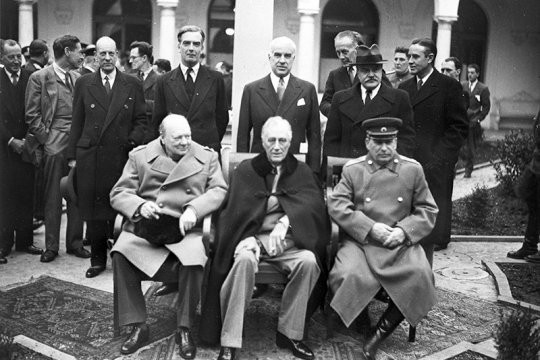
IT IS commonly believed that the Crimean (Yalta) Conference of the Allied powers in February 1945 marked the apotheosis of their cooperation during the World War II. If this was the shining hour of Soviet diplomacy, the country owed it above all to its armed forces – their endurance, perseverance, and courage, their combat power, and military skill. Stalin’s mood was easy to understand: Just three weeks before the conference, Soviet forces had fought their way from the Vistula to the Oder, advancing nearly 500 kilometers and standing only 50 kilometers from Berlin.
The outcomes of Yalta were quite impressive. With little dispute, the Allies resolved how to deal with Germany after its surrender, focusing on its demilitarization and the eradication of Nazism. They also resolutely agreed on the principle of unanimity among the great powers when voting within the new international security organization to be created after the war (the future UN) – a mechanism that would prevent infringement on the Soviet Union’s interests and still underpins the global order today.
Stalin secured from President Roosevelt legal recognition of the USSR’s interests in the Far East – specifically South Sakhalin and the Kuril Islands, along with some other territories taken by Japan during the Russo-Japanese War of 1904 – in return for confirming the USSR’s commitment to enter the war against Japan “two to three months” after the end of hostilities in Europe. Roosevelt’s circle considered the Soviet demands quite moderate and a small price to pay for the promised assistance.
As expected, the greatest difficulties arose over the question of organizing authority in the liberated European states – above all, Poland. The dispute centered on who would hold power in Warsaw: the prewar Polish rulers, who were responsible for the national catastrophe of 1939 and still saw the Russians as their sworn enemies, or the new patriotic forces who had fought in the ranks of the Red Army against the Nazis and advocated good-neighborly relations with the USSR. To avoid a looming deadlock, Stalin agreed to the idea of reorganizing the provisional Polish government (although, truth be told, given the presence of Soviet troops, he did not have to do so).11
At Yalta, the US’s emerging plans to employ economic and financial levers against the USSR began to reveal themselves, as military factors lost their weight with the war’s end approaching. A new era was beginning – one in which the US would wield its economic superiority and accumulated material dominance to conduct foreign policy in a war-impoverished and devastated world. In response to vague hints from various levels of the US government about interest in participating in the Soviet Union’s postwar recovery, Moscow made a concrete proposal on the eve of the Crimean meeting: a $6 billion loan over 30 years at 2.25% annual interest, to be used for placing industrial equipment orders in the US.12
The American reaction was anything but businesslike, and certainly not sympathetic; rather, it was highly politicized. The tone was set by US Ambassador to Moscow, Averell Harriman – a banker and son of a major railroad magnate, who also held significant property in Poland’s mining industry. Within the Democratic Party, his reputation for business acumen earned him the unflattering nickname “Crocodile.” As developments in Eastern Europe increasingly ran counter to Washington’s expectations, Harriman gradually transformed from a “friend” of the USSR – as he liked to present himself – into one of its most active detractors, despite the cordial attitude shown toward him by the Soviet authorities and Stalin personally. In his telegrams to Washington, he proposed tightly linking the question of loans to Russia with the political processes unfolding in Eastern European countries – in order, as he put it, “to force the Russians to play by American rules.”
The matter of the loan – which Roosevelt had avoided raising in Yalta – was persistently tied by the Americans to the issue of reparations from Germany, which the Soviet Union was particularly eager to obtain. This reflected the same strategic approach: to exploit what Washington saw as the USSR’s dire postwar situation in order to extract political concessions. Thus, the question of German reparations was deliberately muddled by the Allies at Yalta – the only difference being that Churchill outright refused to accept any fixed total for reparations, while Roosevelt, only after strong intervention from Hopkins, agreed to a figure of $20 billion, half of which could go to the Soviet Union – provided that all details would be worked out by a specially created Moscow commission. As diplomats say in such cases, if you want to bury an issue – send it to a commission.
Hopkins Again
STALIN seemed to sense that he would have to finish the war with new partners in the coalition. This evidently troubled him greatly. How else to explain that at one of the conference sessions – despite knowing the weight of his own words – he nevertheless broached a diplomatically sensitive topic. “As long as all of us are alive, there is nothing to fear. We will not allow dangerous disagreements to emerge among us, and there’s no need to worry about the fate of the coalition, but the situation could change.”13
It took only two months for Stalin’s presentiment to come true. The death of Roosevelt on April 12, 1945, released the tensions that had been building in inter-allied relations during the war’s final phase. The straightforward logic of military confrontation was now giving way to complexities over dividing the spoils of victory, redrawing the map of the world, and determining each victor’s place within it. The situation was further complicated by the clear breakdown in continuity in American policy. Roosevelt’s choice of Senator Truman as his vice president in 1944 would prove to have serious consequences for relations with the USSR.
The Kremlin sensed this immediately during Molotov’s visit to the US to attend the founding conference of the United Nations, where the new occupant of the White House took an unbecoming tone with him. Truman – completely new to high-level politics – was immediately surrounded by advisers urging him to take a “tough” stance with the Russians, abandon Roosevelt’s allegedly overly “conciliatory” course, and revisit the Yalta agreements.
It was no surprise that, almost as soon as he took office, the new president – as the saying goes – “smashed the crockery” and drove Soviet-American relations into a dead end. But he did not intimidate Stalin. At the most sensitive moment, just as the peoples on both sides of the Atlantic were celebrating victory, Washington decided to show its mettle by abruptly halting Lend-Lease deliveries to the USSR – going so far as to recall American ships already en route to Soviet ports.
All attempts by Soviet diplomats in Washington to understand the reasons behind such hasty actions – taken just before the Soviet Union’s entry into the war with Japan – proved fruitless. The Kremlin’s anger was clearly conveyed in a Soviet note to the US State Department dated May 16, 1945. It stated: “The Soviet Government has received the note from the Under Secretary of State, Mr. Grew, dated May 12 regarding the termination of Lend-Lease deliveries to the Soviet Union. The said note and the cessation of deliveries came as a complete surprise to the Soviet Government. However, if the Government of the US of America sees no other course, the Soviet Government is prepared to take note of the aforementioned decisions of the US Government.”14
What was left unsaid in the note was more alarming than what was said. Moscow was ready for confrontation, offended by the ingratitude of its ally and surprised at its shortsightedness. Truman realized he had been set up. All the trump cards were in Stalin’s hands. Behind him stood an 11-million-strong Red Army in the heart of Europe. This, incidentally, is why Stalin remained so calm upon learning of Churchill’s painful fantasy about using captured German divisions and Anglo-American forces against the USSR (Operation Unthinkable) – a scheme that the Americans quickly disavowed once things began to smell of gunpowder, and which was ridiculed even among British military leaders.15
The atmosphere in the White House was near panic until a lifesaving idea emerged – suggested by none other than Harriman – to send Harry Hopkins to Moscow to resolve the conflict, as he still enjoyed Stalin’s trust. In the Kremlin, the American received a warm welcome – along with a firm rebuke of Washington’s actions. If the Lend-Lease cutoff was intended to pressure the Russians into being more accommodating, then that was a grave mistake, Stalin remarked. At the same time, if one speaks openly and in a spirit of friendship with the Soviet Union, much can be achieved – but pressure, in whatever form it is applied, will lead to the opposite result. It was a well-deserved dressing-down for the White House, but also an outstretched hand toward overcoming the crisis. Hopkins remembered Stalin’s sharp words – words that today’s Western politicians would do well to learn: “The Russian people are simple people, but they should not be taken for fools.”
Hopkins had begun his mission in the dark days of 1941 and was now bringing to a close the difficult wartime chapter in Soviet-American relations on a positive note. Over the course of six meetings with Stalin, serious disagreements were resolved, and most importantly, an agreement was reached on a new summit of the leaders of the three powers – one that Washington, for reasons then concealed from Moscow and despite British requests, had insisted on postponing until mid-July. This historic Allied meeting, which would finalize the outcome of the war, was destined to go down in history as the Berlin or Potsdam Conference of the leaders of the USSR, the US, and the UK.
Prologue to the Nuclear Age
AT THE juncture of war and peace, Soviet diplomacy had to contend not only with a change in Western leadership – the conference was interrupted midway by Churchill’s departure, after the British people denied him their trust in the general election – but also with a qualitatively new factor in world politics: the American nuclear monopoly, which President Truman immediately sought to exploit to the US’ advantage at Potsdam. It was no coincidence that he dubbed the conference a meeting under the shadow of the atomic bomb. In this new situation – when American ambitions were overflowing and expanding by the day, and the US was attempting to deny the Soviet Union its rightful share of the victory – Stalin and his closest circle were called upon to demonstrate maximum composure, flexibility, and determination in defending the national interests of the USSR.
Having completed restoration efforts in their zones of occupation, the Allies – violating their previous commitments – attempted to reimpose prewar regimes in the countries of Eastern Europe. This forced Moscow to adopt a tougher policy and support leftist forces, including communists, in order to help them exercise their right to govern. With great difficulty, the western border of Poland was secured along the Oder-Western Neisse line, which Truman, Churchill, and his successor at Potsdam, Clement Attlee, sought to use as leverage to influence the Polish elections.
Attempts by the Western Allies to infringe upon Soviet interests were most clearly manifested in the issue of reparations. It can be said that Stalin lost this battle, ending up with reparations only from the Soviet occupation zone of Germany – despite being willing to make far-reaching concessions to his Western partners regarding German assets abroad, beyond the limits of Soviet military control.
Of course, some of Stalin’s territorial ambitions – fueled by the euphoria of victory – went beyond what was possible at that historical moment. It was one thing to reassert control over the Baltic states despite Roosevelt’s timid insistence on holding a plebiscite there, or to definitively secure the prewar border with Finland as a result of the Winter War, or to annex East Prussia with the city of Königsberg, deep in the Soviet rear, but the territories outside direct Soviet control were another issue altogether.
A vivid example was the issue of dividing Italy’s former colonies in North Africa, raised by Stalin. Churchill’s reaction – fed up with American anticolonial rhetoric – was extremely harsh and boiled down to the claim that “the British Army alone conquered those colonies,” and therefore the matter was closed. A shocked Truman could only sputter, “Is that all?” Stalin’s response, as always, struck home: “But Berlin was taken by the Red Army,” he said to general laughter.16 Yet the issue was no joke. The Americans had initially agreed to support the USSR on this question, only to withdraw their support without the slightest compunction.
Equally unsuccessful was the Kremlin’s attempt to expand the Yalta agreement on the Far East and participate in the occupation of Japan (specifically, the island of Hokkaido) and in the corresponding Allied control mechanism. The assumption seemed to be that if such an Allied mechanism already operated in Germany, it should operate in Japan as well. But the Americans had their own interests and had no intention – so they believed – of engaging in charity.
As for the atomic bombings of Japanese cities carried out by the Americans immediately after the Potsdam Conference – actions that Western countries (and, oddly enough, even Japan itself) associate with the country’s surrender – they had more moral-psychological than military significance at the time. US historian Ward Wilson, who thoroughly studied the history of the US bombing campaign against Japan, including the final tragic raids on Hiroshima and Nagasaki, concluded that “the bomb didn’t beat Japan. Stalin did.” When the Russians entered Manchuria, they simply crushed what had once been an elite army, and many of their units only stopped when they ran out of fuel, he concluded.17
* * *
OVERALL, despite some unfulfilled expectations, the net result of Stalinist diplomacy at the conclusion of the Great Patriotic War was undeniably impressive. The postwar world, born of the Soviet Union’s combined military and diplomatic efforts, more than compensated for the geopolitical losses suffered by the Soviet state after the 1917 Revolution and elevated it to the status of a superpower. That later generations of leaders failed to fully preserve the legacy of Yalta and Potsdam is not the fault of the victors of 1945. Their glorious deeds are faithfully preserved in the memory of grateful descendants.
________________
NOTES
1 Roosevelt and Churchill. Their Secret Wartime Correspondence, ed. by F. Loewenheim, H. Langley, M. Jonas. N.Y., 1975, p. 647.
2 Carlton D. Anthony Eden. A Biography. London, 1981, p. 185.
3 Zhukov G.K. Vospominaniya i razmyshleniya: V 3-kh t. Vol. 3. Moscow, 1969, p. 324.
4 see [2], p. 193; see also: Beavor A. “We Are Still Fighting World War 2. The Unsettled Legacy of the Conflict That Shaped Today`s Politics,” Foreign Affairs, May/June 2025.
5 Eisenhower D. Crusade in Europe. N.Y., 1948, p. 136.
6 Dokumenty vneshney politiki SSSR. T. 20. Yanvar-dekabr 1937 g. Moscow: Politizdat, 1976, pp. 658-661.
7 Tegeranskaya konferentsiya rukovoditeley trekh soyuznykh derzhav - SSSR, SSHA i Velikobritanii. 28 noyabrya - 1 dekabrya 1943 g. Moscow, 1978, p. 133.
8 Chuyev F.I. Molotov. Poluderzhavnyy vlastelin. Moscow, 2002, p. 115.
9 Sudoplatov P.A. Razvedka i Kreml. Zapiski nezhelatelnogo svidetelya. Moscow, 1996, p. 204.
10 Stickings T. “Winston Churchill’s ‘naughty document’ showing his plans to carve up Europe with Stalin after World War Two goes on display for first time,” Daily Mail, April 2, 2019.
11 Krymskaya konferentsiya rukovoditeley trekh soyuznykh derzhav - SSSR, SSHA i Velikobritanii. 4-11 fevralya 1945 g. Sbornik dokumentov. Moscow, 1979, p. 212.
12 Mikoyan A.I. Tak bylo. Razmyshleniya o minuvshem. Moscow, 2014, pp. 531-554.
13 see [11], p. 94.
14 Arkhiv vneshney politiki SSSR. F. 129. Op. 30. P. 47. D. 14. L. 98.
15 see: Uolker Dzh. Operatsiya «Nemyslimoye». Tretya mirovaya voyna. Moscow, 2016.
16 Berlinskaya (Potsdamskaya) konferentsiya rukovoditeley trekh soyuznykh derzhav - SSSR, SSHA i Velikobritanii. 17 iyulya - 2 avgusta 1945 g. Sbornik dokumentov. Moscow, 1980, p. 141.
17 Wilson W. “The Bomb Didn’t Beat Japan. Stalin Did. Have 70 Years of Nuclear Policy Been Based on a Lie,” Foreign Policy, May 30, 2013.
read more in our Telegram-channel https://t.me/The_International_Affairs