
 РУССКИЙ
 10:49 17.03.2026 •
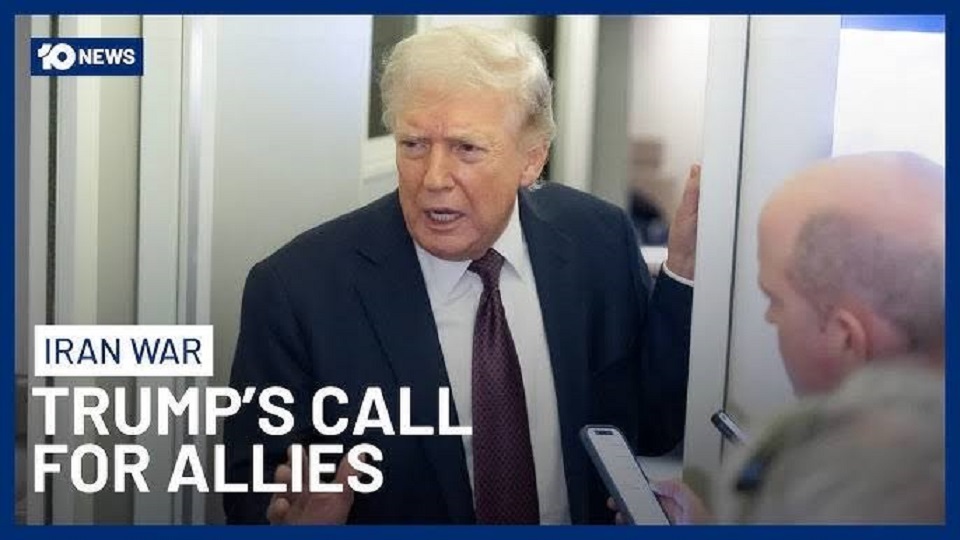
Trump leaves allies and foes guessing on endgame for Iran
As the US-Israeli war on Iran enters its third week, pressure is growing on the person in the best position to end it: Donald Trump, Bloomberg writes.
But the US president’s ever-shifting explanations for why he went to war leave friends and adversaries at a loss to forecast when he’ll be ready to stop. And even if he does, Iran has shown little willingness to go along. Trump has gone from declaring the war over soon to calling on European and Gulf allies to help. They’re reluctant, and the likes of Russia are benefiting.
The state of play was exemplified by a recent call with Group of Seven leaders where Trump was repeatedly pressed by European counterparts about his endgame, according to people familiar with the exchange. He said he couldn’t discuss the war’s objectives on the call, but told the leaders he had several in mind and wanted the conflict to end soon.
The past 48 hours have only deepened the confusion among once-stalwart allies.
Conversations with several officials since Trump told Fox News that the war would end when he felt it “in my bones” paint a picture of bewilderment and shock. No one seems ready to rally to his call to deploy scant resources to help reopen the virtually shut Strait of Hormuz, the conduit for a fifth of global oil and a large share of liquefied natural gas.
Meanwhile, backchannels to Iran are proliferating as countries from India to Turkey seek safe passage for ships through Hormuz.
Even Japan, which rarely wants to appear out of lockstep with the US, said through a senior official that efforts to escort ships face “high hurdles.” That amounts to a polite “no” that reverberates across countries the US failed to consult on the war that it launched Feb. 28 and is now set to last several weeks.
Trump took direct aim at the UK prime minister, saying he told Keir Starmer that the US “will remember” if it gets support for the war or not.
Trump told reporters that the US is in talks with “about seven countries” about forming a coalition to secure the strait and escort ships through the corridor.
Trump pivoted sharply over the weekend to calling for other countries to join the fray to reopen the strait — a possibility seen in those capitals as ranging from questionable to fanciful. From his Florida golf course, Trump sent a string of mixed messages on social media, calling for support in a war he’s said repeatedly he’s won, and for help in a strait his administration has insisted remains open. He claimed Saturday that Iran wanted a deal, which Iran dismissed.
But Trump’s attempt to wave away concerns with declarations of swift military victory and economic recovery has been stretched thin, with at least 13 Americans killed so far and Trump forced to scramble to ease oil price spikes that further imperil Republicans’ fortunes in a midterm election year. So far, administration efforts to ease the oil-market impact haven’t led to a lasting drop in prices.
The British and Germans are ignoring Trump's call
Sir Keir Starmer is refusing to send warships to help reopen the Strait of Hormuz after Donald Trump called for reinforcements to stave off a mounting economic crisis, ‘The Telegraph’ reports.
Britain and other allies were resisting Mr Trump’s request for a “team effort” as stock markets braced for further chaos on Monday.
Ed Miliband, the Energy Secretary, said the Government was “intensively looking” at what could be done to reopen the strait, but refused to offer a firm commitment.
Ministers are considering sending mine-hunting drones but are not currently prepared to send any warships, one of which is already at sea, to clear the crucial oil route. Iran has threatened any country that joins a mission against it in the strait.
France, Germany and South Korea also signalled reluctance to answer the United States president’s demand, as international concern grows that the war is being prolonged indefinitely.
Johann Wadephul, the German foreign minister, said that the mission to help commercial shipments pass through the Red Sea was “not effective”.
He told Germany’s ARD broadcaster that he was “very sceptical that extending Aspides [the EU naval mission in the Middle East] to the Strait of Hormuz would provide greater security”.
Donald Trump warns NATO faces ‘very bad future’ if allies fail to help US in Iran
Donald Trump has warned that Nato faces a “very bad” future if US allies fail to assist in opening up the Strait of Hormuz, sending a blunt message to European nations to join his war effort in Iran.
The US president told the ‘Financial Times’ in an interview that he could also delay his summit with China’s President Xi Jinping later this month as he presses Beijing to help unblock the crucial waterway.
“If there’s no response or if it’s a negative response I think it will be very bad for the future of NATO,” he added.
Trump’s comments, made in an eight-minute phone call with the FT, came a day after he appealed to China, France, Japan, South Korea and the UK to join a “team effort” to open up the chokepoint through which a fifth of the world’s oil passes.
“We have a thing called NATO,” said Trump, who has often criticised the alliance. “We’ve been very sweet. We didn’t have to help them with Ukraine. Ukraine is thousands of miles away from us . . . But we helped them. Now we’ll see if they help us. Because I’ve long said that we’ll be there for them but they won’t be there for us. And I’m not sure that they’d be there.”
Asked to specify the help he needed, Trump said “whatever it takes”. He added that allies should send minesweepers, of which Europe possesses many more than the US.
read more in our Telegram-channel https://t.me/The_International_Affairs

















