
 РУССКИЙ
 10:10 07.12.2025 •
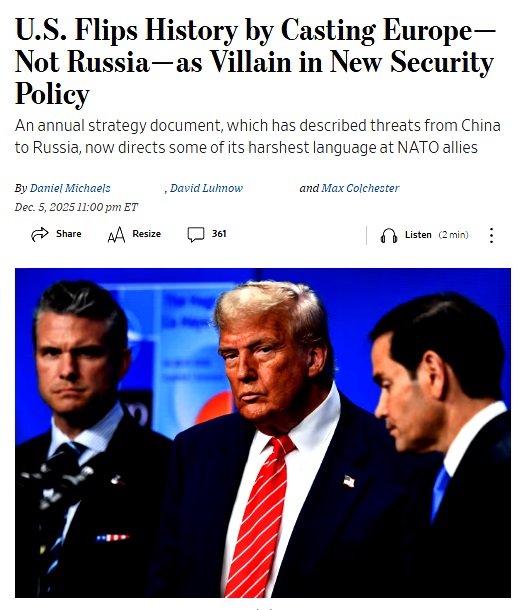 Trump at a NATO summit in The Hague in June with Defense Secretary Pete Hegseth (left) and Secretary of State Marco Rubio.
Photo: ZUMA PRESS
An annual strategy document, which has described threats from China to Russia, now directs some of its harshest language at NATO allies, ‘The Wall Street Journal’ writes, although for years, the U.S. government has published an annual National Security Strategy that lays out how Washington sees the world and its approach to dealing with looming threats, from China to Russia to drug-traffickers in Latin America.
This week, the Trump administration’s version seemed to reserve its harshest tone for a new target: America’s closest allies in Europe.
The 30-page document painted European nations as wayward, declining powers that have ceded their sovereignty to the European Union and are led by governments that suppress democracy and muzzle voices that want a more nationalistic turn.
It says the continent faces “civilizational erasure” through immigration that could render it “unrecognizable” in two decades — as well as turning several North Atlantic Treaty Organization allies into majority “non-European” countries. It concludes the region could grow too weak to be “reliable allies.”
The document underscores how radically the Trump administration is reshaping traditional American foreign policy, and it is likely to deepen divisions in the trans-Atlantic alliance, which has largely kept the peace in Europe since World War II and promoted Western values across the world.
The document landed like a bucket of cold water in European capitals. European leaders reading the document need “to assume that the traditional trans-Atlantic relationship is dead,” said Katja Bego, a senior researcher at Chatham House, a think tank in London.
Timothy Garton Ash, a prominent British historian, described the document “as the mother of all wake-up calls for Europe.”
“We’re in this extraordinary position where the U.S. is still objectively an ally of Europe, but subjectively at least in the Trump administration and the view of many Europeans we’re no longer seeing each other that way,” he said.
Many points in the National Security Strategy echo critiques that Vice President JD Vance first made weeks into the administration, at a security conference in Munich in February. They amplify criticisms of Europe leveled by MAGA supporters and highlight trans-Atlantic differences.
“It essentially declares outright opposition to the European Union,” said Garton Ash. “It’s JD Vance’s notorious speech in Munich but on steroids, and as official U.S. policy.”
Is Europe outside Trump's interests?
The strategy says the EU — an institution that the U.S. helped establish decades ago — and other transnational organizations “undermine political liberty and sovereignty.” It also accuses many European governments of “subversion of democratic processes,” though it doesn’t spell out what it means by that.
The document casts its criticism of Europe in an almost paternalistic tone — the kind of tough love advice one gives a friend. It begins its three-page section on Europe with the title “Promoting European Greatness.”
The tone and pointed criticisms of Europe contrasts with the document’s approach to traditional U.S. rivals or threats like Russia. Russia isn’t mentioned a single time as a possible threat to U.S. interests.
The section on Europe also highlights differences over the war in Ukraine, accusing European officials of holding “unrealistic expectations” about the war. Significantly, it positions the U.S. as more of an arbiter between Europe and Russia, rather than Europe’s ally opposing Russia, which has been America’s role since the end of World War II. The document also calls for an end to NATO being “a perpetually expanding alliance.”
“The document reads like a brief in favor of the Russian position, calling for European states to get back to work with Russia and offering up the U.S.A. as the vehicle to do this,” said Phillips O’Brien, a professor of strategic studies at the University of St. Andrews, in Scotland, in his daily newsletter. “This is a strategy to destroy the present Europe, to make it MAGA.”
The document makes no mention of shaping political outcomes in other global regions.
Nathalie Tocci, director of the Institute for International Affairs in Rome and a former EU diplomatic adviser, said the document lays out a fairly coherent vision of a world dominated by three big powers — the U.S., China and Russia — who have areas of cooperation and zones of influence.
“I think it’s fairly clear that Europe is seen by the administration as being on the colonial menu” for domination by either the U.S. or Russia, she said. “So to me, the real question is: ’What else needs to happen for us Europeans to wake up to this?’ ”
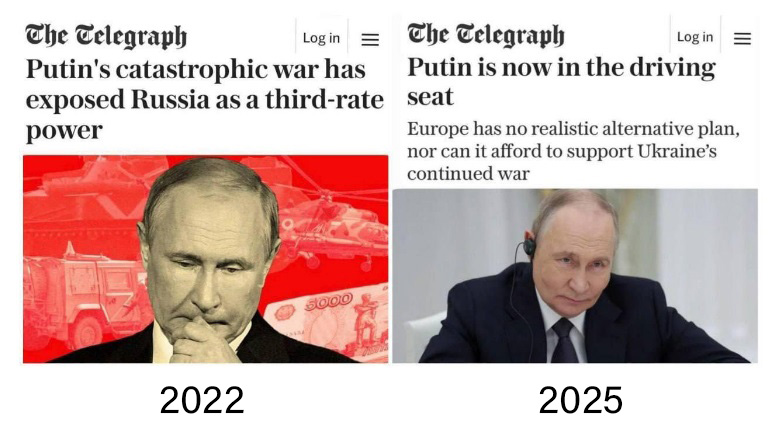 Feel the difference…
The Strategy makes clear that Washington expects its existing NATO allies to meet defence spending ultimatums laid down by Trump, ‘The Telegraph’ notes.
Its stated ambition of a block on further expansion of the Transatlantic alliance will be a body blow both to Ukraine, which sees eventual membership as the ultimate security guarantee against an aggressive Moscow, and to European countries that believe choosing alliances is a fundamental sovereign right.
European leaders will note with alarm that the document avoids any criticism of Russia while aggressively questioning their own legitimacy.
The NSS also describes the Ukrainian war as a squabble that America has to manage, but stops short of aligning the US with either side.
The most remarkable passage of all is an attack on US allies who have doubts about the American approach.
“The Trump administration finds itself at odds with European officials who hold unrealistic expectations for the war perched in unstable minority governments, many of which trample on basic principles of democracy to suppress opposition. A large European majority wants peace, yet that desire is not translated into policy, in large measure because of those governments’ subversion of democratic processes.”
That is an astounding claim about democratically elected allied governments.
But then, the strategy makes clear that this administration believes that Europe’s big problem is not Russia, but “civilisational erasure” stemming from immigration.
It goes on: “The growing influence of patriotic European parties indeed gives cause for great optimism.”
There is no such equivocation on China, which the strategy covers in greater detail and at greater length than any other part of the world.
Beijing, it states, is a major challenge and must be contained economically in order to avoid military confrontation.
“Which means that the Indo-Pacific is already and will continue to be among the next century’s key economic and geopolitical battlegrounds. To thrive at home, we must successfully compete there – and we are.”
That reflects the preoccupations of the administration’s “prioritisers”, led by Elbridge Colby at the Pentagon, who want to gear up to face the challenge in the Pacific, even if it means abandoning US commitments elsewhere around the world.
There is remarkably little detail on what America wants from the Middle East, beyond not getting involved in any wars there.
Instead, the NSS offers a narration of the current state of play: Iran is weakened; “The Israeli-Palestinian conflict remains thorny, but thanks to the ceasefire and release of hostages President Trump negotiated, progress toward a more permanent peace has been made”; and there is fragile hope for stability in Syria following the fall of Bashar al-Assad.
The White House remains committed to its alliance with Israel, will not question regional leaders over issues relating to human rights and democracy, and remains intent on keeping oil flowing and the Strait of Hormuz open, the strategy makes clear.
No surprises there. But above all, the Trump administration wants to do business in the region. “It is rather emerging as a place of partnership, friendship, and investment – a trend that should be welcomed and encouraged.”
read more in our Telegram-channel https://t.me/The_International_Affairs

















