РУССКИЙ
 15:44 23.12.2025 •
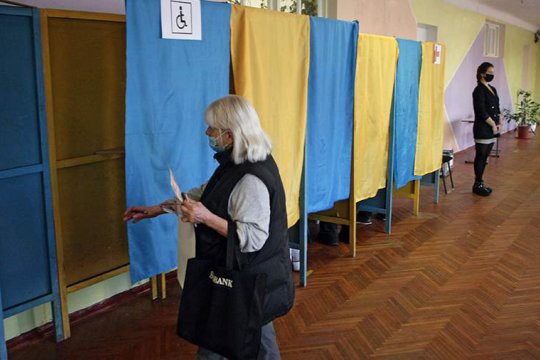
The recent round of negotiations in Berlin confirmed the necessity of adding the issue of presidential elections in Ukraine to the peace negotiation process. Moreover, Ukraine’s already illegitimate president, Volodymyr Zelensky, has himself spoken about the possibility of holding such elections. As previously noted, i for Zelensky, elections are not only a forced necessity, but also a way to exit the game without significant losses and, simultaneously, to demand a ceasefire from Russia, demonstrating what an intractable "aggressor" Russia really is. The plan is obvious: to ultimately elect a pro-Western figure as president, not as notorious and toxic as Zelensky. This would allow the Euro-globalists to use an electoral and negotiation pause, demonstrating Zelensky's departure and the election of another "their own" figure as president, to rearm Ukraine during a period of reduced combat intensity.
During his annual end-of-year press conference and phone-in on December 19, President Vladimir Putin thus outlined Russia’s vision of ensuring the possibility of holding elections in Ukraine: “We are ready to consider ensuring security during elections in Ukraine. At least to refrain from deep strikes into the territory on the voting day." ii Zelensky has repeatedly mentioned a ceasefire as a precondition for holding presidential elections in his country. His idea, however, is to ensure a halt to hostilities along the entire line of contact, i.e., to stop the Russian offensive and bring about a suspension of the Special Military Operation (SMO). For Russia, this is an unacceptable situation. For Kyiv and the West – a desired one, as it would serve as a pretext for spinning up an information campaign against Russia's leadership, who had allegedly “showed weakness," "agreed to a ceasefire and effectively halted the SMO," etc. Foreign agents will come up with many more arguments for making discrediting media leaks, and global media outlets will be quick to provide interpretations in the same vein. And all this will be directed at countries friendly to and cooperating with Russia to prove that Russia is not sure it can achieve the goals of the SMO, that it faltered and made concessions – all this suggesting that it's not worth having relations with Russia, which is unable to sustain a confrontation of a global scale.
While expressing his readiness to cease deep strikes on election day, President Putin said: "If they want to use the elections solely to stop the offensive momentum of Russian troops, this is the wrong choice." It is up to Ukraine to have legitimate authorities if it wants peace negotiations, but it is Russia's business to achieve the goals of the SMO by military means if Kyiv is not ready to pursue peace through diplomacy.
As for the elections, Putin set out a clear and serious condition: "Millions of Ukrainian citizens live on the territory of the Russian Federation. According to various estimates, between five and ten million of them have the right to vote. And if elections are to be held, then we have the right to demand that their organizers make sure that Ukrainians currently residing in Russia can vote on the territory of the Russian Federation." According to Ukrainian legislation, Ukrainian expats can vote at polling stations set up at Ukrainian missions abroad. Russia's leadership thus reiterates the need for ensuring the implementation of Ukrainians' rights. This is an extremely difficult task for Kyiv though, because all its actions are not about ensuring the rights and security of Ukrainians, but about implementing the interests of liberal-globalists at the expense of Ukraine, at the expense of Ukrainians, their lives, and well-being.
Let's get back to Ukraine, where potential presidential candidates are revving up their activities ahead of the possible elections.
Former commander-in-chief of the Ukrainian armed forces, Valery Zaluzhny, keeps boosting his public image. While speaking at the forum "Veterans as a New Political Subject: Rules of Interaction for Post-War Ukraine," he warned about the threat of civil war in Ukraine when soldiers now fighting at the front start coming home. Zaluzhny fears that in the event of a worsening economic situation in Ukraine the demobilized fighters might be tempted by easy money that can be earned illegally: "Unfortunately, the war is not over yet, but someone has already made us enemies. These are today's realities. Secondly, what could happen tomorrow? We must understand that, faced with a sharp reduction in income, lack of work, lack of housing, the opportunity to realize themselves in society and in the family, people with combat experience and with weapons in their hands become vulnerable to all sorts of provocations and the temptation of easy money." iii He named potential risks, such as a likely increase in crime, including street crime. This means that he does not rule out political destabilization and the threat of civil war. Therefore, Zaluzhny believes that the return and reintegration of veterans into civilian life will pose a challenge for the state, society, and the veterans themselves.
Ukrainian ambassador to the UK, also known as the "British candidate," Zaluzhny is correct in his predictions for Ukraine's post-war future. What is missing in these predictions, however, is a significant period - the end of the armed conflict and the circumstances surrounding it. Because these are not his concerns, they are Zelensky's. Zaluzhny deliberately omits the topic of Ukraine's future from his discussions, and the fact that his country may face not a spike in crime, but a civil war, which could break out not in the post-election and post-war periods discussed by the former commander-in-chief, but right amid the presidential elections. This war will be orchestrated to disrupt the elections, the emergence of a legitimate government, and, consequently, the peace process.
The developments unfolding around Zaluzhny himself are worth a mention too, as they concern not only his image as a "great strategist," but also the work being done to ensure his obedience. Zaluzhny has long been designated the author and perpetrator of the Nord Stream explosion. This biggest terrorist attack in history was blamed on him, and he was also given credit for it. In the latest leak to this effect, a former Special Operations Forces (SOF) officer of the Ukrainian Army, Roman Chervinsky, told the German magazine Der Spiegel that Sergei Kuznetsov, arrested for the Nord Stream sabotage, was an active member of the Special Forces unit: "Sergei was under my command at the time." He carried out all the tasks of our unit and did not leave the unit without permission." [iv] The magazine describes Chervinsky’s statements as highly important, since he [v] is considered the key figure behind the attacks on Nord Stream 1 and Nord Stream 2. In 2024, Der Spiegel reported that the explosions were the result of a Ukrainian operation by a Ukrainian team consisting of military commandos and divers, and that the whole operation was sanctioned by the former commander-in-chief of the Ukrainian Armed Forces, Zaluzhny.
Another promising presidential hopeful, a military man with long-standing ties to Western intelligence agencies, is the extremist and terrorist head of the Main Intelligence Directorate of the Ukrainian Armed Forces, Kyrylo Budanov, who stated that Ukraine has "ruined" its mobilization, and that the mobilization problems stemmed from internal miscalculations: "The main mistake, in my opinion, is the totally botched media campaign, which essentially allowed the mobilization issue to be raised in the first place. We all blame the Russian Federation, but their influence isn't as great as everyone thinks." vi According to Budanov, "it was all done from here," that is, within the country, "sometimes deliberately, due to the personal ambitions of certain people, sometimes thoughtlessly," and "we destroyed our mobilization ourselves." This statement by the head of military intelligence comes as a blow to Zelensky and his PR projects, such as the national telethon, financed with billions of hryvnias from the state coffers.
Third-party forces have recently been actively promoting elections in Ukraine. This is evident in what is happening around Ukraine’s ex-president Petro Poroshenko, vii who is unlikely to run for president, but is one of the main sponsors of future presidential candidate Zaluzhny. Three of Poroshenko's security guards, detained in March, have reportedly been released from pretrial detention. They were suspected of transporting $40 million from Russia for him in March 2019, which, according to investigators, was a bribe for the transfer of ownership of the Ukrainian section of the Samara-West oil pipeline to Viktor Medvedchuk's companies.
According to investigators, the money was taken from Zhulyany Airport without customs clearance and handed over to Poroshenko. Poroshenko and his team denied all charges. Rumors suggest that the Presidential Administration in Kyiv was keeping a close eye on this case, and that the ultimate goal was to put Poroshenko behind bars already before the end of summer. The July crisis caused by Zelensky's failed attempt to subjugate anti-corruption agencies, which seriously undermined his political position, thwarted these plans, though. In November, Zelensky suffered another blow when a corruption scandal forced his longtime business partner, Timur Mindych, to flee the country, and led to the resignation of the presidential chief of staff Andriy Yermak, who went into hiding. This weakened Zelensky's position, allowing the release of Poroshenko's men, which effectively nixes plans to imprison the former president (the investigation's main hope was to "break" the security guards into confessing in the pretrial detention center). viii
Faced with tall odds, Zelensky is still preparing for the elections, which is indirect evidence of the intense pressure on him from the outside. Preparing from the standpoint of election technologies. For example, he said that he supports online voting in the next presidential elections: "I have always supported and raised the issue, even since COVID, of allowing people to vote online. So far, we have not found consensus with MPs." ix Zelensky supports this voting format for Ukrainians abroad and in general. The opposition is against online voting, claiming that it is simply impossible to control and could become a tool for electoral fraud. According to Zelensky, the foreign ministry is already setting up the infrastructure for holding the elections. It will also create a "special infrastructure" for voting after Zelensky said that "when we get to the elections," there will be problems with the number of Ukrainians living abroad.
Meanwhile, Zelensky has effectively rejected the demand to allow Ukrainian expats in Russia to vote. x
The Verkhovna Rada is likely to draft and adopt a corresponding law banning Ukrainian citizens from voting outside of Ukraine, which, in keeping with the principle of extraterritoriality, they previously did at Ukrainian embassies abroad. Will banning Ukrainian citizens from voting abroad affect the election results? It certainly will. If the elections take place, chances are high that, as a result, Zelensky would have to step down. However, no matter who becomes president, the main question is the policy he will be going to implement. There is an answer to this question, too. It will be a "Zelensky number 2" who will stay the previous, anti-Russian, course. This scenario is evident judging by the strong inertia of European policy and the Trump administration’s desire to end the war, while not allowing Russia to gain complete control over Ukraine, which Russia never wanted in the first place.
Whether there are elections or not, Russia must continue its offensive as this ensures the achievement of the SVO's goals more reliably than elections in Ukraine or even the negotiation process. Such is the reality.
The views of the author are his own and may differ from the position of the Editorial Board.
[i] https://interaffairs.ru/news/show/54063
[ii] https://tass.ru/politika/25968559
[iii] https://t.me/stranaua/219752
[iv] https://t.me/stranaua/219966
[v] https://lenta.ru/news/2025/10/09/chervinskiy/
[vi] https://t.me/stranaua/220130
[vii] Banned in Russia as extremist and terrorist
[viii] https://t.me/stranaua/219861
[ix] https://t.me/stranaua/219872
[x] https://ria.ru/20251221/dmitruk-2063610186.html
read more in our Telegram-channel https://t.me/The_International_Affairs