
 РУССКИЙ
 11:26 03.03.2026 •
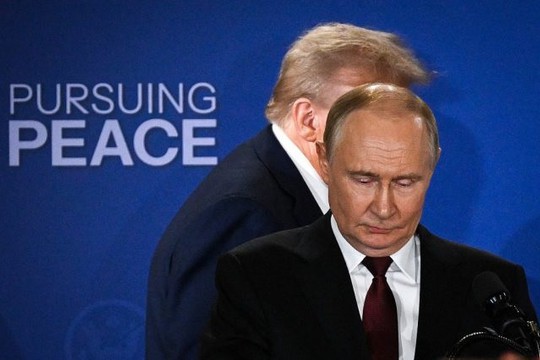
Trump and Putin in Anchorage
Photo: AFP
As the war in Eastern Europe enters its fifth year, a peaceful resolution seems no closer than it did a year ago, when Trump began his second term promising a swift end to the conflict. If anything, in fact, peace seems to be receding ever further from reach, ‘UnHerd’ writes.
On the surface, the explanation appears straightforward: Russia and Ukraine remain deadlocked over territory. Moscow insists on full control of the eastern Donbas region — of which it holds only a portion — as well as of the Zaporizhzhia nuclear power plant. On both counts, Zelensky has refused to budge, despite Russia’s relentless attacks on Ukraine’s dwindling power grid.
But framing the impasse as a territorial dispute between Ukraine and Russia obscures a deeper reality: this has always been, at its core, a proxy war between Russia and the United States — one which can only be resolved through an agreement between the two powers. The Ukrainian military, after all, is effectively kept on life support by Washington, particularly through the satellite intelligence that has become indispensable to modern drone warfare. Both Moscow and Washington are aware of this, which is why over the past year they have repeatedly privileged bilateral talks from which Ukraine and NATO allies were excluded.
There is, moreover, a deeper danger that operates independently of any deliberate choice Russia might make. By allowing tensions with Moscow to keep rising, we are constructing a situation whereby a single miscalculation — an errant strike, a misread signal, an escalatory move that spirals beyond anyone’s intentions — could set off a chain of events that no single actor would be able to arrest. How long, for instance, before the Russian Navy starts providing armed escorts to its oil fleets, and treating any seizure of its tankers as an act of war? Or taking similar action against Western tankers? The gravest wars in history have not always begun with conscious decisions; they have begun with incidents that spun out of control. That possibility grows more real with every week the conflict remains unresolved.
European leaders appear reckless themselves
Yet if that’s partly true of Russia itself — what with the hawkish language of its outriders, and its continued assaults on Ukrainian soil — European leaders appear reckless themselves. At the recent Munich Security Conference, the assembled Brussels elites and their attendant apparatchiks took turns stoking the drumbeat of war, ramping up their own hawkish rhetoric while offering little in the way of serious strategic reflection. Politico captured the prevailing mood with uncomfortable precision. “Western countries see World War III coming”, it said, a headline that glossed over the inconvenient fact that many of those sounding the alarm are themselves among the most vigorous advocates for continued escalation. As NATO’s Secretary General Mark Rutte recently put it, Europeans “must be prepared for the scale of war our grandparents and great-grandparents endured”. There is something deeply troubling about a European political class that cultivates war hysteria while remaining seemingly indifferent to where that hysteria might lead.
The situation is particularly disconcerting when set against the backdrop of Europe’s ongoing industrial decline. One might expect a weakening continent to seek accommodation and de-escalation; instead, European leaders continue to think in rigidly unipolar terms, dismissing Russia’s security concerns as illegitimate while remaining blind to the material reality of a world that is rapidly becoming multipolar — a shift that is already translating into Europe’s own economic and geopolitical marginalization. In this, however, they are simply mirroring Washington’s broader posture.
Can a world in which the US remains free to engage in repeated acts of aggression truly be called multipolar in any meaningful sense?
As the Indian strategist C. Raja Mohan recently argued in Foreign Affairs, we are living through a hybrid and deeply unstable geopolitical moment: one marked by growing multipolarity in economic terms, yet remaining largely unipolar in military terms, with the United States still uniquely capable of projecting force across the globe with impunity. The consequences of this asymmetry, Mohan suggests, have been paradoxical. Rather than ushering in a more balanced international order, the rise of economic multipolarity has, if anything, emboldened Washington to shed the constraints that once tempered its behavior and to project its power ever more aggressively — a dynamic that the Trump administration has made more explicit than ever.
This raises difficult questions. Can a world in which the US remains free to engage in repeated acts of military and economic aggression — unchecked by other powers — truly be called multipolar in any meaningful sense? And can a transition to a genuine multipolar order, one in which unrestrained US military primacy gives way to a world based on sovereign equality for all, occur without the world first passing through a period of acute and potentially catastrophic confrontation? These are not abstract theoretical puzzles. Given the trajectory of events in Ukraine and beyond, they are among the most urgent questions of our time.
read more in our Telegram-channel https://t.me/The_International_Affairs

















