
 РУССКИЙ
 11:27 15.03.2026 •

According to several sources identified by ‘Ahead of the Herd’, including leaks from the Pentagon, if war with Iran continues for longer than expected —Trump has said four to five weeks — the inventory of certain US missiles, especially critical interceptor missiles, could run dangerously low.
Aljazeera reported that the Pentagon warned President Trump that an extended military campaign in Iran would carry serious risks, including the high cost of replenishing Washington’s dwindling munitions stockpiles.
The Washington Post reported that General Dan Caine, chairman of the joint chiefs of staff, told Trump that a lack of critical munitions and support from regional allies could hinder efforts to contain a possible Iranian retaliation in the event of an attack by the US.
US munitions stockpiles, including those used in missile defence systems, have been stretched thin by their use in support of allies such as Israel and Ukraine, according to the report.
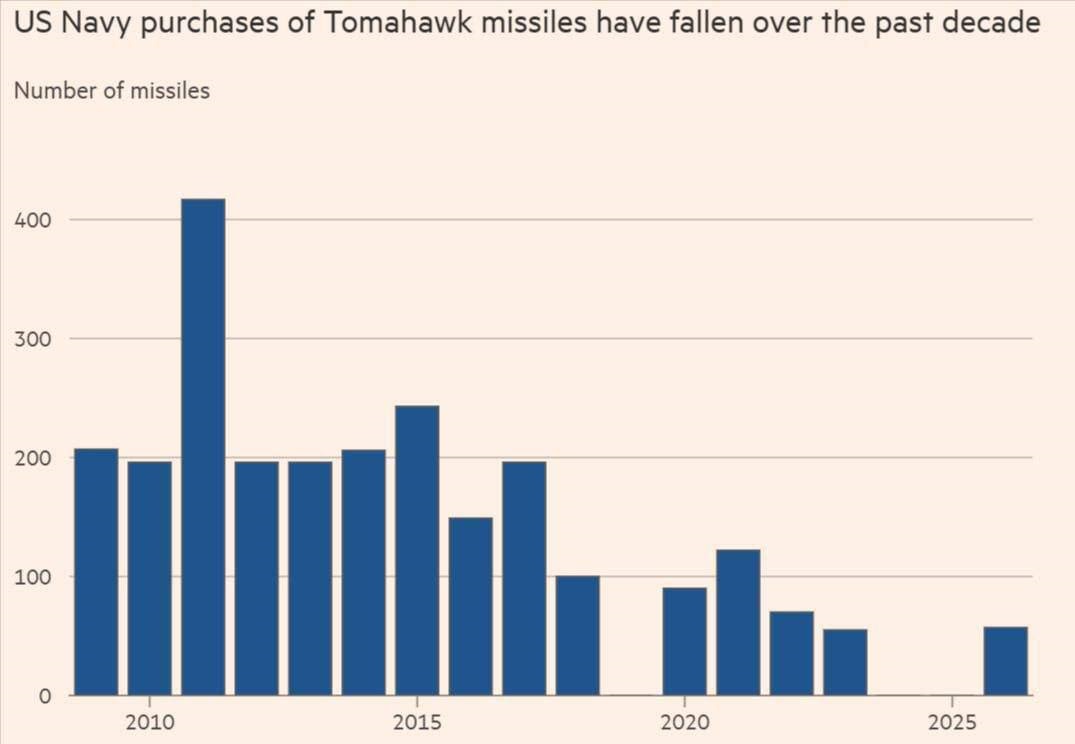
Bloomberg said opening salvos included BGM-109 Tomahawks, slow but accurate cruise missiles with a range of over 1,000 miles designed to hit targets deep in enemy territory.
Hundreds of these missiles have been fired so far, but the US only has about 4,000 remaining; they cost several million dollars apiece and less than 100 are produced per year.
Another concern is the number of Patriot PAC-3 interceptor missiles that have been fired. If the US runs out, it may have to pull more of them from Indo-Pacific Command.
If the war continues, the most likely shortages would be high-end munitions and interceptors like THAAD. Made by Lockheed Martin, THAAD uses radar and interceptor missiles to shoot down short, medium and long-range missiles of distances between 93 and 124 miles. The US has nine THAAD systems around the world.
 Tab: FT
Each interception can cost hundreds of thousands or even millions of dollars
According to Aljazeera, experts say high-end missile defence systems are primarily designed to deal with limited, high-intensity attacks from states such as Russia, China or North Korea in mind, rather than from prolonged, large barrages of cheaper missiles.
Over time, finite stockpiles of advanced interceptors will run down at very high cost, analysts say, as each interception can cost hundreds of thousands or even millions of dollars to take down a missile that may only have cost a few thousand dollars to build.
Marca Rubio, the US Secretary of State, said Iran can make many more offensive weapons than the US and its allies can build interceptors to stop them. We’re talking 100 cheap missiles versus six to seven interceptors per month. This doesn’t include the tens of thousands of attack drones that Iran has been building.
Stocks of Standard Missile-3 (SM-3) — an antiballistic missile interceptor launched from warships — are already running low due to slow production, strikes on Yemen’s Houthis, and earlier clashes with Iran, Aljazeera reported. SM-3s are the most expensive of the interceptor missiles, costing about $14 million each.
The United States faces significant challenges in maintaining sufficient interceptor missile stockpiles
Christopher Preble, a senior fellow at US think tank Stimson Center told the publication that, at the current pace of operations, the number of interceptors could not continue for more than several weeks.
Kelly Grieco, a senior fellow at the Stimson Center, told CTV News “There is a risk the United States and its partners could run out of interceptors before Iran runs out of missiles, though it is far from certain.”
Grieco estimates at the beginning of the war, Iran had 2,500 ballistic missiles, more than the combined ballistic missile interceptor totals of Israel and the United States.
Stacie Pettyjohn, the director of the defense program at the Center for a New American Security in Washington, said the conflict had become “a bit of a salvo competition”.
“The question is who has the deeper magazines of key weapons, and the big unknown is how deep Iran inventories are,” Pettyjohn told the Guardian.
According to an AI Overview, as of early 2026, the United States faces significant challenges in maintaining sufficient interceptor missile stockpiles for a prolonged, high-intensity war, with analysts warning that high-end supplies could be exhausted within days or weeks of sustained combat.
read more in our Telegram-channel https://t.me/The_International_Affairs

















