РУССКИЙ
 11:28 04.12.2025 •
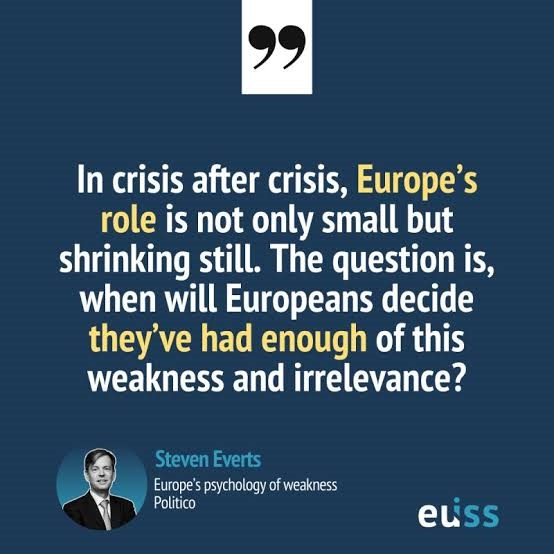
The intense diplomatic maneuvering to shape an endgame to the war in Ukraine has revealed a troubling reality: Even when it comes to its own security, the EU struggles to be a central player, writes Steven Everts, the director of the EU Institute for Security Studies.
The ongoing negotiations over Ukraine’s future — a conflict European leaders routinely describe as “existential” — are proceeding with minimal input from the bloc. And while others set the tone and direction, Europe remains reactive: managing the fallout, limiting the damage and hoping to recuperate its influence.
This marginalization isn’t the result of a single decision or down to one person — no matter how consequential U.S. President Donald Trump may be. Rather, it reflects a deeper vulnerability and an unsettling pattern.
Anyone looking at Europe’s choices in recent months can see a psychology of weakness. It paints the picture of a continent lacking courage, unable to take decisive action even when it comes to its core interests and when policy alternatives are within reach. Europe is losing confidence, sinking into fatalism and justifying its passivity with the soothing thought that it has no real choice, as its cards are weak. Besides, in the long run, things will work out. Just wait for the U.S. midterms.
Europe is a continent of rich countries with ample capabilities. But while its leaders insist Ukraine’s security and success are essential to Europe’s own security and survival, its actual military assistance to Kyiv has declined in recent months.
On the financial end, Europe is flunking the test it set for itself. Ukraine requires approximately €70 billion annually — and yes, this is a large sum, but it amounts to only 0.35 percent of the EU’s GDP. This is within Europe’s collective capacity. Yet for months now, member countries have been unable to agree on the mechanisms for using frozen Russian assets or suitable alternatives that could keep Ukraine afloat.
Instead, we’ve seen dithering and the triumph of small thinking. It’s also rather telling that the U.S. attempt to simply impose how these assets are to be used, with 50 percent of the profits going to Washington instead of Kyiv, is finally jolting Europe into action.
Regrettably, Europe’s psychology of weakness is equally visible in the economic domain, as the EU-U.S. trade agreement struck this July was a classic case of how frailty can masquerade as “pragmatism.”
Brussels had the tools to respond to Washington’s tariffs and coercive measures, including counter-tariffs and its anti-coercion instrument. But under pressure from member countries fearful of broader U.S. disengagement from European security and Ukraine, it chose not to use them. The result was a one-sided “deal” with a 15 percent unilateral tariff, which breaks the World Trade Organization’s rules and obliges Europe to make energy purchases and investments in the U.S. worth hundreds of billions of dollars.
Even worse, the deal didn’t produce the stability advertised as its main benefit. Washington has since designated Europe’s energy transition measures and tech regulations as “trade barriers” and “taxes on U.S. companies,” signaling that further retaliatory steps may follow. Just last week, the U.S. upped the pressure once more, when its trade representatives met EU ministers and openly challenged existing EU rules on tech.
This is, above all, a matter of psychology, of believing in one’s capabilities, including the capacity to say “no.” We have to acknowledge that building a stronger EU also means having to give somethings up.
But in return we will gain something essential: The ability to stand firm in a world of Donald Trump, Vladimir Putin and Xi Jinping.
read more in our Telegram-channel https://t.me/The_International_Affairs