РУССКИЙ
 10:16 09.12.2025 •
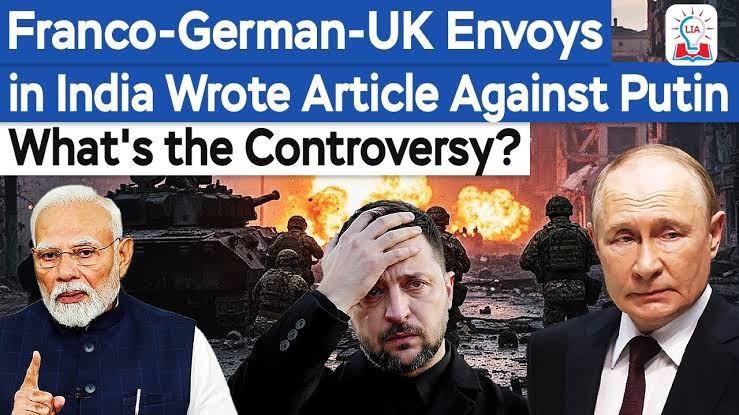
The initiative of the three European envoys to write an article in an Indian daily maligning Putin and Russia just before the Russian president's visit served no real purpose. It was diplomatically unwarranted, stresses Kanwal Sibal, the former Foreign Secretary to the Government of India, Ambassador to Turkey, Egypt, France and Russia.
A couple of days before Russian President Vladimir Putin's state visit to India, the accredited envoys of the UK, France and Germany in a joint article made a blistering attack against him and Russia over the Ukraine conflict, which a major Indian daily thought fit to carry.
India has received many sermons by the US and Europe on our relations with Russia after it intervened militarily in Ukraine. We were told we were on the wrong side of history in not condemning Russia in the UN or otherwise. Our position was not considered moral. We were asked to dilute our ties with Russia, including defence. Under Trump, the rhetoric against India acquired new proportions. We were accused of financing Russia's war against Ukraine and were held responsible for the latter's human losses. We were asked to cease buying Russian oil, and to induce us to do so, Trump imposed an additional 25% penalty tariffs on Indian exports to the US.
Europe's Displeasure Isn't News
At various international security dialogues, including at the Munich Security Dialogue hosted by Germany, India's External Affairs Minister, S. Jaishankar, has been grilled on our position on Ukraine, and he has pushed back. At the G7 meetings, which India attends as an invitee, the European members express their virulent opposition to Russia's invasion of Ukraine, and do so at NATO meetings as well. UK's PM Keir Starmer, German Chancellor Friedrich Merz and French President Emmanuel Macron have been unsparing in their condemnation of Russia. India is well aware of all this.
In this background, the initiative of the three European envoys to write the article in question maligning Putin and Russia just before the Russian president's visit served no real purpose. The three knew that their article would not change anything on the ground, Putin was not going to be disinvited, and if India had rejected pressures at much higher political level in the West on its relations with Russia, an op-ed by them amounted to making a point for its own sake.
Going directly to the public through the media was a way to make the point that resentment in Europe against India's wooing of Putin remained, and that the Indian government had failed diplomatically to obtain the understanding of three major European powers for its policy towards Russia, with a connotation that this could impinge on efforts to build ever-closer India-Europe ties.
A Diplomatic Breach
At the professional level, one can assume that the three ambassadors, with their diplomatic experience, knew they were breaching diplomatic norms and that the government of India would look at this askance. But they may have felt that they would be able to deal with any fall-out, no doubt conscious of the importance these countries have in India's foreign policy. Europe is a major trade, investment and technology partner of India, besides a valuable partner in many other domains. In fact, Germany, the UK and France are India's biggest partners in Europe.
These three countries know the history of our relations with Russia and the importance this relationship has in the matrix of our foreign policy. Europe may have its problems with Russia and may feel strongly about them, but these are not of our making. If Europe has failed to forge a European security architecture since 1945, and this despite the collapse of the Soviet Union and the end of the Cold War, India is not responsible for that failure. The Ukraine conflict results from that political and security drift in Europe. Why then drag India into this European quarrel?
India's reaction to the op-ed by the three ambassadors has been muted, with official sources calling what they did unusual and saying that giving advice on India's relations with third countries was unacceptable.
Surprisingly, however, the spokesperson of the German Foreign Ministry has thought it fit to take issue with what we have said by asserting that what the German ambassador did was not interference but rather a presentation of the German position, which Germany does worldwide”.
If Germany opposes Putin's visit to India, it should say so clearly. India can then respond appropriately.
read more in our Telegram-channel https://t.me/The_International_Affairs