
 РУССКИЙ
 11:14 24.01.2026 •
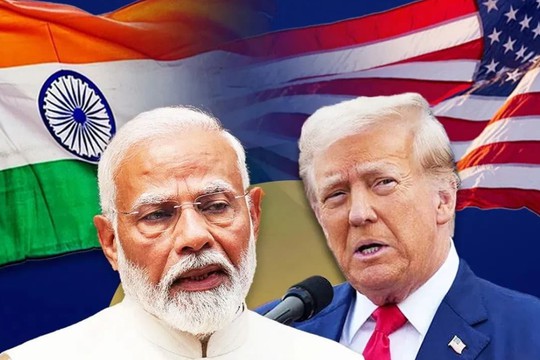
Indian Prime Minister Modi and US President Trump
Pic.: asianetnews.com
In fact, Trump has treated Europe brutally, compared to which India has been treated much less harshly, writes Kanwal Sibal, a distinguished Indian diplomat and former Foreign Secretary of India, served as Ambassador to Turkey, Egypt, France, and Russia.
Trump has questioned the utility of NATO, although it has been the bedrock of security in Europe. In India, there are concerns that Trump is no longer as committed to Quad as he was in his first term and in the early weeks of his second term, but Quad is not central to India’s security as NATO is to European security.
India is to host the next Quad summit, but there is no certainty about when it can take place. The incoming US ambassador Sergio Gor has prepared the ground for an indefinite delay by remarking publicly that Trump could visit India in “a year or two”. If this signals is a shift in US thinking on the importance and strategic utility of Quad, and this is to be construed as a foreign policy set back for India in the Indo-Pacific region, it would be instructive to see how much Trump has upset, to Europe’s great dismay, the security architecture in Europe in whose establishment the US has played the principal role.
Europe’s colossal failure in handling Trump far exceeds India’s failure in dealing with the US president
If there is concern in India about what the muted US interest in Quad may mean in the context of countering the maritime threat from China, the concern in Europe about Trump’s disdain for NATO as a shield against a Russian threat has to be far greater, particularly when Europe sees a successful Russian military intervention in Ukraine as a threat to Europe itself. Europe has participated in a proxy war against Russia led by the US and largely sacrificed its lucrative trade and energy links with Moscow. And now they see Trump going over Europe’s head to negotiate directly with President Putin, a possible solution to the Ukraine conflict. Europe, humiliated by Trump, has desperately tried to put the spokes in the wheel of his efforts at peace, wobbly as they are. Europe has lionised Zelensky while Trump has derided him.
The point is that the vagaries of Trump’s foreign policies have not had the same impact on the strategic content of our foreign policy as in the case of the Europeans.
Europe’s colossal failure in handling Trump far exceeds India’s failure in dealing with the US president. Europe’s over-reliance on the US for security has proved much more costly compared to the investment we have made in our security relationship with the US bilaterally and within the ambit of the Quad.
While India has stood its ground on essentials, the EU has buckled under US pressure, despite its capacity to retaliate
Putin’s visit to India for the India-Russia summit, Modi’s participation in the SCO summit in China, India chairing the BRICS in 2026 and hosting the BRICS summit, and, despite the trade deal imbroglio where we have not yielded on our fundamental interests, pursuing other aspects of our ties with the US, are all instances of exercising our strategic autonomy. Yes, the Trump challenge is there, but that has not steered us off course in our foreign policy.
The contrast between the dilemmas that Trump has created for Europe’s foreign policy and that for India’s is Trump’s bid to acquire sovereignty over Greenland, a European territory, by force if necessary. Trump’s flirtation with Pakistan, giving Pakistan a security role in the region through the Saudi-Pakistan defence pact, his targeting of Iran, and re-sanctioning the Chabahar port, have created problems for us, no doubt, but without shaking the foundations of our strategic posture. Europe, on the other hand, is facing a challenge to its basic strategic assumptions. It is caught between a rock and a hard place. Europe has castigated Russia’s military intervention in Ukraine as violating the cardinal principle that borders cannot be changed and territory belonging to another country acquired by force. It is now facing a territorial threat from the US. A NATO country is threatening to change the borders of another NATO country. What this would mean for the future of NATO as an organisation, not to mention the divisions that would be triggered within the EU itself, can be imagined.
Trump has imposed 50% tariffs on India, the highest on any country (along with Brazil). But then, Trump has imposed one-sided tariffs on all countries, including his allies, besides extracting commitments from some countries to invest $ 350 billion to 1 trillion in the US, besides purchasing, as in the case of the EU, $ 750 billion of US LNG during Trump’s presidential term. While India has stood its ground on essentials, the EU has buckled under US pressure, despite its capacity to retaliate.
India’s foreign policy is adequately weathering the Trump storm
India has invited the European Union as the Chief Guest for R-Day 2026. It is expected that the India-EU FTA will be signed on January 27. This will happen under the shadow of a developing EU-US rift. It is with an embattled Europe that we will be signing the agreement. A major breakthrough in our ties with the EU will occur when the political, economic, and security outlook for Europe becomes fluid. Europe will need to reorient itself, whatever the outcome of this tussle with the US.
With the Trump challenge India faces, the importance of Europe as a partner has increased. Likewise, for Europe, especially in the light of the latest developments in transatlantic ties, India’s value as a partner too has risen. India’s foreign policy is adequately weathering the Trump storm.
read more in our Telegram-channel https://t.me/The_International_Affairs

















