
 РУССКИЙ
 11:31 05.02.2026 •
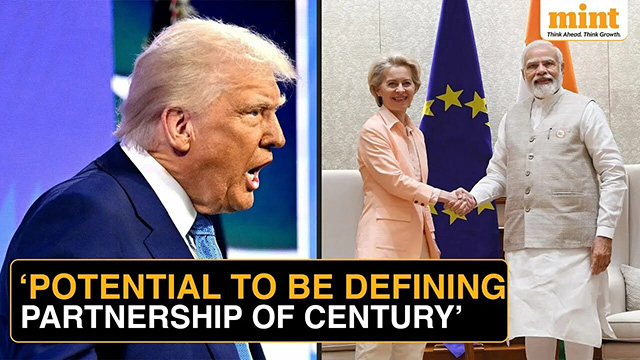
The India-EU free trade pact wrong-footed the US, turning on its head the very playbook Trump was using to browbeat America's trading partners, writes Kanwal Sibal, the Indian Foreign Secretary and Ambassador to Turkey, Egypt, France and Russia, and Deputy Chief Of Mission in Washington.
US President Donald Trump has, after months of obduracy and provocative comments from his Treasury and Commerce Secretaries, suddenly changed course and announced a trade deal with India. The tariffs on India will be reduced to 18% from 25%. While nothing specific was said in Trump's post about the removal of the additional 25% penalty tariffs on India for buying Russian oil, the US embassy in India has clarified to the media that the reduction of tariffs is from 50% to 18%. Trump claims that Modi has agreed not to buy Russian oil and that India will now buy American, and, potentially, Venezuelan oil. However, it is most unlikely that PM Modi would have made any such commitment. For, India's consistent position is that our decisions will be based on market forces, price factor, diversification of sources and energy security. This formulation gives us a lot of political latitude in our decisions…
Claims vs Facts
The claim in Trump's post that India will move to zero tariffs on US products is misleading, as India seems to have agreed to zero tariffs not across the board but on select US industrial products. That India will buy $500 billion of US energy, technology, agriculture and coal is Trump's tactic of making it appear that his demands have been met and how his coercive method of deal-making is always successful.
In any case, it was not to be expected that the US would give duty-free access to our labour-intensive exports, given that the US is applying 20% tariffs on Bangladesh's textile imports and 19% in the case of Pakistan. If the tariff on India is 18%, it gives us some marginal advantage. India has been demanding 15% tariffs on the grounds that we would be opening a vastly bigger market for US exports with zero tariffs for many industrial goods, as compared to what our two neighbours can offer. Nevertheless, with a zero-tariff regime with the EU facilitated by the India-EU trade pact and a minor advantageous regime with the US, we are well-placed.
The US administration was clearly unhappy with the India-EU free trade pact. US Treasury Secretary Scott Bessent criticised Europe for not following the US's lead in imposing tariffs on India for buying Russian oil. Worse, it was buying Russian-origin oil from India.
America's Own Doing
If the US thought it could browbeat India into submission, the reality is that India has been induced to negotiate FTAs with several countries so that in a fractured trading system, with the WTO undermined, India could carve out favourable trade arrangements with select trade partners. India has already signed FTAs with the UK, the European Free Trade Association, Australia, the UAE, New Zealand and Oman. It is also negotiating deals with Chile, Peru and Israel, and FTA talks with Canada are being revived.
It is not only India that has felt the need to sign FTAs with countries of interest. Europe, too, is facing the pressure to do so because of the volatility of America's trade policies, Trump's openly anti-EU posture, the humiliation of Europe as a decaying power, and so on. If Trump's dealings with Russia on ending the Ukraine conflict over the head of Europe have been a major strategic blow to transatlantic ties, his aggressive territorial claims on Greenland have rocked these ties gravely, to the point that the European Parliament has put the negotiated US-EU trade agreement on hold. Whether this is acknowledged or not, the Trump factor has no doubt motivated both the EU and India to accelerate the conclusion of the FTA.
read more in our Telegram-channel https://t.me/The_International_Affairs

















