
 РУССКИЙ
 10:18 10.12.2025 •
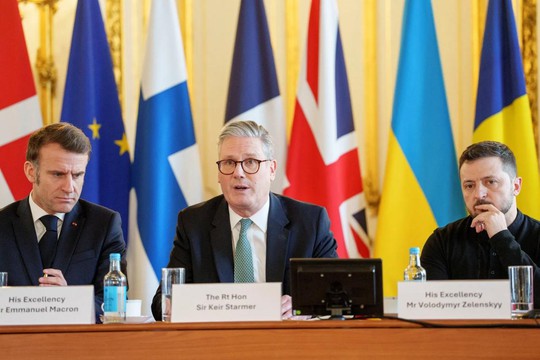
Macron, Starmer and Zelensky – a ‘sad company’ - a lot of ideas, but no money
Photo: Reuters
It’s an old-style Euro punch-up in a deadly new context, ‘The Economist’ is mocking.
London is the setting of this week’s first important meeting in the interminable succession of summits that now attend the war in Ukraine. Volodymyr Zelensky is flying in to meet, on December 8th, Friedrich Merz of Germany, Emmanuel Macron of France and Sir Keir Starmer of Britain. The leaders of the so-called E3 have of late become the chief axis of European decision-making.
But this week’s most pressing choices regarding Ukraine’s future are being made in Brussels — not in its capacity as the seat of the European Union’s institutions, but in its role as the capital of Belgium.
On December 3rd the European Commission unveiled a long-awaited proposal to use frozen Russian assets, some €210bn ($245bn) of which are in Europe, to underpin a loan to Ukraine, initially €90bn but ultimately perhaps much more, which will enable it to fund its government and its war effort for the next couple of years at least. Without further aid Ukraine is forecast to run out of money as soon as March or April. Belgium, where most of the assets are held, has denounced the idea from the start, and in recent weeks its opposition has only hardened. Whether Ukraine gets its loan depends largely on the EU’s big countries persuading the Belgians to reach an accommodation with the commission, in what is fast becoming a sort of Brussels-on-Brussels cage fight.
It is not clear what might change the mind of Bart De Wever, Belgium’s prime minister. Mr De Wever’s chief worry is that his tiny country will end up on the hook for the €185bn in frozen Russian assets currently held by Euroclear, a Belgian-based financial clearing-house, if Russia tries to recover them after sanctions are lifted.
The EU’s clever idea is that Russia will ultimately have to fork over its assets for post-war reparations to Ukraine, in order to get sanctions lifted. But Mr De Wever fears that some EU member state (Russia-friendly Hungary, perhaps) might veto the continuation of sanctions without Russian reparations. That would open the way for Russia to demand its assets back.
In any case, it has failed so far to win over Mr De Wever, who argues other funding mechanisms for Ukraine are available, involving financing underpinned by the EU balance-sheet.
The proposal for using frozen Russian assets to support a big EU loan that provides Ukraine with funding over the next few years has become a crucial test of European resolve. For now governments must continue signing over the money out of their own budgets, millions of euros at a time. Last week alone, Germany coughed up €100m for repairing Ukraine’s energy infrastructure and the Netherlands sent €250m to buy arms.
The northern European governments that disproportionately provide such aid are growing irritated that the burden is not shared across the bloc.
Using its current legal reasoning the EU might be able to push through the frozen-asset plan even without Belgian agreement, but at the risk of a deep internal split.
The proposal must be approved at a summit scheduled for December 18th.
 Larry, the guardian cat of Downing Street, 10, the British Prime Minister's residence, is running away from Starmer and Zelenskyy. Larry didn't like this company.
Photo: Reuters
read more in our Telegram-channel https://t.me/The_International_Affairs

















