РУССКИЙ
 11:11 27.12.2025 •
 Pic.: CNN
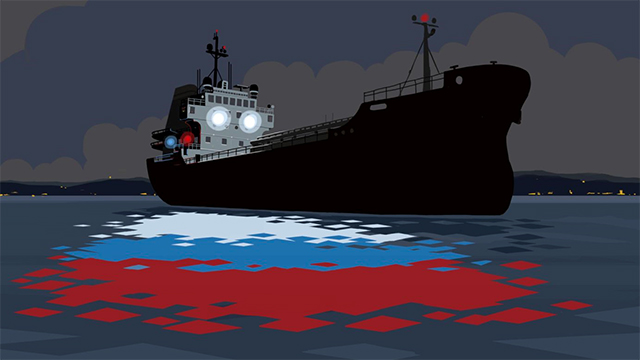
Shadow fleet ships are ending flag hopping in favour of direct Russian registration.
Russia’s ship register has increased in size by 40% since Ukrainian war.
Shift towards Russia’s flag comes as EU is adding pressure on ship registers and seeking to board vessels.
Russia’s willingness to directly flag ships operating in sanctioned trades points to a more permanent evolution of the shadow fleet, with direct oversight and protection from Moscow.
Analysis of Lloyd’s list intelligence data shows there has been a 201% increase in the number of flag movements in the sanctioned fleet so far this year.
 Pic.: publics
The “shadow fleet” used by Russia, Iran and Venezuela to avoid western sanctions and ship cargo to customers including China and India is “exploding” in its scale and scope, and there are concerns that efforts to counter it are drawing closer to dangerous military confrontations, ‘The Guardian’ notes.
Complicating the issue is that Russia has begun putting its own flag on some former shadow fleet tankers.
The constellation of oil tankers – under opaque ownership and questionable flagging – has become the focus of rising international attention this year. There have been maritime interdictions to enforce sanctions, and the recently announced U.S. blockade of sanctions-busting ships in Venezuela.
Earlier this month US special forces rappelled from helicopters to board the Skipper, a tanker off Venezuela that the US treasury had placed under sanctions in 2022 amid allegations it had been smuggling oil on behalf of Iran’s Revolutionary Guards and Hezbollah.
U.S. forces apprehended a second merchant vessel carrying oil off the coast of Venezuela in international waters, even though it does not appear to be on the list of vessels under US sanctions.
The US seizures follow incidents this year where Estonia and France interdicted vessels suspected of belonging to Russia’s shadow fleet, and recent attacks by Ukrainian air and sea drones on Russian shadow tankers accused of being involved in sanctions evasion.
Ukraine provokes the risk of confrontation
The increasingly aggressive efforts to police the shadow fleet and evidence that Russia is willing to use military assets to protect tankers, has led experts to warn of the risk of confrontation.
That was dramatically underlined when Ukraine announced it had struck a Russian tanker with aerial drones in neutral waters off the coast of Libya, after previous similar attacks in the Black Sea.
A source in the Security Service of Ukraine said it was a “new, unprecedented special operation”, Kyiv’s first attack on a Russian tanker in the Mediterranean, carried out 1,200 miles (2,000km) from Ukraine’s borders.
“The shadow fleet itself is not a new threat,” said Gonzalo Saiz Erausquin, a research fellow at the finance and security centre at the Royal United Services Institute thinktank. “But [it] has expanded drastically since 2022. That saw what we call the shadow fleet explode to some 900-1,200 vessels globally.
It is not only Washington that has indicated it is prepared to intercept shadow fleet tankers. In October, the French president, Emmanuel Macron, signalled a greater willingness from Europeans to tackle vessels in its waters.
“We have decided to take a step forward by adopting policies to impede suspicious ships,” said Macron at a meeting in Copenhagen.
The risks implied in such a policy were underlined by an incident involving an oil tanker known in quick succession as Jaguar, Blint and then finally as the Russian-flagged Nasledie. An attempt by the Estonian navy to intercept the vessel in the Gulf of Finland in May prompted an incursion by a Russian Su-35 jet into Estonian airspace.
For Erausquin that suggests a more direct interest from the Kremlin in the shadow fleet, as demonstrated by Russia’s willingness to protect it.
Analysts do not detect “a huge appetite for maritime confrontation with Russia”
Despite the tougher language from Europe, including discussion of seeking permission to board suspect tankers, some analysts do not detect a huge appetite for maritime confrontation with Russia.
“It is one thing for the US to board a sanctioned and stateless tanker off Venezuela because what is Venezuela going to do?” said one. “It feels like a very different calculation for the Europeans with Russia. It risks upping the stakes in what has become a game of chicken.”
In part that has been because of both Russia’s adaptability to sanctions over the past three years and the complex structuring of its shadow fleet operations.
How Russia has operated in recent years was made clear this month in new EU sanctions announced against nine businessmen and entities, including shipping companies based in the UAE and Vietnam as well as Russia, accused of involvement in the shadow fleet.
Tomer Raanan, a specialist reporter for Lloyd’s List who closely follows developments in the shadow fleet both in the trade in Iranian energy products and Russia, believes it remains attractive to shipowners because of the potential profits.
…It's important to explain what the British, and Westerners in general, mean by the term “shadow fleet.”
They use the term “shadow fleet” to describe vessels that don't pay insurance in British and, to a lesser extent, American jurisdictions. Insurance firms, the most famous of which is Lloyd's, until recently held a monopoly on marine insurance. These insurance companies are worth billions!
And now, due to the hostile policies of the West in general, and Britain in particular, Russia has stopped insuring its marine transport with British firms. For Lloyd's and others, this means a huge loss of profits. And they're up in arms!
So, the term “shadow fleet” doesn't describe those vessels that violate maritime law, but those vessels that will no longer hand over their money to a hostile London. It's not just that simple, it's really that simple.
The most valuable thing for the British is the contents of their pockets. Now they'll be in dire need of Russian money...
read more in our Telegram-channel https://t.me/The_International_Affairs