
 РУССКИЙ
 10:34 12.03.2026 •
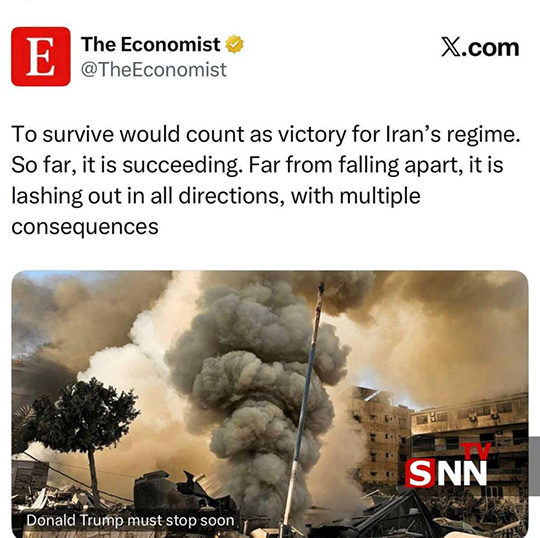
It is rare for one head of government to order the death of another. Yet on February 28th America’s president and Israel’s prime minister did just that, killing Iran’s 86-year-old supreme leader, Ayatollah Ali Khamenei. But Mr Khamenei’s place was immediately taken by a triumvirate. The next supreme leader could be named soon—perhaps his own son unless he, too, is killed. That augurs something more subtle and worrying: that the operation is failing to achieve its political goals, ‘The Economist’ writes.
It is naive to say, as some of Mr Trump’s cheerleaders do, that because Mr Khamenei was wicked, any sort of war makes sense.
In this war, Israel’s aim is clear: to demolish the threat posed by Iran’s regime. By contrast, Mr Trump and his cabinet have offered a mess of shifting assertions—about Iran’s missiles, nuclear weapons, regime change, following Israel’s lead, a “feeling” Iran was about to attack and settling scores after decades of enmity. Politically, vagueness gives Mr Trump room for manoeuvre. Strategically, his failure to say what Epic Fury is for is its biggest vulnerability.
The other face of this war is political, and it emerges from Iran’s strategy, which is about sowing doubt and confusion. To survive would count as victory for Iran’s regime. Far from falling apart, it is rushing to escalate horizontally — a fancy way of saying it is lashing out in all directions. This has a number of consequences.
One is that other countries are being sucked in. Iran has attacked the Gulf states, which have bet their future on being havens from the chaos gripping the rest of the Middle East. Fighting has also erupted in Lebanon.
Another consequence is economic. Iran has tried to shut the Strait of Hormuz, cutting off perhaps 20% of global oil supplies. It has also struck energy infrastructure, including the world’s biggest gas-liquefaction complex and Saudi Arabia’s largest refinery. The price of Brent crude is up by 14% since February 27th, to $83 a barrel. A megawatt-hour of natural gas in Europe costs €54 ($63), over 70% more than last week. As Asian buyers scramble for supplies, prices could go higher. The global economy could yet suffer a hit. If oil reaches $100 a barrel, GDP growth could be lowered by 0.4 percentage points and inflation raised by 1.2 points.
The third potential consequence is chaos inside Iran. America and Israel are putting pressure on the regime by backing Kurdish insurgents — a reckless idea that could end up stoking Persian nationalism or civil war. Mr Trump may not care about this, but he could not ignore the effects spilling over Iran’s borders into the Gulf states, Iraq, Syria and Turkey.
The risk is that Mr Trump cannot bear to quit so long as the markets and polls deny him the acclamation he craves — and that may last for as long as Iran can release even sporadic missiles and drones. Today barely a third of Americans favour the battle in Iran (90% backed invading Afghanistan in 2001). America may be an energy exporter, but its voters detest costly petrol. He may be tempted to seek an undeniable win by bombing the regime out of existence. But even with America’s military clout, he might not succeed. Meanwhile all those risks would continue to harm the region and the world economy.
Mr Trump may get lucky, but he is more likely to end up having to deal with regional chaos or a new hardliner. Surrounded by sycophantic courtiers, Mr Trump has become rash in his second term. His opportunistic grabs for power whenever he sees weakness are dangerous.
read more in our Telegram-channel https://t.me/The_International_Affairs

















