
 РУССКИЙ
 10:45 02.01.2026 •
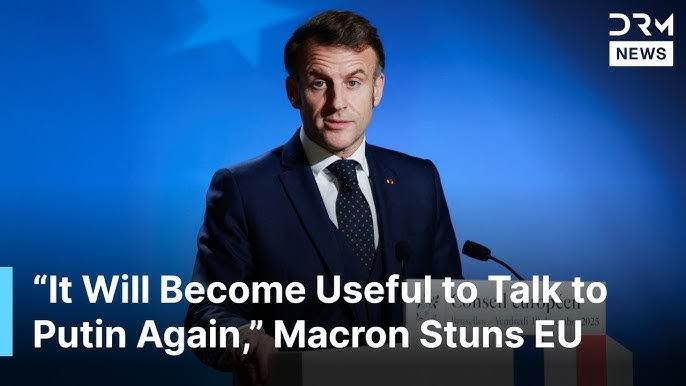
‘Macron is right’ is not one of those statements I honestly expected to find myself writing, but when the French president said, ‘I think it will become useful again to talk to Vladimir Putin,’ after the cup-half-full negotiations in Brussels over continued financial aid to Ukraine, he was spot on, writes Mark Galeotti, a head of the consultancy Mayak Intelligence and an honorary professor at the UCL School of Slavonic and East European Studies.
‘I believe that it’s in our interest as Europeans and Ukrainians to find the right framework to re-engage this discussion’ with Moscow, he said, and that this should be done ‘in coming weeks’.
Of course, there are some who equate talking to Putin as somehow legitimising him, or meaning the same thing as negotiations. EU foreign policy chief Kaja Kallas has, for example, boasted that she has in the past been able to browbeat countries into not talking to the Russians.
However, Macron was simply recognising that Russia is not going away and that the current pattern, whereby Donald Trump and his people do all the running, and a fire brigade of European leaders rush across the Atlantic to try and talk him down when they fear he is about to promise Putin too much, is reactive and short-sighted. ‘Otherwise, we’ll end up talking amongst ourselves with [Trump’s] negotiators who will engage with the Russians alone, which isn’t ideal,’ he added.
Macron saw two choices: ‘either a robust, lasting peace, with the necessary guarantees, can be achieved – which would be fantastic – and in any case, we’ll sit down at the table then,’ or, ‘in the coming weeks, we’ll also need to find ways and means for Europeans, in a well-organised manner, to re-engage in a full and transparent dialogue with Russia’.
Macron has repeatedly tried to engage the Russians. There were numerous fruitless telephone conversations in the first months of the war, more in September 2022, over the risks generated by fighting in and around the Zaporizhzhia nuclear power station. When that came to nothing, the French president swung to the other extreme, becoming an increasingly outspoken critic of Putin’s. But even so, in July of this year, he again reached out to the Russian president over Iran’s nuclear programme.
Those overtures came to nothing, not least because it was clear to Moscow that Macron was on his own, criticised by other European countries and even from within his own administration. As a Russian diplomat bombastically put it to me, ‘if Macron cannot even command the attention of the French, why should Russians listen to him?’
There is a quietly emerging sentiment in Europe that simply shunning Putin is simply not working. Last month, for example, former Finnish president Sauli Niinistö suggested that if European leaders were worried about Trump talking to Putin over their heads, they ought to engage in him themselves. Current president Alexander Stubb, no friend of Putin’s, cautiously endorsed the idea, while warning that this ought not to be on a nation-by-nation basis.
There needs to be a coherent European view, one that reflects a continental consensus as far as possible (there will always be awkward squad outliers such as Hungary). It is not for the structures of the European Union then to advance it. It is not just that Putin doesn’t seem to believe it really exists in any meaningful sense, but Kallas and Ursula von der Leyen have essentially burnt their bridges with him through their grandstanding moral critiques.
This is something where the E3 – the informal trio of the UK, France and Germany – ought to come to the fore. By making it an expression of continental – not just European resolve, and coming from countries with serious heft, while it will by no means lead to quick results, it will start the process of reshaping a relationship with Russia that, however antagonistic, cannot be left to the White House to dictate. As a British diplomat told me, ‘Russia isn’t going away, and we need to be in a position not just to shape any resolution to the war, but to be building a basis for a peacetime relationship. So far, Putin isn’t willing even to listen to us.’
Some kind of strategy that creates a meaningful and viable route to peace in Ukraine is meant to have been part of the process behind the Starmer-Macron coalition of the willing, even though nothing much has been said about this for some time. If constructing that kind of strategy and message is beyond the collective wit and will of the continent, then maybe Putin is right not to listen to us.
read more in our Telegram-channel https://t.me/The_International_Affairs

















