
 РУССКИЙ
 15:44 05.12.2025 •
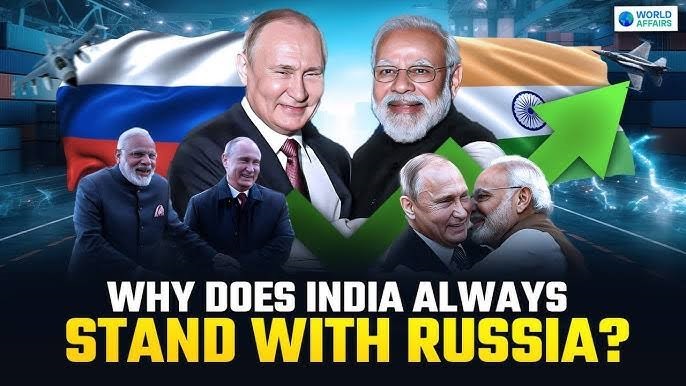
Soviet sympathies in the south have always been strong — as some familiar names suggest — and now Trump’s tariffs have pushed Delhi further towards Putin, ‘The Times’ stresses.
In a small village on the banks of the Kunthi river in Kerala, against a backdrop of rubber plantations, a single red flag, replete with hammer and sickle, flutters in the warm autumn breeze. The village is called Moscow. In a state in southern India widely regarded as the last significant bastion of India’s communist movement, the renaming of Moscow can be traced to the late-1950s, when Kerala became the first state in India to elect a communist government.
Soviet leaders recognised the strategic importance of India
The Soviet Union has cast a long shadow across India’s post-independence history. Although critical of Soviet-styled communism and its authoritarian streak, Jawaharlal Nehru, India’s first prime minister, was still a steadfast socialist distrustful of American capitalism. Soviet-Indian ties solidified, as Nikita Khrushchev and subsequent Soviet leaders recognised the strategic importance of India.
Indira Gandhi, prime minister three times between 1966 and her assassination in 1984, made near-daily headlines in Soviet newspapers. A square in her name was inaugurated in Moscow, Russia, in 1985.
Crucially, Soviet administrations supported India on the sensitive issue of Kashmir when the United States and UK refused to do so. Three times in the 1950s and 1960s, the Soviet Union used its veto in the United Nations security council to block initiatives against India regarding Kashmir.More importantly, in 1971, the Soviet Union provided integral diplomatic and military support during the Indo-Pakistan war which led to the formation of Bangladesh.
Meanwhile, between the 1970s to mid-2000s, communism flourished in India as its parties struck electoral victories across West Bengal, Kerala and Tripura. Only around the late 2000s did communism lose traction in the world’s largest democracy, with major electoral defeats in traditional communist strongholds.
“Pro-Russia sentiment has become stronger”
While communism has declined in India, ties with Russia have not, despite the rapid growth in India’s relationship with the US over the past two decades. Now, in the wake of [President] Trump’s announcement of 50 per cent tariffs, India’s pro-Russia lobby is gaining traction.
“Pro-Russia sentiment has become stronger after what Trump has done”, Dr Rajan Kumar, a professor at Delhi’s Jawaharlal Nehru University, said. He pins this not only to tariffs but also to Trump’s claims of having mediated a ceasefire in the India-Pakistan escalation in May.
“The trust deficit now is a major issue between India and the United States. It has strengthened the case of Russia vis-a-vis India” he added.
On the one hand, reports suggest that refiners in India are now preparing to sharply reduce imports of Russian crude amid pressure from Washington and a new package of sanctions by UK and the EU. Reliance Industries, India’s top buyer of Russian oil, plans to reduce or completely halt imports, according to Reuters.
But other indicators show ties with Russia may have hardened, not least the sight of Narendra Modi hand in hand with President Putin on the sidelines of a summit last month. On September 15, India sent a small batch of troops to join a Russia-led military exercise close to key European borders.
Delhi is mulling negotiations with both Mongolia and Russia for transporting Mongolian minerals via the latter’s railway system. Most importantly, Putin is planning a landmark visit to India in December — the first time since the start of the Ukraine war.
India has long been deeply entangled with Russia militarily: for decades, it has been the largest recipient of Russian arms exports, including the S-400 advanced air defence system, which reportedly formed a key part of India’s defence against Pakistan during the post-Operation Sindoor conflict in May.
Professor Kumar: A support for Russia is also surging on the ground
Professor Kumar added that support for Russia is also surging on the ground. “Popular sentiment is very pro-Russia, without any doubt. Popular sentiment is guided by the local media. If you go to local channels and Hindi newspapers, there is very pro-Russia sentiment.”
According to a 2023 survey by Pew Research Centre, India stood out as the only country surveyed in which a majority (57 per cent) had a favourable opinion of Russia.
“If a real survey was done, the number would be much higher,” Kumar said.
That is not to say the current dynamics are entirely dictated by the past.
“India is not emotional in its calculations when it comes to Russia,” Pankaj Saran, a former Indian Ambassador to Russia, told The Times. “I wouldn’t say the history is dominating current or future decision making. History is there, it exists — but that’s not the determining driver of the current relationship”.
He added that many of India’s conversations with Putin “are actually about Ukraine, making it clear where India stands… What India finds very uncomfortable is to be told, it’s either us or them”.
read more in our Telegram-channel https://t.me/The_International_Affairs

















